
Ready by 1:50pm Sep 21, 2026
Does Turnitin Detect AI and ChatGPT Writing?
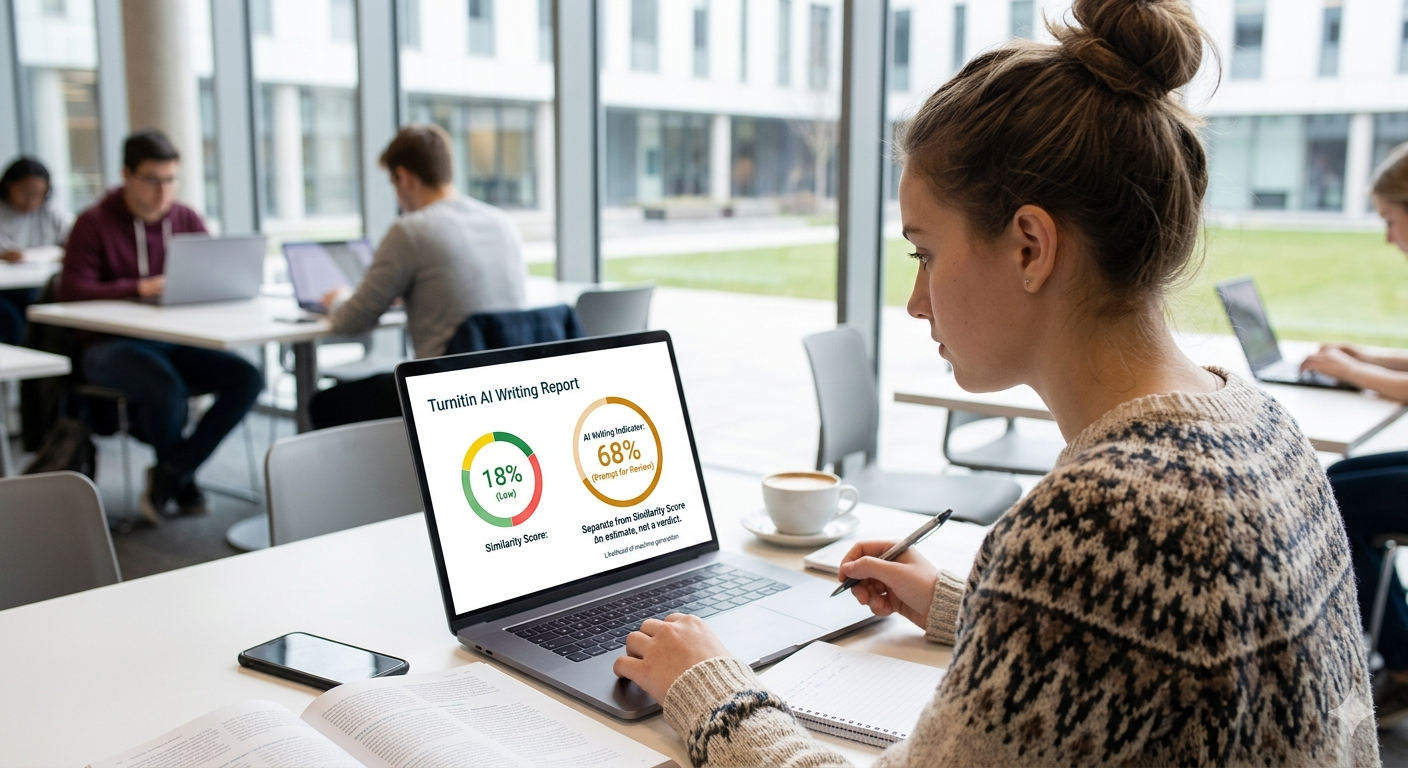
Yes. Turnitin has an AI writing indicator that estimates how much of your text reads as AI generated. It is separate from the similarity score and it is not perfect. It can flag human writing as AI and miss edited AI text, so the result is a prompt for review, not a verdict.
Since AI writing tools became part of everyday student life, the first thing people want to know is whether Turnitin can tell. The short answer is that it tries, through a feature built specifically for the job, and that the feature is useful but far from infallible. Understanding what it can and cannot do is the difference between sensible caution and needless panic.
Does Turnitin have an AI detector?
Yes. In addition to the familiar similarity report, Turnitin provides an AI writing indicator. Where the feature is switched on by your institution, it produces an estimate of how much of your document appears to have been generated by an AI tool, shown as a percentage. It runs on a completely separate model from the similarity check and answers a different question, so a single submission can return both a similarity score and an AI score that have nothing to do with each other.
Check your Turnitin score for UK universities, Australian universities, European universities, and Canadian universities.
How does the AI indicator actually work?
The model looks at patterns in how the text is written rather than whether it matches another source, and it does this in a fairly specific, mechanical way. Turnitin breaks your document into small segments, roughly a paragraph or a few sentences at a time, rather than judging the whole thing at once. Each segment is scored on its own for how likely it is to be machine generated, and the individual segment scores are then averaged into the overall percentage you see.
Two properties of the writing matter most to this kind of model. The first is predictability, sometimes called perplexity in the underlying research: AI text tends to choose the statistically most likely next word again and again, which produces smooth, expected phrasing. Human writing is less predictable, with more unusual word choices and small imperfections. The second is rhythm, sometimes called burstiness: humans naturally mix long, complex sentences with short, blunt ones, while AI output tends to settle into a more even, consistent sentence length. Turnitin’s model was trained on a large set of confirmed human writing and confirmed AI writing from tools including GPT-3.5 and GPT-4, and it learned the statistical fingerprint that separates the two.
This is an indirect signal, not a fingerprint in the forensic sense. There is no hidden watermark in most AI text that the tool reads. It is making an educated guess based on style, which is why it can be confidently wrong in both directions, and why a heavily edited AI paragraph can slip through while an unusually smooth human paragraph gets flagged.
A worked example makes the averaging concrete. Say a 1,500-word essay is broken into ten roughly equal segments. If the model scores eight of those segments as essentially human, say 0.05 to 0.15 on its internal 0-to-1 scale, but two consecutive segments in the middle of the essay score 0.9, the overall document percentage comes out far lower than the risk actually sitting in that one section, because the average smooths across the whole paper. This is precisely why the segment-level highlights matter more than the headline number. A 22% overall AI score sitting in one concentrated, unedited block tells a very different story than the same 22% spread thinly and inconsistently across the entire document, and only opening the highlighted view shows you which one you are looking at.
Why does Turnitin hide scores under 20%?
This is a detail most guides skip, and it matters if you are trying to make sense of a low number. Turnitin’s testing found that AI scores in the 1% to 19% range carry a meaningfully higher risk of being false positives than scores at 20% and above. Rather than show a precise but unreliable number in that range, the system displays an asterisk instead of a percentage, so your tutor sees something like *% rather than, say, 12%. No sentence-level highlights are shown for scores in that band either.
Once a submission crosses 20%, Turnitin shows the exact percentage and starts highlighting the specific segments it believes are AI generated. In 2026, this breakdown is further split into two categories: text that appears to be AI generated with no further changes, and text that appears to be AI generated and then run through a paraphrasing or humanising tool afterwards. That second category exists precisely because running ChatGPT output through a paraphraser used to be a common workaround, and Turnitin’s detector now specifically looks for the statistical residue that paraphrasing leaves behind, even when the words themselves have been substantially changed.
Is the AI score the same as the similarity score?
No, and confusing the two causes a lot of needless worry. The similarity score measures matching text, the overlap between your words and other sources. The AI score measures how a machine like your writing reads. They are entirely independent, produced by different models looking at different things. You can write something entirely yourself, cite nothing identical to any source, score a clean zero on similarity, and still pick up a high AI score because your style happens to look even and predictable. The reverse is also true: a paper stitched together from quotes and paraphrased sources can score high on similarity while reading as completely human. For the similarity side of the picture, see how Turnitin works.
Can Turnitin’s AI detection be wrong?
Yes, and this is the most important thing to understand. No AI detector on the market is fully reliable, and Turnitin is open that its indicator should be read as guidance rather than proof. Turnitin’s own published testing puts the false positive rate at under 1% for documents where more than 20% of the text is flagged, which sounds reassuring until you remember that even a low percentage translates into a real number of students when applied across hundreds of millions of submissions worldwide.
False positives do not land evenly. Students who write in a very structured, formal style, and students writing in a second language whose phrasing is careful and even, are more likely to be caught out unfairly, because their natural writing already resembles the smooth, low-perplexity pattern the model associates with AI. It can also miss AI text that a person has edited and reshaped, because heavy editing breaks the predictable pattern the tool relies on, which is exactly why the AI-generated-and-paraphrased category was added.
Because of this, a high AI score is a reason to look more closely, not a finding of guilt. A fair tutor treats it the same way, as one signal among several, alongside knowing how you usually write and talking to you if something seems off. We go deeper into reliability in how accurate AI detectors are.
Need plagiarism checks at scale? Get bulk Turnitin reports for your business in the UK, Australia, Europe and Canada.
Can teachers see the AI score?
Where the feature is enabled, the AI indicator appears to staff alongside your similarity report, usually as its own tab rather than mixed into the similarity colour. Whether it is switched on at all, and how much weight your institution gives it, varies widely. Some universities lean on it, some treat it as background information, and some have switched it off entirely because of the false positive problem. You usually will not know which approach your course takes unless they tell you, which is another reason to make sure your work is genuinely your own writing regardless.
How do I check my own AI score first?
The simplest way to avoid a surprise is to check before you submit. Run your work through our AI content detector and look at which sections come back flagged. If a passage reads as AI, rework it in your own voice, add your own examples and analysis, and break up any uniform phrasing rather than just swapping synonyms, since synonym swapping is exactly the kind of paraphrasing the newer detection category is built to catch. The official Turnitin report for $5 includes full AI detection too, so you can see the same kind of result your examiner would, including whether you land above or below the 20% visibility threshold.
This is worth doing even if you wrote every word yourself, because the false positive risk means honest work sometimes gets flagged. Checking first lets you smooth out anything that might read oddly before it reaches someone who is deciding your grade.
Why do AI detectors flag human writing?
False positives are the part of AI detection that worries honest students most, and they are worth understanding properly. The indicator works by measuring how predictable your writing is, and some people simply write in a predictable way. A student who has been taught to write in clear, even, well structured sentences is producing exactly the kind of smooth text the tool associates with machines, through no fault of their own.
The effect is stronger for some groups. Students writing in a second language often learn careful, regular sentence patterns, which can be read as machine-like to a detector even though every word is their own. Highly organised writers who plan rigidly and edit heavily can smooth out the natural lumpiness that the tool treats as a human signal. Technical and scientific writing, which values consistency and standard phrasing, can also trip the indicator, since a methods section describing a standard protocol is naturally low in perplexity regardless of who wrote it.
None of this means the student did anything wrong, it means the signal the tool relies on is imperfect and correlates with style rather than with cheating. This is why a responsible institution treats an AI flag as a starting point for a conversation, not a conclusion, and why you should not panic if your own honest work picks up a score. For a fuller treatment of how reliable these tools actually are, read how accurate are AI detectors.
What if I am wrongly flagged for using AI?
If your genuine work is flagged, the worst thing you can do is panic or assume guilt. The best protection is evidence that you did the work, and that evidence is easiest to produce if you build it as you go. Keep your drafts, your version history, your research notes and your reading, because a trail showing the work developing over time is strong proof of authorship that no detector score can override.
If you are asked about a flag, stay calm and explain your process. Walk through how you researched, how the argument developed, and why you made the choices you did, because a student who genuinely wrote the work can talk about it in a way that someone who generated it cannot. Point to your draft history if you have it. You can also run your own work through an AI content detector before submission, so you are not caught off guard, and rework any section that reads as machine-like even though you wrote it. The aim is to enter any conversation already knowing where your work stands, rather than seeing the score for the first time when someone else raises it.
Frequently asked questions
Will editing AI text remove the flag?
Heavier rewriting in your own words can lower it, because editing breaks the predictable pattern the tool looks for. There is no guarantee, though, since Turnitin’s AI-generated-and-paraphrased category was built specifically to catch light editing of machine text. The honest fix is to make the writing genuinely yours rather than to disguise generated text.
Does using Grammarly count as AI writing?
Light grammar and spelling fixes usually do not trigger detection. Using a tool to generate whole sentences or paragraphs is far more likely to. The line is roughly between correcting your writing and producing it for you.
Is a high AI score proof of cheating?
No. It is a probabilistic estimate that can be wrong, which is exactly why it needs a human to interpret it. For where the rules actually sit, see is using ChatGPT plagiarism.
Why does my score show an asterisk instead of a number?
Turnitin suppresses the exact percentage for AI scores between 1% and 19% because its own testing found that range less reliable, and displays an asterisk instead. A score of 0% or 20% and above is always shown as an exact figure with highlighted sections.
Does AI detection work on writing in other languages?
It is generally less reliable outside English, and false positives can be more common, because the patterns the tool learned are strongest for the language it was trained on most. If you write in a second language or in a language other than English, treat any AI flag with extra caution and be ready to show your drafting process.
Should I avoid AI completely to be safe?
You do not have to, but you should keep it in a supporting role. Using it to understand a topic, plan your structure or check grammar is widely accepted, as long as the writing and thinking are yours and you follow your course disclosure rules. The risk comes from letting it produce the substance you submit, not from using it as a study aid.
Can I see the AI result myself before my tutor does?
Not through your university system, which only staff control, but you can run your own AI check independently first. That way you find out how your work reads before it reaches anyone who is grading it, and you can smooth out anything that looks like a machine even though you wrote it.
Check what might get flagged before anyone else does. Run an AI check on your draft.
Popular posts

How Student Content Creators Can Get Paid Brand Deals in 2026
March 23, 2026

How to Write a Dissertation Proposal: Step by Step With an Example
April 17, 2026
Harvard Referencing Made Simple: The Only Guide You Will Need in 2026
May 12, 2026
Is Using ChatGPT for Essays Plagiarism?
June 19, 2026
How Long Does It Take to Write a 2000 Word Assignment?
June 24, 2026
Want more tips & great deals? Get them sent to your inbox
Please enter a valid E-mail
By clicking "Subscribe" you agree to be contacted via e-mail. You can always unsubscribe from the newsletter


