
Ready by 5:15pm Sep 30, 2026
What Do UK University Markers Actually Look For?
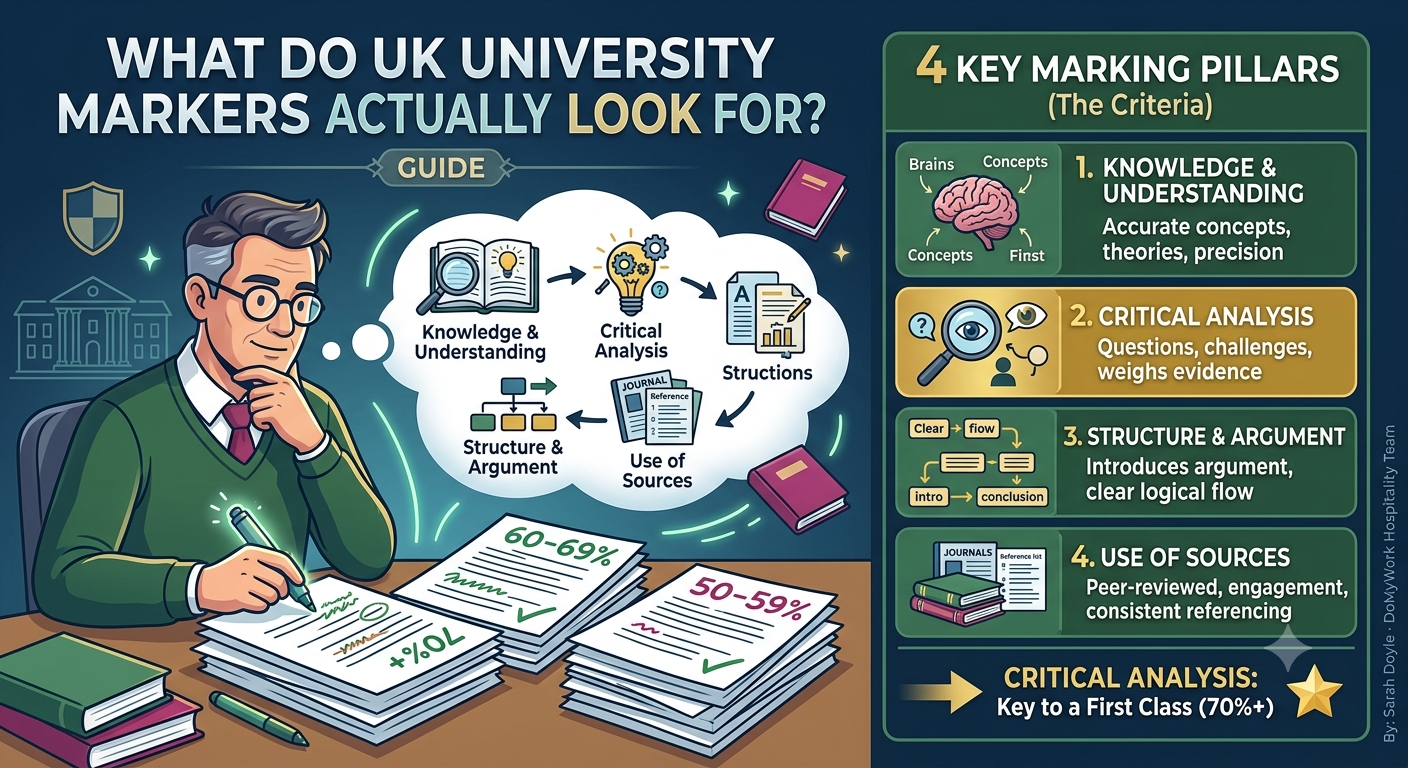
UK university markers assess your work against a published set of criteria, not against your classmates. Across almost every institution, four things carry the marks: how well you understand the topic, how far you analyse rather than describe, how clearly your work is structured, and how well you use academic sources. Critical analysis is the single factor that separates a First from a 2:1. Once you know what markers are trained to reward, you can shape your writing to hit each point on purpose rather than by luck.
This guide explains what markers look for, what each grade boundary really means, how UK universities keep marking fair, and how you can use the criteria to lift your own grade. It applies whether you are studying in the UK for the first time or you have been here for years.
Why does the UK mark the way it does?
UK universities use what is called criterion referenced marking. Your work is measured against a fixed standard written down in advance, not ranked against the rest of your cohort. This matters because it means there is no quota of top grades. If everyone in the room meets the standard for a First, everyone can get one. If nobody does, nobody does.
Every module publishes its standard in two places you can read before you write a single word. The first is the assignment brief, which sets the task, the word count and the learning outcomes. The second is the marking rubric, a table that describes what work looks like at each grade band. Most students never open the rubric until after they get their mark back. Reading it first is the closest thing to seeing the answers before the test.
One more point that surprises students who move here from other systems. Full marks are almost unheard of at UK universities, and 70% is treated as outstanding rather than average. A score of 60% is a genuinely good result, not a near miss. The scale runs differently here because it rewards independent judgement, and judgement is hard to score at the very top of the range.
What do markers actually look for?
While every department writes its own rubric, the criteria almost always group into four areas. Understanding these gives you an advantage over classmates who write without knowing how the work will be judged.
1. Knowledge and understanding
This measures whether you actually grasp the topic. Markers look for accurate use of key theories, concepts and terminology. A strong answer shows depth rather than surface awareness. Name the relevant scholars, refer to specific theories, and show how different ideas connect to each other rather than listing them one after another. Getting a term slightly wrong signals to a marker that the understanding underneath is shaky, so precision counts.
2. Critical analysis and evaluation
This is where most students lose marks and where the biggest ones are won. Description tells the reader what a scholar said. Analysis explains why it matters, whether the argument holds up, and how it connects to the wider debate. A 2:2 essay summarises. A First questions, challenges and weighs the evidence. Examiners are trained to tell the two apart, and an assignment that only summarises rarely climbs above 60% no matter how neat or long it is. If you want a higher grade, spend more time on this than on anything else.
A simple habit builds this in. After every piece of evidence you include, answer three questions in your writing: why does this matter, what are the limits of this argument, and how does it support or complicate my overall point? Do that consistently and you are already writing at First Class level.
3. Structure and argument
Markers notice how your work is organised because a clear structure lets them find your argument quickly. A strong piece opens with an introduction that states your position, builds through body paragraphs that each carry one idea, and closes with a conclusion that ties back to the question. When a marker has to hunt for your argument, marks that are hard to find often go unawarded. Structure is not decoration. It is how everything else you have done reaches the reader. If you want the shape spelled out section by section, see our guide on how to structure a university assignment.
4. Use of sources and evidence
This assesses the range and quality of what you read. Markers want peer reviewed journal articles and academic books, not lecture slides and general websites. They also want to see that you have understood your sources and used them to support an argument, rather than dropping in quotes to fill space or padding a reference list. Accurate, consistent referencing sits inside this pillar too, since sloppy citations quietly drag a mark down even when the ideas are sound. Our guide on how to reference your sources correctly walks through the Harvard style most UK departments expect.
What do the grade boundaries actually mean?
UK results are grouped into honours classifications. The table below shows the standard bands and what each one usually reflects about the work behind it.
| Classification | Mark range | What it usually reflects |
| First Class | 70% and above | Independent thinking, sharp critical analysis, wide reading and polished presentation. |
| Upper Second (2:1) | 60 to 69% | Good understanding, clear structure and solid analysis, though not every point is fully developed. |
| Lower Second (2:2) | 50 to 59% | Reasonable understanding with some analysis, but often more descriptive than critical. |
| Third Class | 40 to 49% | Basic understanding, mostly descriptive, with limited use of sources. |
| Fail | Below 40% | Falls short of the standard for a pass, usually through weak understanding or an off-brief answer. |
Two details are worth holding on to. In most degrees, first year marks must be passed to progress but do not count towards your final classification, which is weighted heavily towards the later years. And most taught master’s programmes drop the 2:1 and 2:2 labels, sorting results into Pass, Merit and Distinction instead, with a Distinction usually sitting at 70% and above.
How do UK universities keep marking fair?
A worry that follows almost every returned mark is whether the grade was fair or just one person’s opinion. UK institutions build several checks into the process to answer exactly that concern, and knowing they exist can settle a lot of anxiety.
- Anonymous marking. Wherever possible, markers do not see whose work they are grading, which removes personal bias from the result.
- Moderation. A senior academic reviews a sample of marked work to confirm the standard has been applied consistently across the cohort.
- Double or blind marking. On high stakes work such as dissertations, two markers assess the piece independently and then reconcile any real gap between their marks.
- External examiners. Senior academics from other universities check standards across the course, making sure a First at one institution means broadly what a First means elsewhere.
This is also why you cannot argue your way to a higher mark simply by disagreeing with it. The mark reflects the work measured against the criteria, checked by more than one person. What you can do is use the feedback to see exactly which criterion cost you, then fix that next time.
How can you use the marking criteria to raise your grade?
The criteria are not a secret. They are handed to you, and the students who read them tend to score higher for a straightforward reason. They write towards the standard instead of guessing at it. Here is how to put them to work.
- Find the rubric before you start. It usually sits in the assignment brief or on your virtual learning environment. Highlight the wording that describes the top band.
- Check each paragraph against it. As you draft, ask whether the paragraph shows analysis, uses quality sources and links back to the question. If it does not, it needs work or it does not belong.
- Ask for feedback before the deadline. Many tutors will look at an outline or discuss your approach in office hours. A five minute conversation can save you from writing the wrong essay well.
- Read only your topic sentences at the end. If they tell a coherent story on their own, your structure is sound. If they jump around, reorder the body before you worry about wording.
If you want to see how the criteria translate into a finished piece, our guide on how to write a First Class essay shows the standard your programme expects and gives you a reference to measure your own draft against.
Which myths about marking should you ignore?
A few beliefs travel around every campus and quietly cost students marks. None of them hold up against how markers actually work.
- Longer means higher. Markers value quality over quantity. Padding to hit a word count usually dilutes the argument and lowers the mark.
- Complex writing scores better. Clarity beats complexity every time. Dense sentences that hide the point work against you, not for you.
- More references equal more marks. What counts is how well you engage with sources, not how many you list. Five sources used well beat twenty dropped in for show.
Effort is rewarded. Markers assess the work in front of them against the criteria, not the hours behind it. Time spent on the wrong things does not move the grade.
Frequently asked questions
Is 60% a good mark at a UK university?
Yes. UK marking is stricter than most school systems, and 60% sits inside the 2:1 band, which is the standard many employers and postgraduate courses look for. Treat it as a solid result rather than an average one.
Why is 70% considered so high?
Because the top band rewards independent thinking and critical judgement, which are hard to demonstrate fully. A First does not require perfection. It requires clear evidence that you can evaluate ideas rather than repeat them, which is why the range above 70% is used sparingly.
Do all UK universities use the same criteria?
The wording differs by department, but the underlying pillars are consistent: knowledge, critical analysis, structure and use of sources. Always read your own module’s rubric, since that is the standard your work will actually be judged against.
Can I challenge a mark I think is unfair?
You cannot appeal simply because you disagree with the grade. Appeals usually require grounds such as a procedural error or extenuating circumstances. Because work is anonymised, moderated and often double marked, the mark reflects a checked judgement rather than one person’s view.
What is the fastest way to move from a 2:2 to a 2:1?
Shift time from describing to analysing. Most students stuck in the 2:2 band already understand the material but spend too long summarising sources. Add evaluation after each point, tighten your structure, and build a stronger evidence base, and the same knowledge starts to read as a stronger, more critical argument.
A final word
Marking at a UK university is more transparent than it first appears. The standard is written down, handed to you in advance and checked by more than one person. Once you know that markers reward understanding, analysis, structure and strong use of sources, and that critical analysis carries the most weight, you can write towards the grade you want on purpose.
If you would like a worked reference example built to your own marking criteria, DoMyWork produces model answers and study support that show you what First Class work looks like in your subject, so you can apply the same standard to your own writing.
Popular posts
How to Write an Annotated Bibliography (with Example, 2026)
September 1, 2026
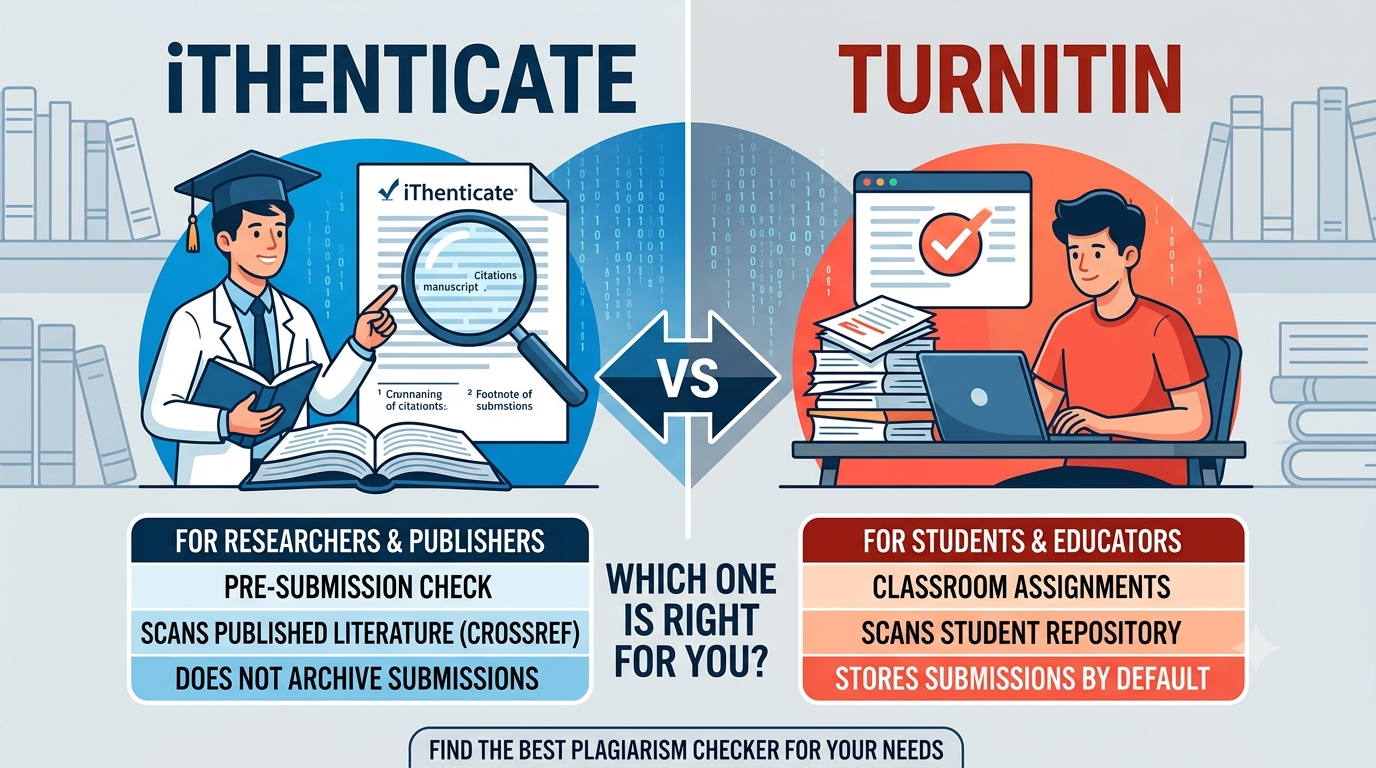
iThenticate vs Turnitin: What Is the Difference?
July 18, 2026
Scribbr vs Turnitin: Which Plagiarism Checker Is Better? (2026)
June 5, 2026
Quoting, Paraphrasing and Summarising: How to Use Sources Well
July 22, 2026

Law Assignment Help: A Practical Guide to Higher Marks
June 15, 2026



Want more tips & great deals? Get them sent to your inbox
Please enter a valid E-mail
By clicking "Subscribe" you agree to be contacted via e-mail. You can always unsubscribe from the newsletter


