
Our Blogs
Essay writing blog on DoMyWork

Older Posts
Aims, Objectives and Research Questions Explained (2026)
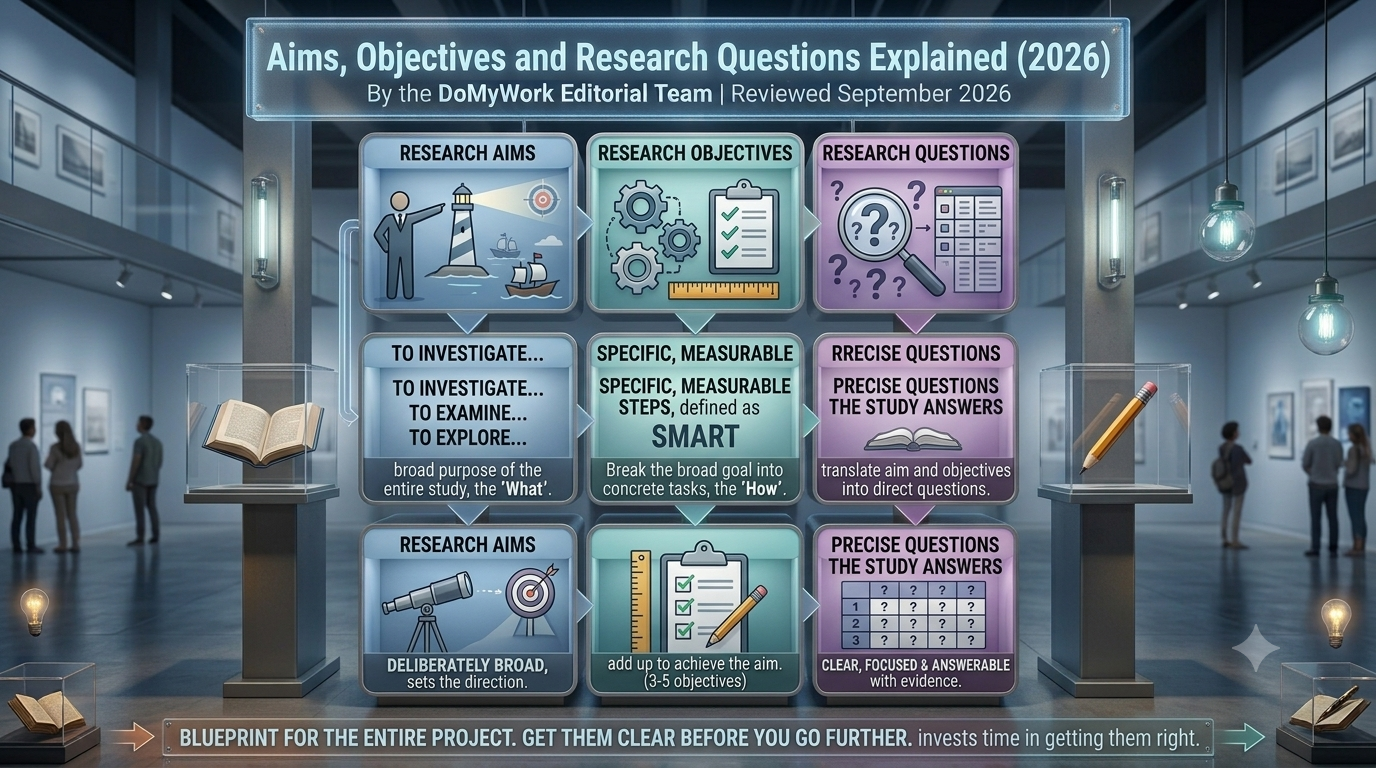
A research aim is the overall goal of your project, what you want to achieve. Objectives are the specific, measurable steps you will take to achieve the aim. Research questions are the precise questions your study will answer. The aim is broad, the objectives break it down, and the questions define exactly what you will investigate. Aims, objectives and research questions are the foundation of any dissertation or research project, yet students frequently confuse them, which leads to muddled proposals and unfocused research. Getting them clear and distinct is one of the most important early steps, because they set the direction for everything that follows. This guide explains what each one is, how they differ, how they connect, and how to write clear ones, with examples. They grow out of the gap identified in your literature review and are set out in your research proposal. What is a research aim? A research aim is the overall goal of your project: a broad statement of what you want to achieve or find out. It captures the purpose of the whole study in one or two sentences, usually beginning with a verb such as to examine, to investigate, to explore or to evaluate. For example: to investigate how flexible working affects employee productivity in UK technology firms. The aim is deliberately broad, since it sets the direction rather than the detail, and a dissertation typically has one clear aim. Everything else, your objectives and questions, flows from it, so getting a clear, focused aim is the essential first step. What are research objectives? Research objectives are the specific, measurable steps you will take to achieve your aim. If the aim is the destination, the objectives are the route: they break the broad goal into concrete tasks, so you and your reader can see how the aim will be met. Good objectives are specific and achievable, often described as SMART, and there are usually three to five of them. For the aim above, objectives might be: to examine current flexible working practices in the sector; to assess their relationship with productivity; and to identify the factors that make flexible working effective. Notice how each is a concrete step towards the aim, and how together they add up to it. What are research questions? Research questions are the precise questions your study sets out to answer, and they are what your findings will ultimately address. They translate your aim and objectives into direct questions, phrased so that evidence can answer them. For the example above, a research question might be: how does flexible working affect employee productivity in UK technology firms? Some studies use research questions instead of objectives, some use both, and some quantitative studies use hypotheses instead. Your research questions should be clear, focused and answerable, since a vague or unanswerable question leads to an unfocused study. They are the sharpest expression of exactly what your dissertation will investigate. How aims, objectives and questions connect The three work as a hierarchy, from broad to specific. The aim states the overall goal; the objectives break that goal into specific steps; and the research questions define exactly what will be answered. They should align tightly: every objective should serve the aim, and every research question should relate to an objective, so that together they form a coherent plan. If an objective does not contribute to the aim, or a question does not connect to your objectives, something is misaligned. Checking that your aim, objectives and questions line up cleanly is one of the best ways to ensure your whole study is focused and coherent from the start. How to write clear aims and objectives Write your aim first, as a single, focused statement of what you want to achieve, using a clear verb and a specific context. Then write your objectives as the specific steps needed to achieve that aim, keeping each one concrete, measurable and achievable, and making sure they cover everything the aim requires without straying beyond it. Aim for around three to five objectives, since too few may not cover the aim and too many suggest the scope is too broad. Use precise verbs, to examine, to assess, to identify, to evaluate, and avoid vague ones. Clear, well-aligned aims and objectives are what give a dissertation its direction. Common mistakes to avoid ● Confusing the aim (the broad goal) with the objectives (the specific steps). ● Writing objectives that are vague or unmeasurable, rather than concrete. ● Setting too many objectives, which signals an over-broad scope. ● Aims, objectives and questions that do not align with each other. ● Research questions that are too broad or cannot be answered with evidence. Aims and objectives versus a hypothesis Students sometimes wonder how a hypothesis fits alongside aims, objectives and research questions, and the distinction is worth clarifying. A hypothesis is a specific, testable prediction about the relationship between variables, used mainly in quantitative research, for example that flexible working increases productivity. When a research question asks something open, how does flexible working affect productivity, a hypothesis states an expected answer to be tested, that it increases it. So some studies, particularly experimental and quantitative ones, use hypotheses in place of or alongside research questions, while qualitative and exploratory studies usually use research questions, since they explore rather than test. Which you use depends on your research approach, and our qualitative vs quantitative research guide helps you decide. The aim and objectives, however, remain the same whichever you use: the aim states your overall goal and the objectives break it into steps, and then either research questions or hypotheses define precisely what you will investigate or test. In short, treat your aims, objectives and research questions as the blueprint for the entire project, and get them clear before you go further. Time spent sharpening them at the proposal stage is repaid many times over, because a study
Read more
How to Write an Explanatory Essay (2026)
An explanatory essay explains a topic, process or idea clearly and objectively, using facts rather than arguing a position. To write one, choose a topic you can explain, research it, and present the information in a logical structure with an introduction, body and conclusion. The key is to inform and clarify, not to persuade. An explanatory essay does exactly what its name suggests: it explains something clearly and objectively, helping the reader understand a topic, process or idea. Unlike an argumentative essay, it does not take a side or try to persuade; its job is to inform. This makes it one of the more straightforward essay types to write, provided you keep the focus on clear, factual explanation. This guide explains what an explanatory essay is, how to structure it, and how it differs from other essays. It shares much with the expository essay, and our expository essay topics guide offers ideas to explain. What is an explanatory essay? An explanatory essay, sometimes called an expository essay, presents a balanced, objective explanation of a topic. Its purpose is to help the reader understand something, whether that is how a process works, what a concept means, or why something happens, using facts and evidence rather than opinion. The writer explains the topic clearly and neutrally, without taking a position or trying to convince the reader of anything. This objective, informative purpose is what defines the explanatory essay and distinguishes it from persuasive and argumentative writing, so the whole essay should aim to clarify and inform rather than to argue a case. Explanatory essay versus argumentative essay The clearest way to understand an explanatory essay is to contrast it with an argumentative one. An argumentative essay takes a position and tries to persuade the reader to accept it, marshalling evidence for a particular case. An explanatory essay stays neutral, presenting information objectively so the reader can understand the topic, without arguing for a conclusion. So where an argumentative essay on renewable energy would argue that we should adopt it, an explanatory essay would simply explain how renewable energy works and its effects. Knowing which your task requires matters, because writing a persuasive argument when an objective explanation is wanted, or the reverse, answers the wrong brief. Choose a topic you can explain A good explanatory essay topic is one you can explain clearly and completely, and one supported by reliable facts rather than opinion. It should be specific enough to cover in depth, since a broad topic becomes shallow, and it should genuinely have something to explain, a process, a concept, a cause, rather than a debate to take sides in. If your topic is set, focus on the explanatory angle; if you choose it, pick something you understand well or can research thoroughly. The best explanatory topics leave the reader clearly more informed, so choose one you can teach the reader about. Research and gather your facts Because an explanatory essay stands on accurate information, thorough research is essential. Gather facts from credible, reliable sources, and take notes in your own words so your explanation is genuinely yours rather than copied. Make sure you understand the topic well enough to explain it simply, since you cannot clearly explain what you only half understand. Reference your sources properly, which our how to cite sources guide covers, since even an objective essay must credit where its information comes from. Solid research is what lets you explain a topic accurately and confidently, which is the foundation of a good explanatory essay. How to structure an explanatory essay An explanatory essay follows the standard structure. The introduction presents the topic and states what the essay will explain, often with a thesis that previews the main points. The body develops the explanation across several paragraphs, each covering one aspect clearly with facts and examples, organised logically so each builds the reader’s understanding. The conclusion summarises the key points and reinforces the reader’s understanding, without introducing new information or opinion. Organising the information in a logical order, so the reader is guided step by step through the topic, is what makes an explanation easy to follow, and our how to structure an assignment guide covers the wider shape. Keep the tone objective and clear The defining feature of an explanatory essay is its objective, informative tone, so keep your writing neutral and factual throughout. Avoid opinion, persuasion and emotive language, since these belong to argumentative writing, and focus instead on presenting information clearly. Clarity is everything: use plain, precise language, define any technical terms, and use examples to make complex points accessible. The measure of a good explanatory essay is whether a reader who knows little about the topic finishes genuinely understanding it, so write with that reader in mind, explaining rather than assuming knowledge, and letting clear, well-organised information do the work. Types of explanatory essay Because explaining can be done in several ways, explanatory essays take a few common forms, and recognising them helps you choose the clearest approach. A process explanation sets out how something works or is done, step by step, in a logical order. A definition explanation clarifies what a concept means, often by breaking it into its features. A cause-and-effect explanation sets out why something happens and what results from it. A compare-and-contrast explanation clarifies a topic by setting it against something else, showing similarities and differences. Many explanatory essays combine these, using whichever approach best suits the topic, so an essay explaining climate change might define the concept, then explain its causes and effects. Identifying which approach fits your topic tells you how to organise the body of the essay, since a process explanation follows steps in sequence while a definition explanation works through features, and matching the structure to the type of explanation is what makes the essay easy to follow. Ultimately, an explanatory essay is judged on one thing above all: clarity. A reader should come away understanding the topic better than before, without having been argued
Read more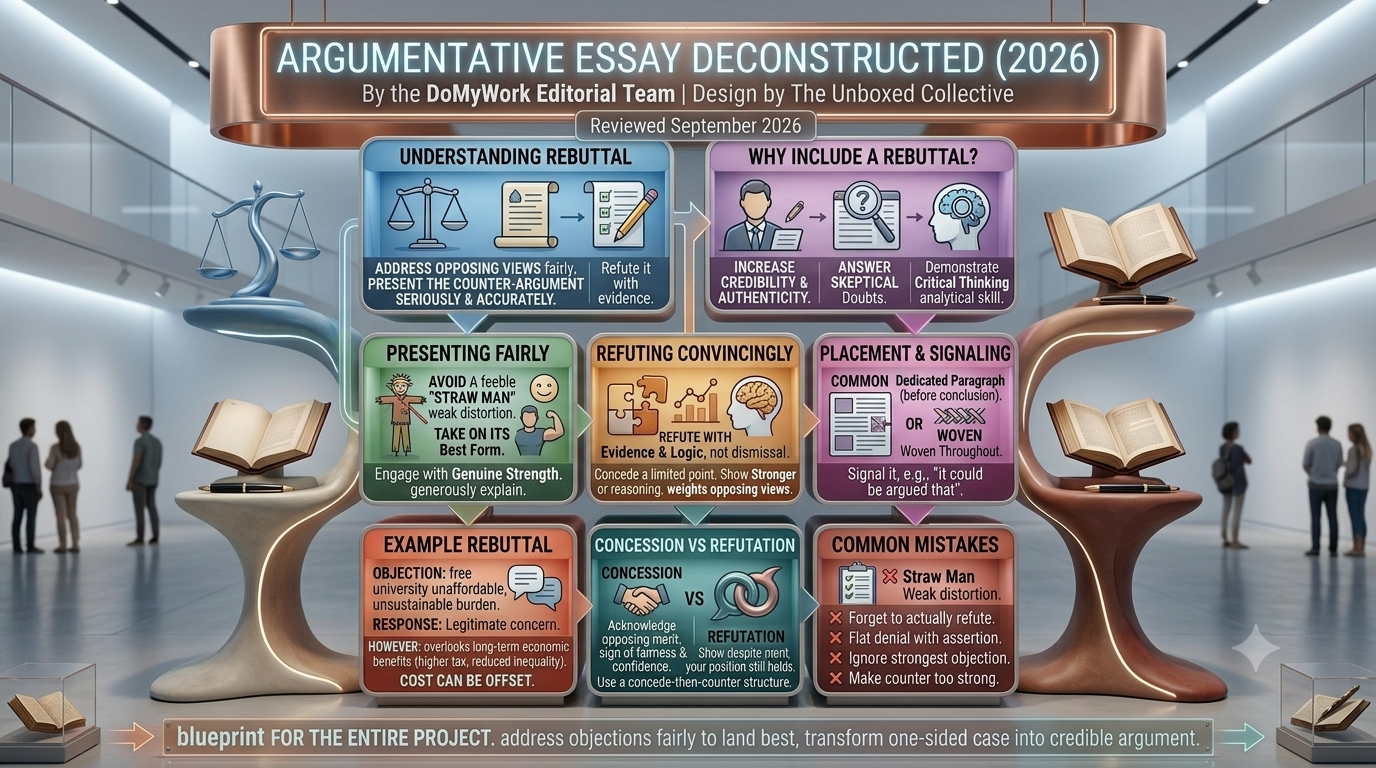
Rebuttal in an Argumentative Essay: A Guide (2026)
A rebuttal is the part of an argumentative essay where you address the opposing view and explain why your position still holds. You present the counter-argument fairly, then refute it with evidence and reasoning. Including a rebuttal makes your argument stronger, because it shows you have considered the issue fully rather than ignoring the other side. Many students think the strongest argumentative essay is one that only makes its own case, but the opposite is true: the most convincing essays engage with the other side. The rebuttal, where you acknowledge the opposing view and refute it, is what turns a one-sided essay into a persuasive, well-rounded argument. This guide explains what a rebuttal is, why it strengthens your writing, how to write one, and where to place it, with an example. It is a key technique in persuasive and argumentative writing, and it works alongside our how to write a persuasive essay guide. What is a rebuttal? A rebuttal, also called a refutation or counter-argument response, is the part of an argumentative essay where you address an opposing viewpoint and explain why your own position is stronger. It has two parts: first you present the counter-argument, the strongest case against your view, fairly and accurately; then you refute it, using evidence and reasoning to show why it does not overturn your position. A rebuttal is not about ignoring or dismissing the other side; it is about engaging with it seriously and then answering it. This engagement is what distinguishes a mature argument from a one-sided assertion of opinion. Why include a rebuttal? Including a rebuttal makes your argument significantly stronger, for several reasons. It shows the reader that you have considered the issue fully, from more than one angle, which makes you a more credible and trustworthy writer. It answers the doubts a sceptical reader is likely to have, rather than leaving them unaddressed, which is far more persuasive. And it demonstrates the critical thinking markers reward, since weighing opposing views is exactly the analytical skill assessed at the higher grades, as our how to write critically guide develops. An essay that ignores the obvious objections looks naive; one that answers them looks authoritative. How to present the counter-argument fairly The first part of a rebuttal is presenting the opposing view, and it must be done fairly, which many students get wrong. Present the strongest, most reasonable version of the counter-argument, not a weak or distorted one, since knocking down a feeble version, a straw man, convinces no one and undermines your credibility. Explain the opposing view accurately and even generously, as its supporters would, so the reader trusts that you understand the issue. Only by engaging with the genuine strength of the other side does your refutation carry weight, so resist the temptation to make the counter-argument easy to defeat; take on its best form. How to refute the counter-argument Having presented the opposing view fairly, you refute it, showing why your position still holds. There are a few ways to do this. You can challenge the evidence, showing that it is weak, outdated or misinterpreted. You can concede a limited point but show that it does not overturn your overall argument, which is often the most sophisticated approach. Or you can show that your position is supported by stronger evidence or reasoning. Whichever you use, refute with evidence and logic rather than dismissal, since a rebuttal that simply asserts the other side is wrong is no rebuttal at all. A well-reasoned refutation is what actually answers the objection. Where to place the rebuttal There are two common places for a rebuttal in an argumentative essay. The most common is a dedicated paragraph, usually placed after you have made your own main arguments and before your conclusion, where you address the main counter-argument in full. The alternative is to weave smaller rebuttals throughout the essay, answering objections to each of your points as you make them. The dedicated paragraph suits a single major counter-argument, while the woven approach suits an essay with several points each facing objections. Either works, so choose the placement that lets you address the opposing view most clearly, and signal it with phrases such as ‘it could be argued that’ before presenting the counter-view. An example of a rebuttal Suppose your essay argues that university should be free. A rebuttal might run: ‘It could be argued that free university is unaffordable, placing an unsustainable burden on taxpayers. This is a legitimate concern, and the cost would indeed be significant. However, this objection overlooks the long-term economic benefits of a more educated workforce, including higher tax revenues and reduced inequality, which several studies suggest can offset the initial cost over time. The affordability concern, while real, therefore does not outweigh the wider social and economic case for free university.’ Notice how the rebuttal presents the objection fairly, concedes its legitimacy, and then refutes it with reasoning and evidence, rather than dismissing it. Concession versus refutation Within a rebuttal, it helps to understand the difference between concession and refutation, because the most sophisticated rebuttals use both. A concession is where you acknowledge that part of the opposing argument has merit, which is not a weakness but a sign of fairness and confidence. A refutation is where you show why, despite that merit, your position still holds. The strongest rebuttals often concede a limited point before refuting the wider argument, using a structure such as: while it is true that X, this does not outweigh Y. This concede-then-counter approach is more persuasive than flatly denying everything the other side says, because it shows the reader you are reasonable and have weighed the issue honestly, which makes your refutation more credible when it comes. Learning to concede a genuine point gracefully, then explain why your position nonetheless prevails, is a mark of mature argumentative writing, and it disarms a sceptical reader far more effectively than pretending the opposing view has no strengths at all. Common rebuttal mistakes to
Read more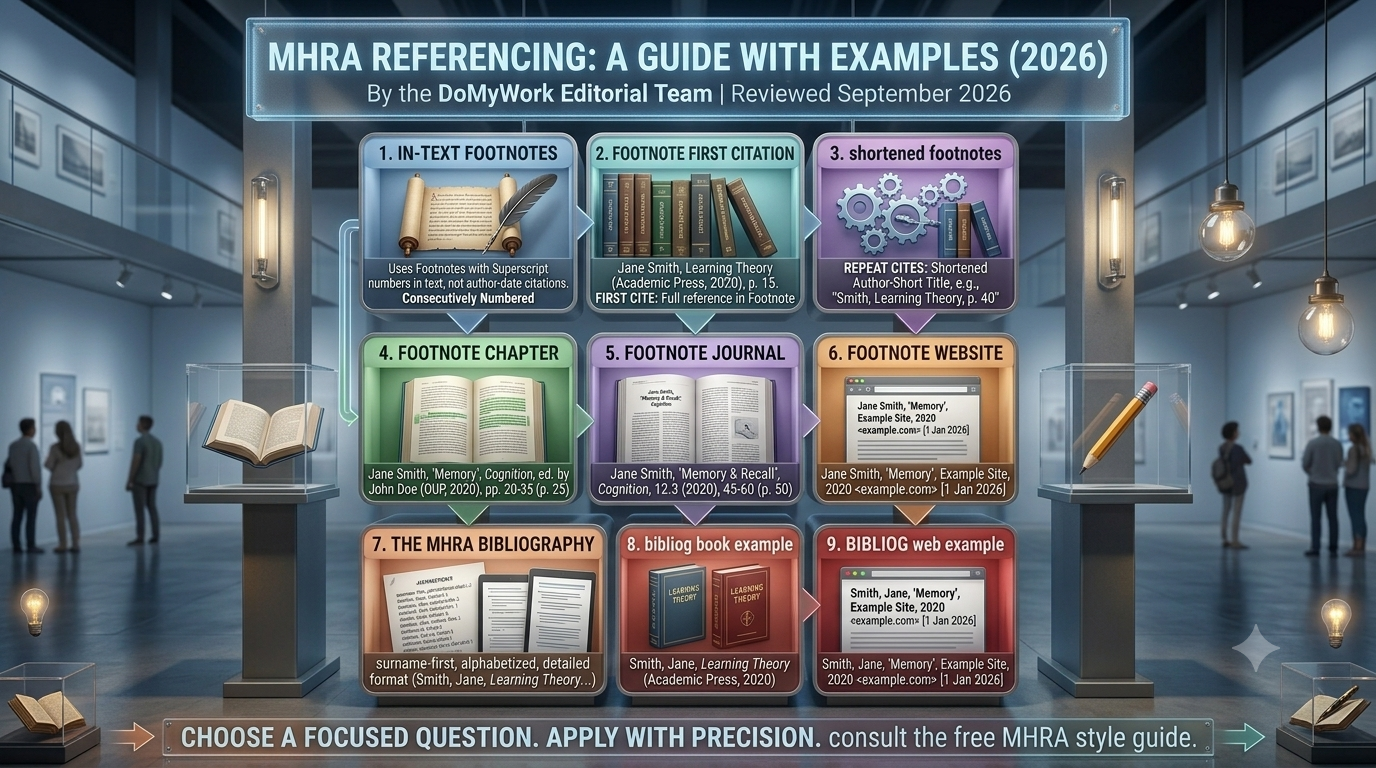
MHRA Referencing: A Guide with Examples (2026)
MHRA referencing is a footnote style used in the arts and humanities, especially English and modern languages. You place a superscript number in the text and give the full citation in a footnote at the bottom of the page, then list all sources in a bibliography at the end. It differs from author-date styles like Harvard by using footnotes rather than in-text citations. MHRA referencing, from the Modern Humanities Research Association, is the standard style for many arts and humanities courses, particularly English, history and modern languages. If you have only used author-date styles like Harvard, MHRA feels different, because it uses footnotes rather than in-text citations. This guide explains how MHRA works, how to format footnotes and the bibliography, with examples, and how it compares to other styles. It fits within the wider family of styles our referencing styles explained guide covers. What is MHRA referencing? MHRA is a footnote-based referencing style used widely in the humanities. Instead of an in-text citation giving the author and year, you place a small superscript number in your text at the point you use a source, and give the full reference in a footnote at the bottom of the page. All sources are then listed in a bibliography at the end. Its footnote system suits humanities writing, where detailed references and discursive notes are common, and it allows for commentary within footnotes as well as citations. This makes it quite different from author-date styles, which is the main adjustment students make when they first use MHRA. How MHRA footnotes work In MHRA, each time you cite a source, you insert a superscript number in the text, and a correspondingly numbered footnote appears at the bottom of the page with the full citation. The numbers run consecutively through your work. The first time you cite a source, you give the full reference in the footnote; for later citations of the same source, you use a shortened form, usually the author’s surname and a short title, to avoid repeating the full details. This first-full-then-short pattern is central to MHRA, and it keeps footnotes manageable while still letting the reader identify every source. MHRA footnote formats The footnote format differs by source type. Here are the common formats for a first, full citation: Book: Jane Smith, Learning Theory (London: Academic Press, 2020), p. 15. Chapter: Jane Smith, ‘Memory’, in Cognition, ed. by John Doe (Oxford: OUP, 2020), pp. 20-35 (p. 25). Journal: Jane Smith, ‘Memory and Recall’, Cognition, 12.3 (2020), 45-60 (p. 50). Website: Jane Smith, ‘Understanding Memory’, Example Site, 2020 <https://example.com> [accessed 1 January 2026]. Note that MHRA gives the author’s name in normal order (first name first) in footnotes, uses a page number for the specific reference, and encloses web URLs in angle brackets with an access date. These details matter, since MHRA is precise about punctuation and format. The MHRA bibliography As well as footnotes, MHRA requires a bibliography at the end, listing every source you have cited, ordered alphabetically by the author’s surname. The bibliography format differs slightly from the footnote format: crucially, the author’s name is inverted (surname first) so the list can be alphabetised, and page numbers for the specific reference are usually omitted. For example, a book that appeared in a footnote as ‘Jane Smith, Learning Theory…’ becomes, in the bibliography, ‘Smith, Jane, Learning Theory (London: Academic Press, 2020)’. Keeping the two formats straight, first-name-first in footnotes, surname-first in the bibliography, is one of the details students most often slip on in MHRA. Shortened footnotes for repeat citations Because giving the full reference every time would clutter the footnotes, MHRA uses shortened forms for any source cited more than once. After the first full footnote, later citations of the same work use just the author’s surname and a short version of the title, followed by the page number, for example: ‘Smith, Learning Theory, p. 40’. This keeps footnotes concise while still identifying the source clearly. Older guidance sometimes used Latin terms such as ibid. for consecutive references to the same work, though modern MHRA generally prefers the short author-and-title form throughout, so check the current MHRA Style Guide, which is freely available, for the up-to-date convention. How MHRA differs from other styles The biggest difference is that MHRA uses footnotes rather than in-text citations. Author-date styles like Harvard and APA place a brief (author, year) citation in the text and give full details in a reference list, as our Harvard referencing guide shows. MHRA instead uses a superscript number leading to a footnote, which suits the humanities. It is closer in spirit to OSCOLA, the footnote style used in law, though the formats differ. Knowing that MHRA belongs to the footnote family, alongside OSCOLA and Chicago’s notes system, rather than the author-date family, helps you understand why it works so differently from the referencing you may have used before. When will you use MHRA, and where to find the rules You are most likely to meet MHRA if you study English literature, modern languages, medieval or early-modern studies, or certain history and arts courses, since it is the house style of many humanities departments and journals in these fields. If your course specifies MHRA, it is because the footnote system suits writing that quotes and discusses texts closely, where a reader benefits from full references and the occasional explanatory note at the foot of the page. The definitive source is the MHRA Style Guide, which the Association publishes and makes freely available online, and it is worth consulting directly whenever you are unsure of a format, since it covers source types this guide does not, from manuscripts to films, and is periodically updated. Because MHRA is precise about punctuation and the difference between footnote and bibliography formats, keeping the official guide to hand as you write, rather than relying on memory, is the surest way to apply it correctly and consistently across a whole piece of work. Tips for using MHRA correctly MHRA rewards precision, so consistency
Read more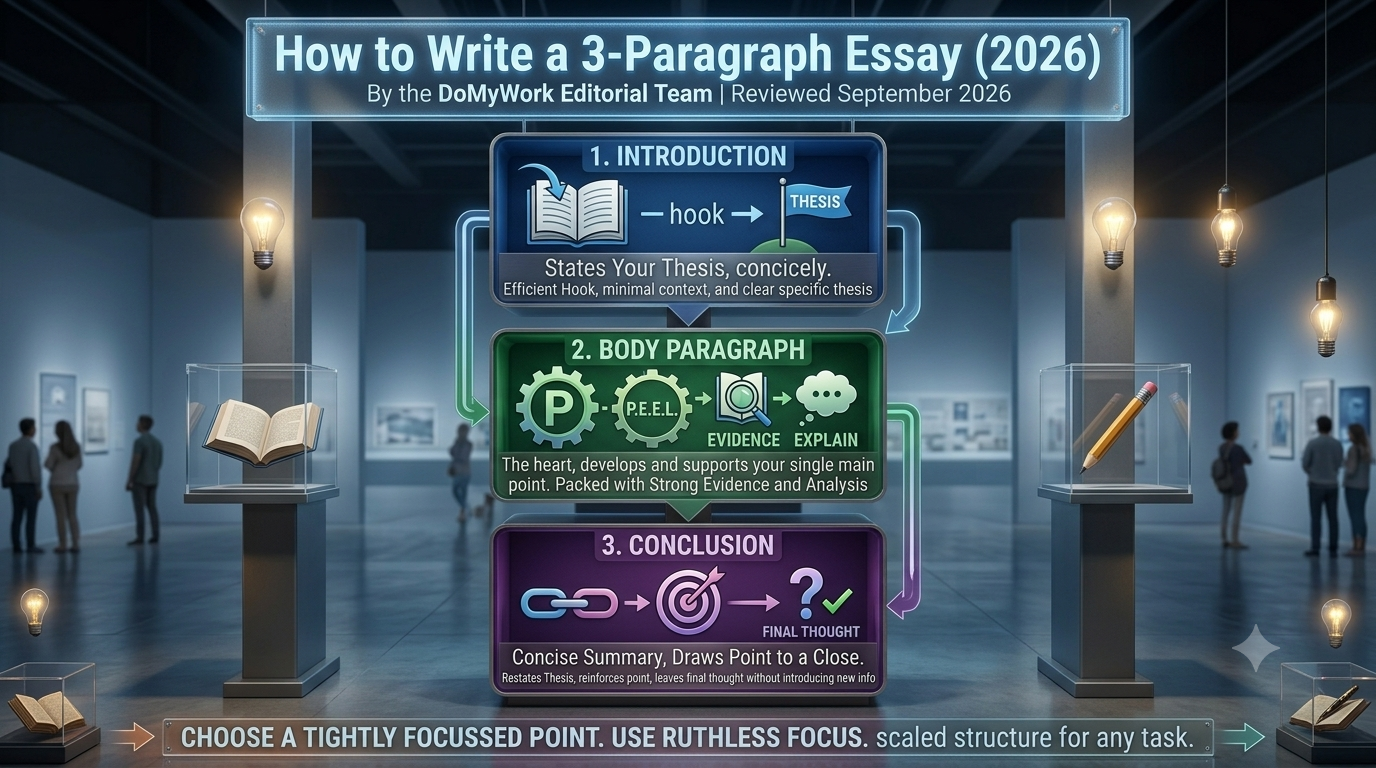
How to Write a 3-Paragraph Essay (2026)
A 3-paragraph essay has an introduction, one body paragraph, and a conclusion. The introduction states your thesis, the single body paragraph makes and supports your main point, and the conclusion restates your position. It suits short assignments, exam answers and younger writers, and it teaches essay structure in its simplest form. The 3-paragraph essay is the simplest complete essay form, with just an introduction, one body paragraph, and a conclusion. It is often used for short assignments, exam answers, and as a way of teaching essay structure before students move on to longer forms. Its brevity is a challenge as much as a help, since you have very little space to make and support your point. This guide explains how to write a 3-paragraph essay, how to structure each part, and when the format is used. It builds on the essay structure and how to structure an assignment guide. What is a 3-paragraph essay? A 3-paragraph essay is a short essay with exactly three paragraphs: an introduction, a single body paragraph, and a conclusion. It follows the same beginning-middle-end logic as any essay, but compressed into its most basic form. Because there is only one body paragraph, a 3-paragraph essay makes a single main point or a tightly focused argument, rather than developing several. This makes it ideal for short tasks and for learning the fundamentals of essay structure, since it contains all the essential parts, a thesis, supporting evidence and analysis, and a conclusion, without the complexity of a longer essay. When is the 3-paragraph format used? The 3-paragraph essay suits several situations. It is common in short assignments and quick written responses, where a full-length essay is not required. It is useful in exams, where time is limited and a concise, well-structured answer is more achievable than a long one. It is often used to teach essay writing, since it introduces the core structure in a manageable form before students tackle five-paragraph and longer essays. And it works well for a simple, focused argument that needs only one main point. Knowing when a short, focused essay is appropriate, rather than a longer one, is part of matching your writing to the task. How to write the introduction The introduction of a 3-paragraph essay does the same job as any introduction, but concisely. In a few sentences, it should engage the reader, introduce the topic briefly, and state your thesis, the clear point your essay will make. With so little space overall, the introduction must be efficient: a short hook, minimal context, and a clear thesis are enough. The thesis is especially important in such a short essay, since it is the single claim your one body paragraph will support, so make it clear and specific, as our thesis statement guide explains. A focused introduction sets up the whole short essay. How to write the body paragraph The single body paragraph is the heart of a 3-paragraph essay, and it must make and support your main point on its own. A reliable approach is to make your point, provide evidence or examples to support it, explain what that evidence shows, and connect it back to your thesis, which is exactly the PEEL structure our how to write a PEEL paragraph guide covers. Because you have only one body paragraph, it needs to be well-developed and focused, packing your strongest evidence and clearest analysis into a single, coherent argument. This is where the real content of the essay lives, so give it the most words and the most care. How to write the conclusion The conclusion of a 3-paragraph essay draws your point to a close. In a few sentences, restate your thesis in the light of what you have argued, briefly reinforce your main point, and end with a final thought, without introducing new information. Because the essay is short, the conclusion should be concise and should not simply repeat the introduction word for word; instead, it should show that your point has been made. A tight, purposeful conclusion completes the essay’s beginning-middle-end shape and leaves the reader clear on what you have argued, which is all a short essay’s conclusion needs to do. The challenge of the 3-paragraph essay Do not mistake short for easy. The main challenge of a 3-paragraph essay is that its brevity leaves no room for padding or wandering, so every sentence has to earn its place. With a single body paragraph, you must choose your strongest point and your best evidence, since there is no space to develop several ideas. This forces a discipline that longer essays do not: ruthless focus. The skill of a good short essay is selection, deciding what to include and, just as importantly, what to leave out, so that the one point you make is made as convincingly as possible in the space available. 3-paragraph versus 5-paragraph essay It helps to see the 3-paragraph essay alongside its larger sibling, the 5-paragraph essay, since the two share a logic and differ only in scale. The 5-paragraph essay has an introduction, three body paragraphs and a conclusion, giving it room to develop three separate points in support of its thesis. The 3-paragraph essay compresses this to a single body paragraph and therefore a single main point, which makes it suitable for shorter tasks and quicker responses but leaves no room to develop multiple lines of argument. In practice, you choose between them based on the length and demands of the task: a brief exam answer or a short assignment suits three paragraphs, while a fuller essay that needs to argue several points calls for five or more. Both teach the same underlying structure, a clear thesis, supported body, and conclusion, which is why the 3-paragraph form is often a stepping stone to longer essays. Understanding that the two are the same shape at different sizes helps you scale your writing up or down to fit whatever the task requires. Tips for a strong 3-paragraph essay Keep your focus tight,
Read more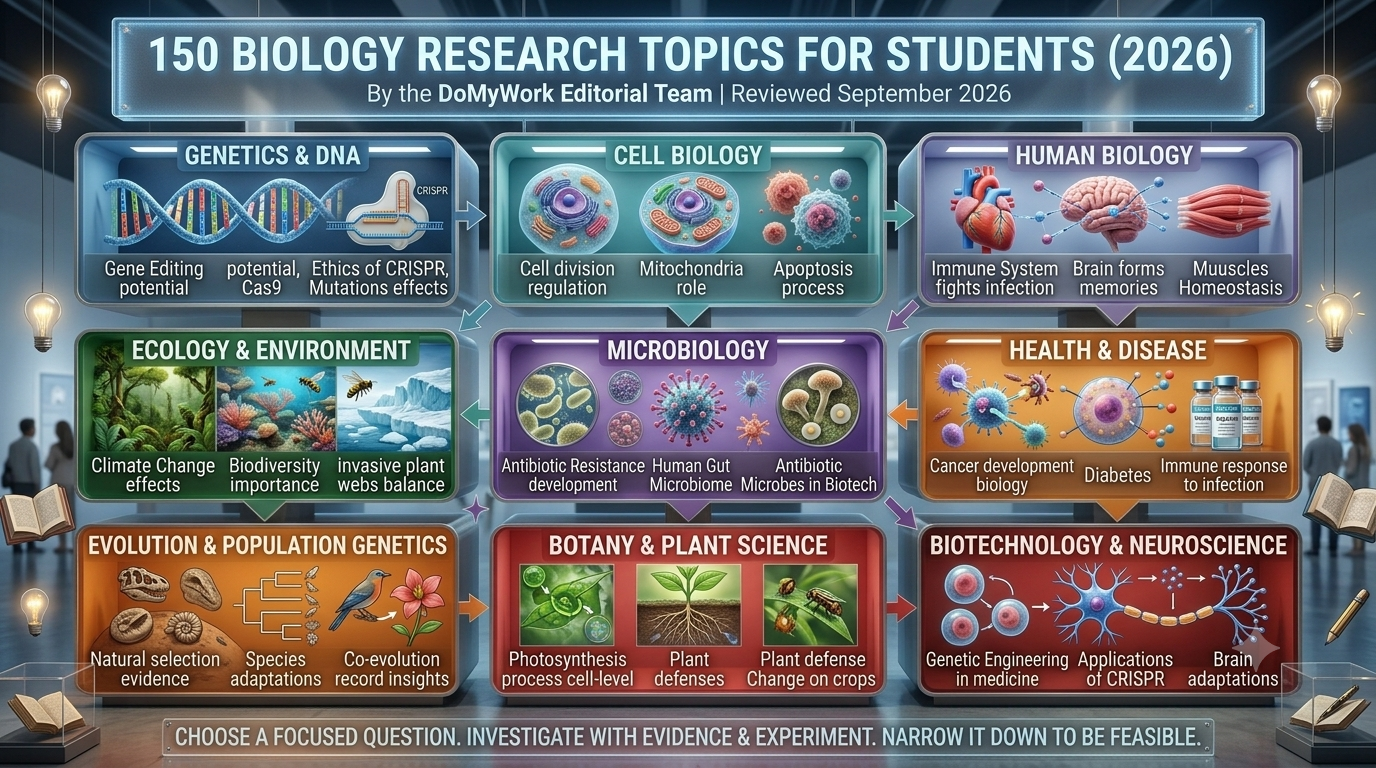
150 Biology Research Topics for Students (2026)
A strong biology research topic asks a clear question you can investigate with evidence or experiment. Good areas include genetics, cell biology, ecology, human biology, microbiology, evolution and biotechnology. The topic should be specific enough to research in depth. This guide gives 150 topics grouped by area, then shows how to choose one. Biology is a vast field, from molecules to ecosystems, which makes it rich in research topics but easy to pick something too broad. The best topics are specific questions you can investigate with evidence or experiment. This guide gives 150 biology research topics grouped by area, then shows how to choose and shape one. Because a research project depends on good sources and a clear method, our science research topics and how to write a literature review guides help you take a topic further. What makes a good biology research topic? A good biology topic asks a clear, specific question you can investigate, whether through experiment, observation or existing data. It is narrow enough to research in depth, since a broad topic becomes shallow, and it is feasible with the resources and time you have. It should also connect to current biological knowledge, so there is a body of research to build on. The most common mistake is choosing something too broad, such as genetics, when a focused topic like how a specific gene affects a trait in a model organism gives you a researchable question. Narrow every promising idea to that level. 150 biology research topics by area The topics below are grouped by area. Narrow any of them to a specific, researchable question. Genetics and DNA ● How gene editing could treat inherited disease. ● The ethics of CRISPR gene editing. ● How mutations affect protein function. ● The role of epigenetics in gene expression. ● How genetic testing affects healthcare. ● The genetics of a chosen disease. ● How DNA replication is regulated. ● The role of genes in behaviour. ● How gene therapy works. ● The genetics of ageing. ● How inherited traits are passed on. ● How genome sequencing has changed medicine. ● The role of junk DNA. ● How genetic diversity affects populations. Cell biology ● How cells regulate their division. ● The role of mitochondria in energy production. ● How cancer cells differ from normal cells. ● The process of apoptosis. ● How stem cells could treat disease. ● The structure and function of cell membranes. ● How cells communicate with each other. ● The role of enzymes in cellular reactions. ● How cells respond to stress. ● The process of photosynthesis at cell level. ● How the cell cycle is controlled. ● The role of proteins in the cell. ● How cells transport materials. ● How viruses hijack host cells. Human biology and physiology ● How the immune system fights infection. ● The physiology of the human heart. ● How the brain forms memories. ● The effects of exercise on the body. ● How the digestive system absorbs nutrients. ● The role of hormones in the body. ● How the nervous system transmits signals. ● The physiology of sleep. ● How the body maintains homeostasis. ● The effects of stress on the body. ● How the respiratory system works. ● The role of the microbiome in health. ● How the body ages. ● The physiology of the human eye. Ecology and the environment ● How climate change affects ecosystems. ● The importance of biodiversity. ● How invasive species disrupt ecosystems. ● The role of pollinators in ecosystems. ● How pollution affects aquatic life. ● The effects of deforestation on wildlife. ● How ecosystems recover after disturbance. ● The role of keystone species. ● How urbanisation affects biodiversity. ● The effects of ocean acidification. ● How food webs maintain balance. ● The role of decomposers in ecosystems. ● How habitat loss affects species. ● The effects of climate change on migration. Microbiology ● How antibiotic resistance develops. ● The role of bacteria in the human gut. ● How viruses evolve. ● The benefits of probiotics. ● How microbes are used in biotechnology. ● The role of fungi in ecosystems. ● How pathogens cause disease. ● The use of bacteria in bioremediation. ● How the immune system responds to bacteria. ● The role of microbes in food production. ● How vaccines train the immune system. ● The threat of emerging infectious diseases. ● How biofilms form. ● The role of microbes in nutrient cycling. Evolution and genetics of populations ● How natural selection drives evolution. ● The evidence for human evolution. ● How species adapt to their environment. ● The role of genetic drift in evolution. ●
Read more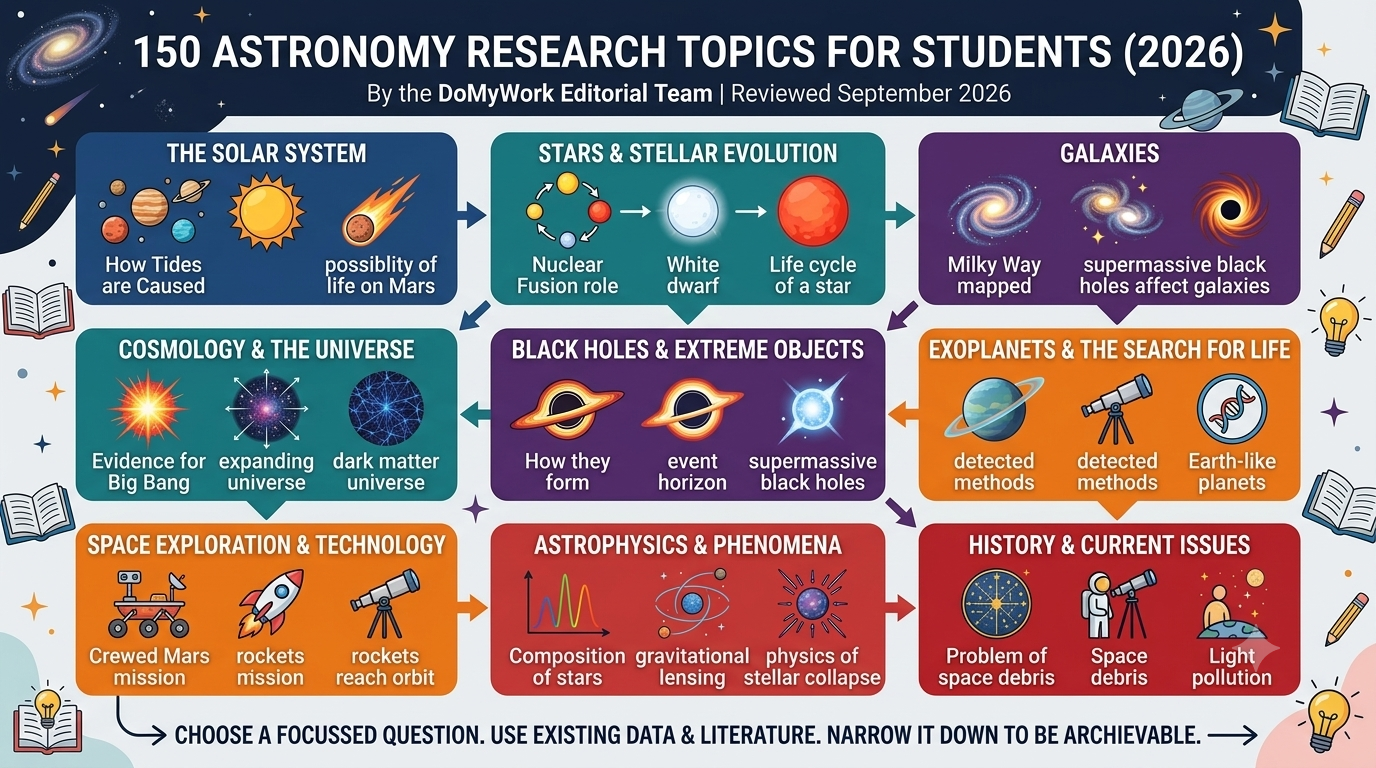
150 Astronomy Research Topics for Students (2026)
A strong astronomy research topic asks a clear question you can explore using existing data, observations and research. Good areas include the solar system, stars, galaxies, cosmology, exoplanets and space exploration. Since most student astronomy is literature or data-based, the topic should have good sources. This guide gives 150 topics grouped by area, then shows how to choose one. Astronomy is one of the most fascinating sciences, spanning everything from our own solar system to the origins of the universe. Because students rarely have access to telescopes or original data, most astronomy research is literature or data-based, so the best topics are ones with a strong body of existing research and available data. This guide gives 150 astronomy research topics grouped by area, then shows how to choose and shape one. Our science research topics and how to write a literature review guides help you take a topic further. What makes a good astronomy research topic? A good astronomy topic asks a clear, specific question you can explore with existing observations, data and research, since students rarely gather their own astronomical data. It should be narrow enough to cover in depth and supported by a good body of published research, given how data-rich and fast-moving the field is. It should also connect to current astronomical knowledge. The most common mistake is choosing something too broad, such as black holes, when a focused topic like how astronomers detect supermassive black holes gives you a researchable question. Narrow every promising idea to a specific, well-documented question. 150 astronomy research topics by area The topics below are grouped by area. Narrow any of them to a specific, researchable question with good sources. The solar system ● How the solar system formed. ● The geology of Mars. ● How the Moon affects Earth. ● The composition of the gas giants. ● How asteroids and comets differ. ● The possibility of life on Mars. ● How the Sun produces energy. ● The exploration of the outer planets. ● How planetary atmospheres form. ● The role of Jupiter in the solar system. ● How the Kuiper Belt was discovered. ● The search for water on other planets. ● How tides are caused. ● The study of Saturn’s rings. Stars and stellar evolution ● How stars are born. ● The life cycle of a star. ● How supernovae occur. ● The formation of neutron stars. ● How stars produce heavier elements. ● The nature of red giants. ● How white dwarfs form. ● The classification of stars. ● How binary star systems work. ● The study of variable stars. ● How stellar distances are measured. ● The end stages of massive stars. ● How brown dwarfs form. ● The role of nuclear fusion in stars. Galaxies ● How galaxies form and evolve. ● The structure of the Milky Way. ● How galaxies collide. ● The role of dark matter in galaxies. ● The different types of galaxies. ● How supermassive black holes affect galaxies. ● The study of spiral galaxies. ● How galaxy clusters form. ● The distribution of galaxies in the universe. ● How the Milky Way was mapped. ● The nature of active galactic nuclei. ● How galaxies are classified. ● The role of gas in galaxy formation. ● How the earliest galaxies formed. Cosmology and the universe ● The evidence for the Big Bang. ● How the universe is expanding. ● The nature of dark energy. ● The nature of dark matter. ● How the cosmic microwave background was discovered. ● The age and size of the universe. ● How the universe might end. ● The formation of the first stars. ● The evidence for cosmic inflation. ● How astronomers measure the universe. ● The role of dark matter in cosmic structure. ● How galaxies trace the structure of the universe. ● The multiverse hypothesis. ● How the universe’s expansion is measured. Black holes and extreme objects ● How black holes form. ● How astronomers detect black holes. ● The nature of supermassive black holes. ● What happens at the event horizon. ● How gravitational waves were detected. ● The study of neutron stars. ● How pulsars work. ● The physics near a black hole. ● How the first black hole image was captured. ● The role of black holes in galaxies. ● How quasars produce energy. ● The study of magnetars. ● How stellar black holes form. ● The information paradox of black holes. Exoplanets and the search for life ● How exoplanets are detected. ● The search for Earth-like planets. ● How the habitable zone is defined. ● The study of exoplanet atmospheres. ● How many
Read more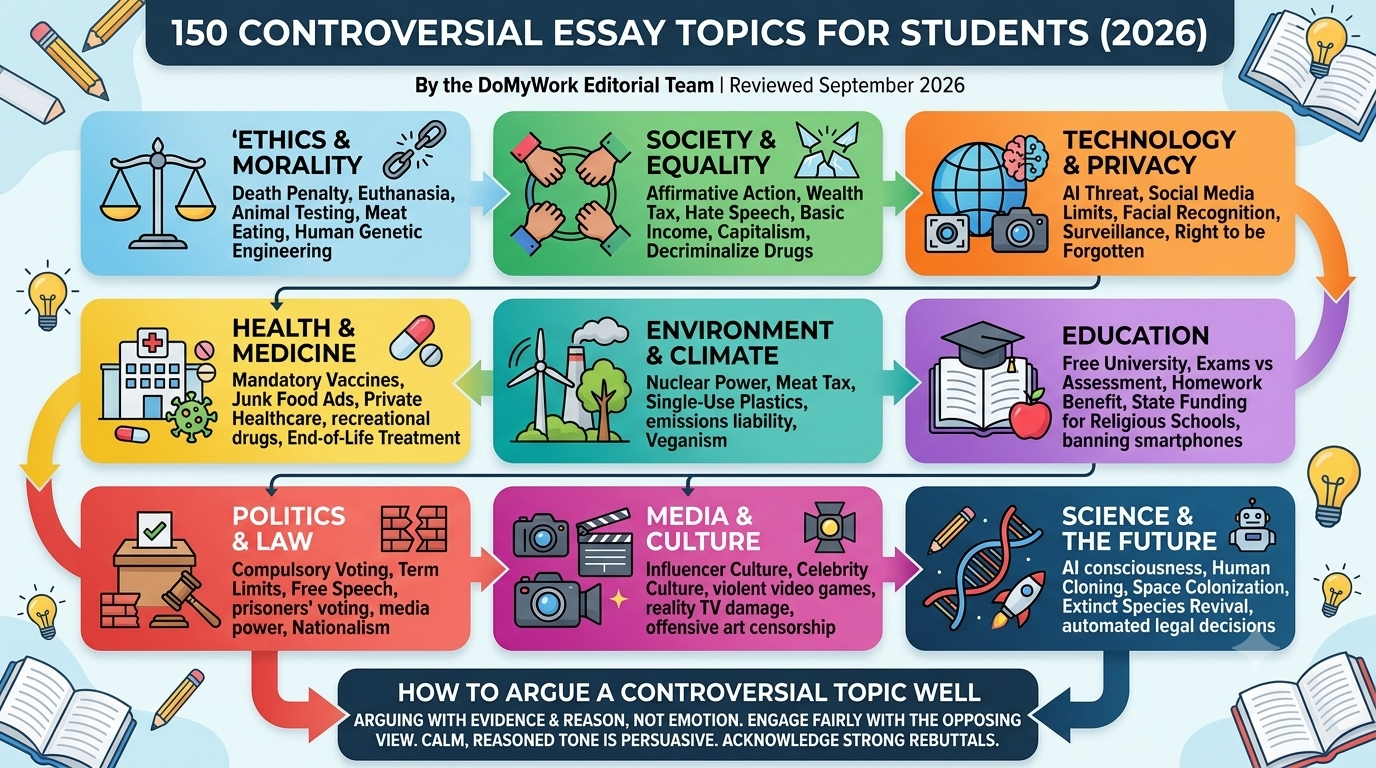
150 Controversial Essay Topics for Students (2026)
A good controversial essay topic is genuinely debatable, with strong arguments on both sides, and one you can argue with evidence rather than emotion. Good areas include ethics, society, technology, health, the environment and politics. This guide gives 150 topics grouped by theme, then shows how to argue a controversial topic fairly and convincingly. Controversial topics make excellent essays because they are genuinely debatable, with real arguments on both sides, which gives you something substantial to argue. The challenge is to argue them well: with evidence and reasoning rather than emotion, and by engaging fairly with the opposing view. This guide gives 150 controversial essay topics grouped by theme, then shows how to argue one convincingly. Because these are argumentative essays, they rest on a clear position and reasoning, which our thesis statement and how to write critically guides help you build. What makes a good controversial essay topic? A good controversial topic is genuinely debatable, with strong, reasonable arguments on both sides, so there is a real debate to engage with rather than an obvious answer. It should be one you can argue with evidence, not just strong feeling, and specific enough to argue thoroughly in the length you have. It is also worth choosing a topic you can discuss maturely and fairly, since the best controversial essays engage respectfully with views they disagree with. Avoid topics so inflammatory that reasoned argument becomes difficult, and favour those where evidence, not just emotion, can carry the case. 150 controversial essay topics by theme The topics below are grouped by theme. Narrow any of them to a clear, arguable position you can defend with evidence. Ethics and morality ● Should the death penalty be abolished? ● Is euthanasia ethical? ● Should animals be used in scientific testing? ● Is it wrong to eat meat? ● Should human genetic engineering be allowed? ● Is it ethical to keep animals in zoos? ● Should assisted dying be legal? ● Is capital punishment ever justified? ● Should we clone humans? ● Is it ethical to use AI to make moral decisions? ● Should organ donation be compulsory? ● Is censorship ever justified? ● Should there be limits on scientific research? ● Is it ethical to test cosmetics on animals? Society and equality ● Should the voting age be lowered to 16? ● Is affirmative action fair? ● Should the wealthy pay significantly more tax? ● Is inequality inevitable in society? ● Should hate speech be criminalised? ● Is a universal basic income a good idea? ● Should there be a maximum wage? ● Is society too politically correct? ● Should the monarchy be abolished? ● Is capitalism the best economic system? ● Should drug use be decriminalised? ● Is the justice system fair? ● Should there be open borders? ● Is cancelling culture harmful? Technology and privacy ● Should social media have an age limit? ● Is artificial intelligence a threat to humanity? ● Should facial recognition be banned? ● Is online privacy a lost cause? ● Should social media be regulated more strictly? ● Is technology making us less human? ● Should AI-generated content be labelled? ● Is surveillance justified for security? ● Should children under 16 be banned from social media? ● Is automation good for society? ● Should there be a right to be forgotten online? ● Is data collection by companies ethical? ● Should AI be allowed to make legal decisions? ● Is the internet doing more harm than good? Health and medicine ● Should vaccines be mandatory? ● Is a sugar tax justified? ● Should junk food advertising be banned? ● Is private healthcare ethical? ● Should recreational drugs be legalised? ● Is the wellness industry harmful? ● Should there be limits on end-of-life treatment? ● Is it ethical to ration healthcare? ● Should smoking be banned entirely? ● Is mental health taken seriously enough? ● Should genetic screening of embryos be allowed? ● Is the healthcare system fair? ● Should unhealthy lifestyles affect treatment priority? ● Is alternative medicine dangerous? Environment and climate ● Should individuals be responsible for climate change? ● Is nuclear power the answer to climate change? ● Should meat consumption be taxed? ● Is enough being done about climate change? ● Should single-use plastics be banned? ● Is economic growth compatible with sustainability? ● Should air travel be restricted? ● Is climate activism effective? ● Should companies be liable for their emissions? ● Is veganism the most ethical choice? ● Should fossil fuels be banned outright? ● Is population growth an environmental threat? ● Should governments prioritise the environment over the economy? ● Is fast fashion morally acceptable? Education ● Should university be free? ● Are exams
Read more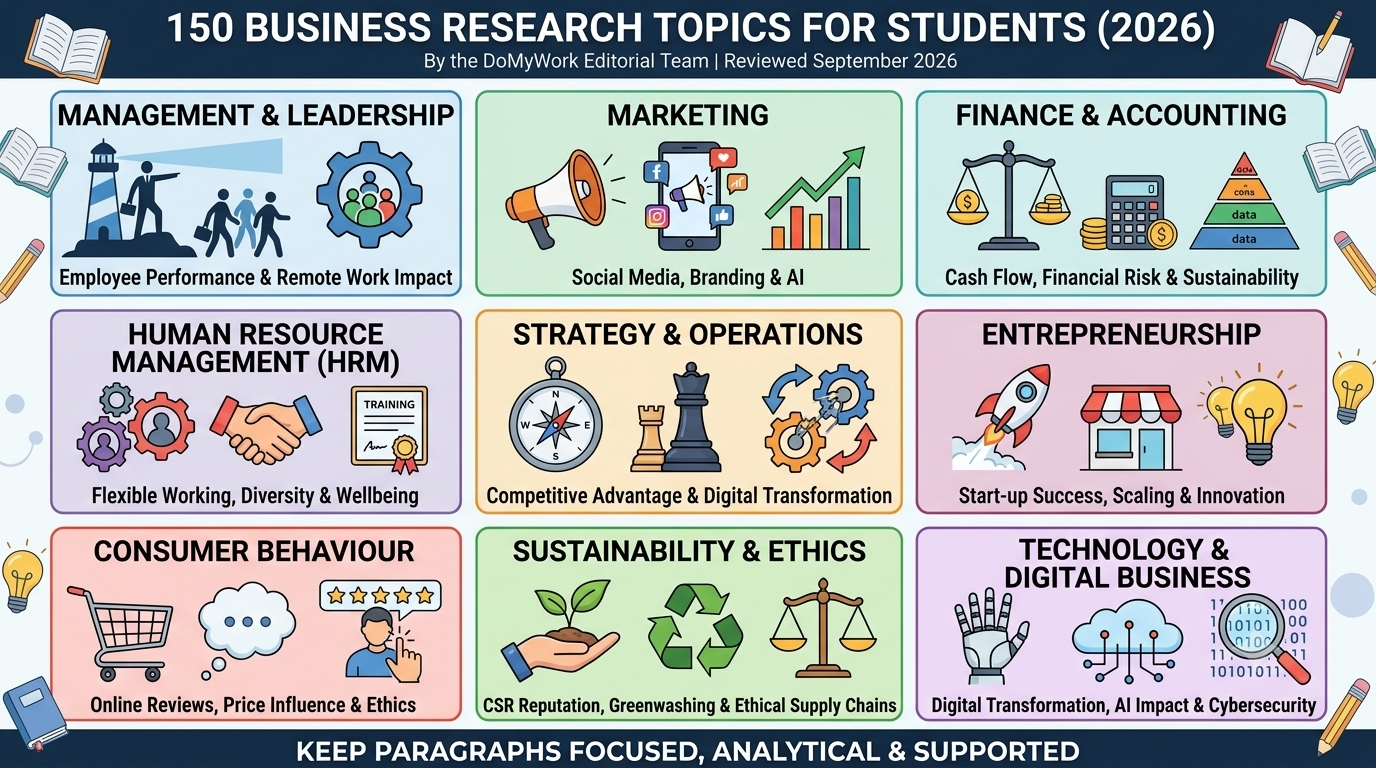
150 Business Research Topics for Students (2026)
A strong business research topic is specific, researchable and relevant to current practice, focused on a clear relationship you can study with data. Good areas include management, marketing, finance, HR, strategy, operations and entrepreneurship. This guide gives 150 topics grouped by area, then shows how to shape one into a research question. Business is a broad, practical field, which makes it a rich source of research topics but easy to pick something too general. The best topics focus on a specific relationship you can study with data, and connect to current business practice. This guide gives 150 business research topics grouped by area, then shows how to shape one into a research question. For a dissertation-length project, our business dissertation topics guide develops these further with research aims, and our how to write a literature review guide helps you build the study. What makes a good business research topic? A good business topic focuses on a specific relationship, such as how one business factor affects an outcome, rather than a broad area. It is grounded in a definable context, a sector, a type of company or a market, which keeps the scope manageable and the data reachable. And it connects to current practice or a gap in the research, which gives the work relevance. The most common mistake is choosing something too broad, such as marketing, when a focused topic like how social media marketing affects small-business sales gives you a clear question to research. Narrow every idea to that level. 150 business research topics by area The topics below are grouped by area. Narrow any of them to a specific context and relationship you can research. Management and leadership ● How leadership style affects employee performance. ● The impact of remote work on management. ● How organisational culture drives success. ● The role of emotional intelligence in leadership. ● How managers handle change. ● The effect of leadership on employee retention. ● How management style affects innovation. ● The impact of flat versus hierarchical structures. ● How managers motivate teams. ● The role of trust in management. ● How leadership affects workplace wellbeing. ● The impact of digital tools on management. ● How decision-making styles affect outcomes. ● The role of middle managers is changing. Marketing ● How social media marketing affects sales. ● The impact of influencer marketing on trust. ● How branding builds customer loyalty. ● The effect of personalisation on buying. ● How content marketing drives awareness. ● The role of storytelling in advertising. ● How online reviews affect purchases. ● The impact of AI on marketing. ● How sustainability messaging affects buyers. ● The role of emotion in advertising. ● How loyalty programmes affect retention. ● The effect of digital advertising on privacy. ● How brands manage a crisis. ● The impact of user-generated content. Finance and accounting ● How financial literacy affects business survival. ● The impact of cash flow on small businesses. ● How firms manage financial risk. ● The role of ratio analysis in decisions. ● How access to finance affects growth. ● The impact of interest rates on investment. ● How firms use budgeting effectively. ● The role of financial reporting in trust. ● How firms manage debt. ● The effect of pricing strategy on profit. ● How sustainability affects investment. ● The impact of financial planning on SMEs. ● How cryptocurrency affects business finance. ● The role of auditing in accountability. Human resource management ● How training affects employee performance. ● The impact of flexible working on productivity. ● How reward systems affect motivation. ● The role of HR in employee wellbeing. ● How recruitment affects business success. ● The effect of workplace culture on retention. ● How performance appraisal affects behaviour. ● The impact of diversity on team performance. ● How HR manages remote teams. ● The role of employee engagement in productivity. ● How work-life balance affects staff. ● The impact of leadership on HR outcomes. ● How HR supports change management. ● The effect of burnout on the workforce. Strategy and operations ● How strategy affects business growth. ● The impact of digital transformation on strategy. ● How firms build competitive advantage. ● The role of innovation in strategy. ● How operations affect efficiency. ● The impact of supply chain disruption. ● How firms manage risk strategically. ● The role of data in strategic decisions. ● How lean management affects performance. ● The effect of sustainability on strategy. ● How firms respond to competition. ● The impact of globalisation on strategy. ● How quality management affects operations. ● The role of forecasting in operations. Entrepreneurship and small business ● How small businesses achieve growth. ● The factors behind start-up success.
Read more

