
Ready by 7:11pm Oct 24, 2026
How to Answer a Law Problem Question Using IRAC (With a Worked Example)
Problem questions are where law students win or lose the most marks, and where the gap between knowing the law and applying it shows up most clearly. You can memorise every case on the syllabus and still score a 2:2 if you cannot spot the issues in the scenario and advise the parties. The IRAC method is the framework that keeps your answer structured, complete and focused on exactly that — application.
This guide explains what IRAC is, walks through a short worked example, and shows how a problem question differs from an essay question at UK law schools.
What is a problem question testing?
An essay question asks you to argue or evaluate a point of law. A problem question does something different: it gives you a factual scenario, usually with named characters, and asks you to advise one of them. The skill being marked is issue-spotting and application. Can you read a messy set of facts, identify the legal disputes that genuinely arise, pull in the right rules, and reason your way to advice? Reciting the law is only the raw material. The marks are in what you do with it.
What does IRAC stand for?
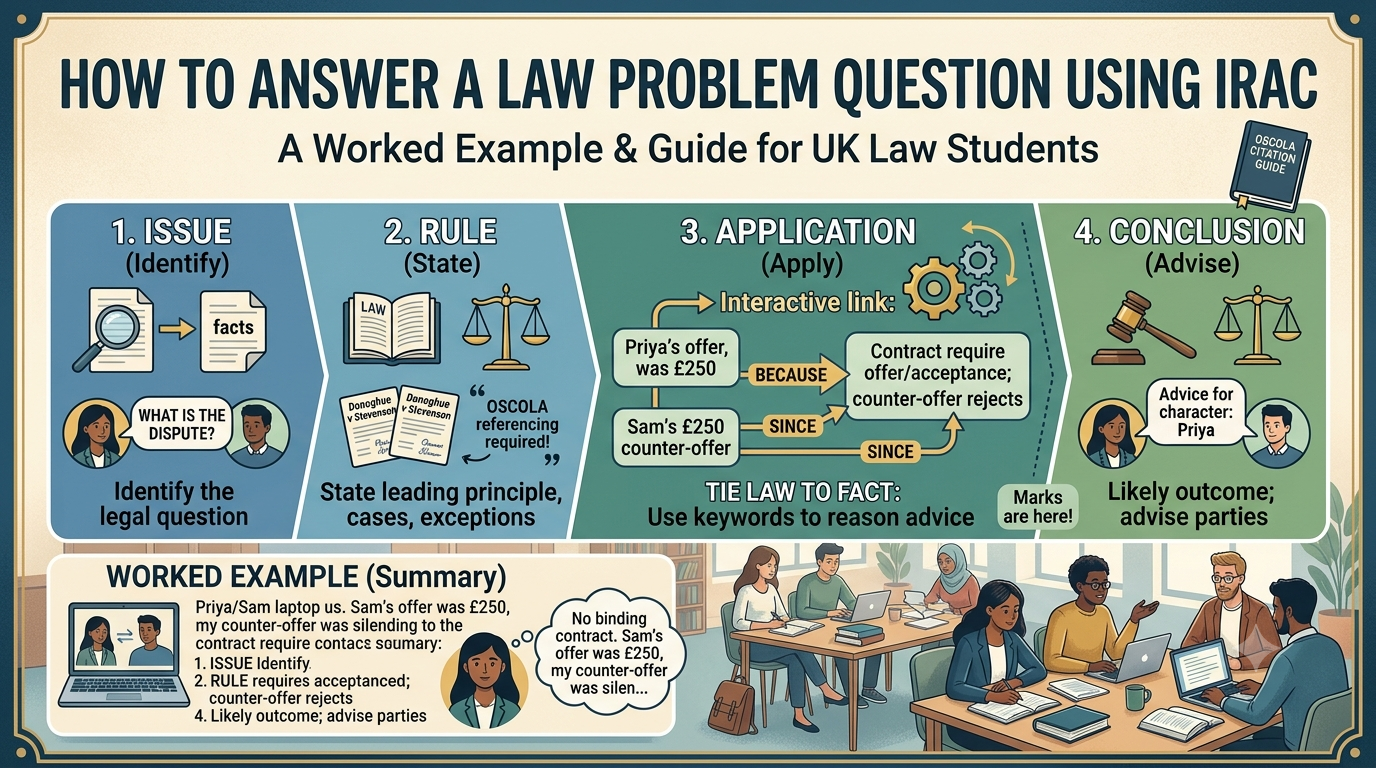
IRAC breaks your answer into four moves, repeated for each issue you spot.
| Step | What you do |
|---|---|
| Issue | Name the specific legal question the facts raise. Be precise — “is there a valid contract?” not “what happens next?” |
| Rule | State the relevant law: the principle, the leading case or statute, and any exceptions. |
| Application | Apply that rule to these facts. This is the largest part and where most marks sit. Use words like “because” and “since” to tie law to fact. |
| Conclusion | State the likely outcome for the party you are advising. Where the law is uncertain, give the alternatives. |
A short worked example
Scenario: Priya offers to sell her laptop to Sam for £300. Sam replies, “I’ll take it for £250.” Priya says nothing. Sam later insists there is a binding contract at £250. Advise Priya.
Issue — Is there a binding contract between Priya and Sam, and if so, on what terms?
Rule — A valid contract requires offer, acceptance, consideration and intention to create legal relations. A counter-offer rejects and destroys the original offer rather than accepting it, so no contract forms on the original terms unless the counter-offer is itself accepted.
Application — Priya’s offer was to sell at £300. Sam’s reply of £250 is not an acceptance because it changes a material term; it is a counter-offer, which extinguishes Priya’s original £300 offer. Priya’s silence does not amount to acceptance of the £250 counter-offer, because acceptance generally cannot be inferred from silence alone.
Conclusion — There is no binding contract. Priya is not obliged to sell at £250, and her original £300 offer no longer stands for Sam to accept.
Notice that the analysis never just states the law and stops. Every rule is immediately pinned to the facts. That is the habit examiners reward.
How is this different from a law essay question?
Essay questions want a thesis, an argument and evaluation of competing views — the same critical-analysis skills that separate a First from a 2:1 in any subject. If your course mixes both formats, our guide on how to write a First-Class essay covers the essay side, and our breakdown of what UK markers actually look for explains how analysis, structure and use of authority translate into grade bands. Problem questions borrow the same analysis skill but aim it at a scenario rather than a debate.
Common mistakes that cost marks
The biggest is stating the law without applying it — long paragraphs of rules with no link to the facts read like revision notes, not advice. Close behind is poor issue-spotting, where students either miss an issue entirely or invent disputes the facts do not raise. Others forget to actually advise the named party, ignore the counter-arguments the other side would run, or bury a clear conclusion under hedging. Deal with each issue in its own IRAC block and the structure stays clean.
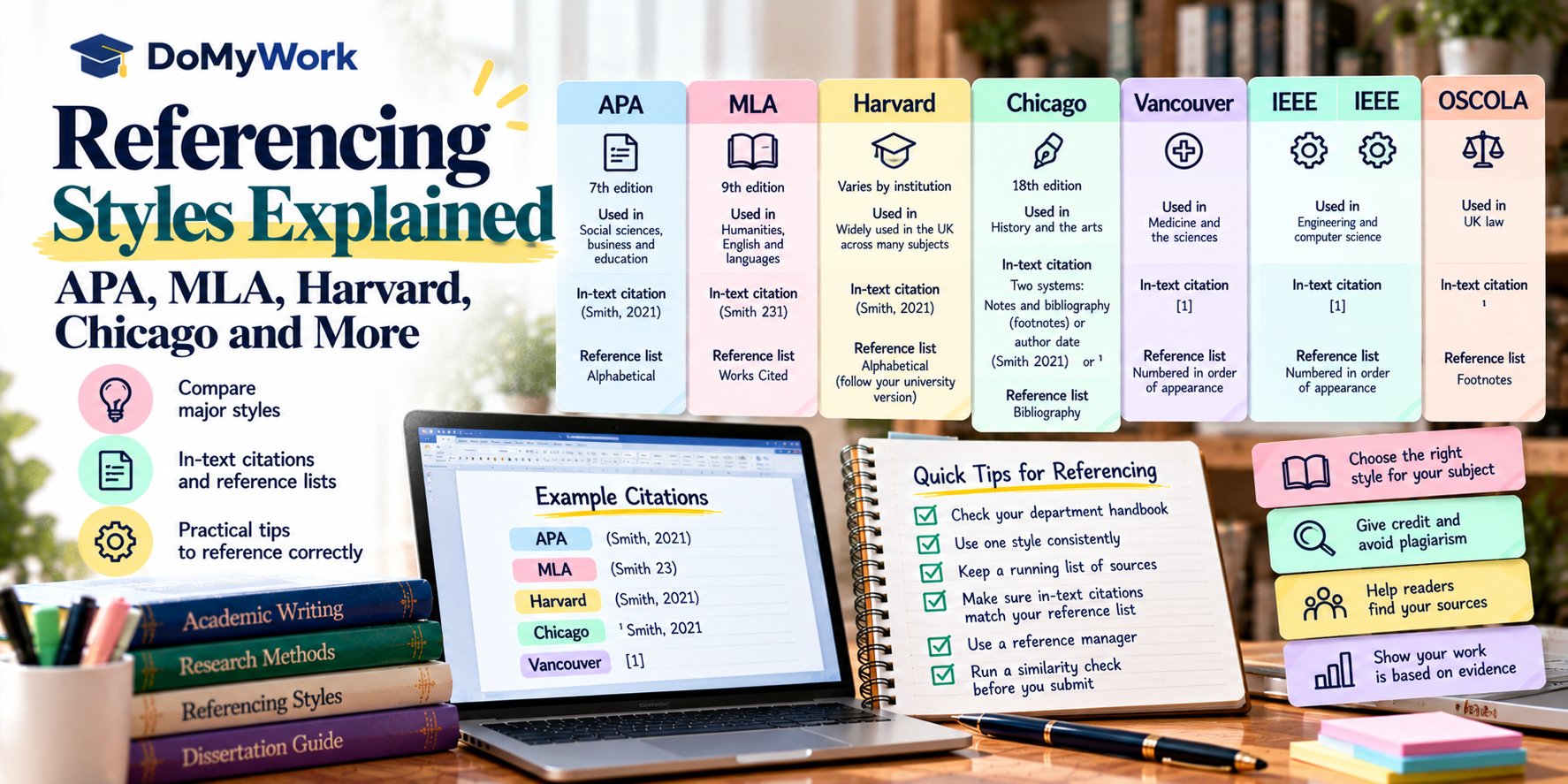
On referencing, note that UK law uses OSCOLA, not Harvard, so cases and statutes go in footnotes. Get the format right early — it is straightforward marks.
Facing a tricky problem question, or want a worked model answer in your subject to learn the method from? DoMyWork’s law assignment help is written by law specialists and delivered as original reference and study material you can check your own reasoning against. You can also confirm your final draft is clean with the $5 Turnitin Plag Check before you submit.
Frequently asked questions
Do I need an introduction in a law problem question?
Usually not. A problem question rewards getting straight to the first issue. A one-line signpost of the issues can help, but a long essay-style introduction earns no marks.
What is the difference between IRAC and ILAC?
They are the same framework. ILAC uses “Legal application” and some courses use IPAC (Issue, Principle, Application, Conclusion). Whatever the label, the structure is identical.
How do I reference cases and statutes?
UK law schools almost always require OSCOLA, which uses footnotes. Cite the full case and citation first, then a short form afterwards, and follow your law school’s OSCOLA guide for the exact format.
Popular posts
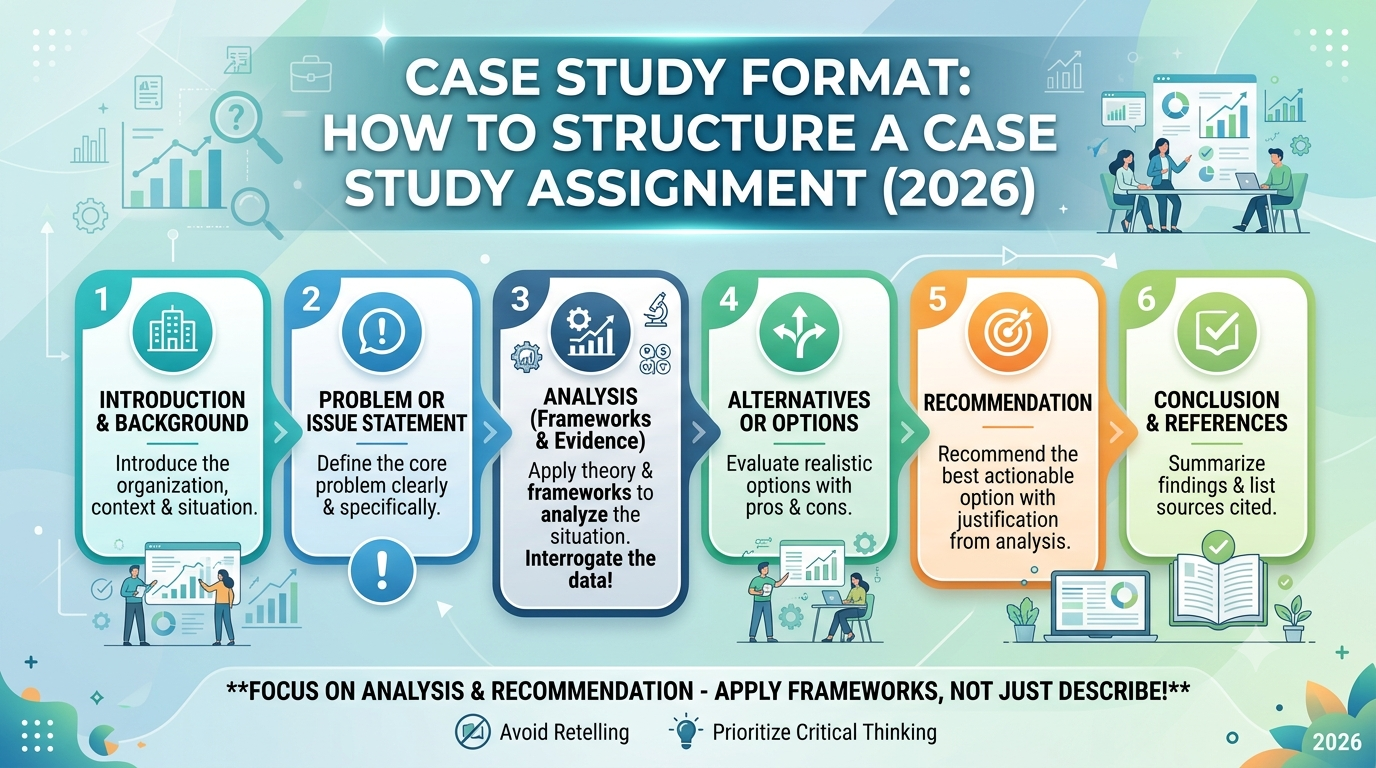
Case Study Format: How to Structure a Case Study Assignment (2026)
August 25, 2026
Harvard Referencing Made Simple: The Only Guide You Will Need in 2026
May 12, 2026

120+ Business Dissertation Topics and Ideas for 2026
March 2, 2026

How to Write a SWOT Analysis for an Assignment (with Example, 2026)
August 24, 2026
How to Write an Annotated Bibliography (with Example, 2026)
September 1, 2026

Want more tips & great deals? Get them sent to your inbox
Please enter a valid E-mail
By clicking "Subscribe" you agree to be contacted via e-mail. You can always unsubscribe from the newsletter


