
Ready by 1:24pm Oct 6, 2026
7 Best Note-Taking Methods for Students (with Examples, 2026)
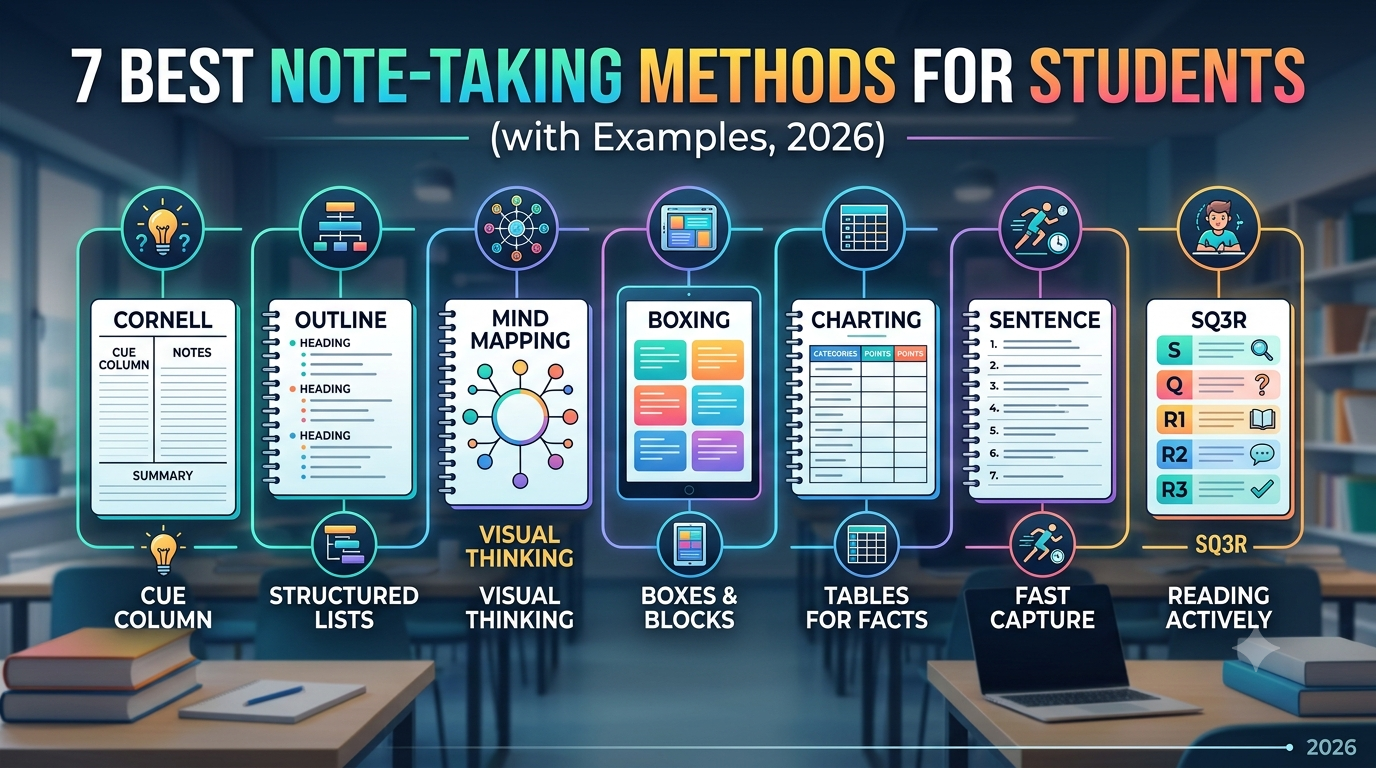
The best note-taking methods are the Cornell method, the outline method, mind mapping, the boxing method, the charting method, the sentence method, and the SQ3R method. The right one depends on the subject and setting: Cornell suits lectures and revision, outlines suit structured topics, and mind maps suit visual or linked ideas. Good notes are selective and reviewed, not word-for-word.
Note-taking is one of the highest-return study skills, yet most students are never taught a method and simply try to write down everything. That leaves you with pages you never reread and little understanding. This guide explains seven proven note-taking methods, when each works best, and how to choose, so you can capture ideas in a way that actually helps you learn and revise.
What are the best note-taking methods?
There is no single best method; the strongest choice depends on the material and how you will use the notes. The table below summarises the seven methods and where each fits.
| Method | Best for | How it works, in short |
| Cornell | Lectures and revision | Split the page into cues, notes and a summary |
| Outline | Structured, hierarchical topics | Headings and indented sub-points |
| Mind mapping | Visual thinkers, linked ideas | A central idea with branching connections |
| Boxing | Digital notes, separate themes | Group related notes into boxes or blocks |
| Charting | Comparisons and lots of facts | A table with columns for each category |
| Sentence | Fast-paced lectures | One idea per numbered line |
| SQ3R | Reading and textbooks | Survey, Question, Read, Recite, Review |
1. The Cornell method
The Cornell method divides your page into three areas: a narrow left column for cues or questions, a wide right column for your notes during the lecture, and a strip along the bottom for a short summary written afterwards. During class you take notes on the right; soon after, you add key questions or keywords in the cue column and a summary at the bottom. It is powerful because the review step is built in, and the cue column turns your notes into self-test prompts. It suits lectures and revision better than almost any other method.
2. The outline method
The outline method uses headings and indented sub-points to capture the structure of a topic. Main points sit at the left margin, with supporting detail indented beneath them, so the hierarchy of ideas is visible at a glance. It is quick, tidy, and ideal for well-structured material such as a clearly organised lecture or textbook chapter. It works less well when a session jumps around, since it relies on a logical order you can follow in real time.
3. Mind mapping
A mind map places the central topic in the middle of the page, with related ideas branching outwards and sub-ideas branching from those. It suits visual thinkers and any subject where ideas connect in a web rather than a list, such as brainstorming an essay or linking themes across a topic. Mind maps are excellent for seeing the big picture and making connections, though they are harder to use for dense, detailed information that needs to be recorded in order.
4. The boxing method
The boxing method groups related notes into separate boxes or blocks on the page, one theme per box. It has become popular for digital note-taking on tablets, where boxes are easy to move and resize. It keeps distinct topics visually separate, which makes later review and revision easier, and works well when a session covers several loosely related themes you want to keep apart.
5. The charting method
The charting method records information in a table, with columns for the categories you are comparing and rows for each item or point. It is the best choice when you have a lot of facts to compare, such as theories, dates, or the features of different models, since it forces the information into a structure you can scan quickly. It needs a little planning, because you have to know your columns in advance, so it suits material you can anticipate.
6. The sentence method
The sentence method is the simplest: write each new idea on its own numbered line as you hear it. It lets you capture a lot quickly in a fast-paced lecture where more structured methods cannot keep up. The trade-off is that it produces long, loosely organised notes, so it works best as a fast capture that you tidy or convert into another format afterwards.
7. The SQ3R method
SQ3R is a reading and note-taking method for textbooks, standing for Survey, Question, Read, Recite and Review. You first survey the chapter to get an overview, turn headings into questions, read to answer them, recite the answers in your own words, and review at the end. It is less about the layout of your notes and more about reading actively, which makes it excellent for getting more out of dense academic reading rather than passively highlighting.
How do you choose a note-taking method?
Match the method to the material and how you will use the notes, and do not be afraid to combine them.
- For lectures you will revise from, use Cornell, so review and self-testing are built in.
- For structured topics, use the outline method for speed and clarity.
- For linked or visual ideas, use a mind map.
- For comparisons and fact-heavy material, use charting.
- For fast lectures, use the sentence method, then rewrite into a cleaner format later.
- For textbook reading, use SQ3R to read actively.
Whatever method you choose, the two habits that matter most are being selective, capturing ideas rather than transcribing, and reviewing your notes soon after, since notes you never reread do little. Good notes also make later work faster, from planning an essay to building a reference list, which connects to how you structure an assignment and cite your sources.
Common note-taking mistakes
- Trying to write down everything word-for-word instead of capturing key ideas.
- Never reviewing your notes, so the information is not retained.
- Using one method for everything, even when it does not fit the material.
- Passive highlighting instead of putting ideas in your own words.
Better notes support every stage of study. If you would like help turning your research and notes into a strong piece of work, our assignment writing help and essay writing help services can support you.
Frequently asked questions
What are the best note-taking methods?
The most effective are the Cornell method, the outline method, mind mapping, the boxing method, the charting method, the sentence method, and SQ3R. The best one depends on the subject and how you will use the notes.
What is the Cornell note-taking method?
A method that splits the page into a cue column, a notes column and a summary strip. You take notes during class, then add cues and a summary afterwards, which builds in review and self-testing.
Which note-taking method is best for lectures?
The Cornell method is often best for lectures you will revise from, because the cue column and summary build review in. The sentence method suits very fast lectures where you need to capture quickly.
How can I take better notes?
Be selective and capture key ideas rather than transcribing, choose a method that fits the material, put ideas in your own words, and review your notes soon after to help them stick.
Popular posts

Can Students Access Turnitin Without Their University? Here Is the Truth
April 15, 2026
Quoting, Paraphrasing and Summarising: How to Use Sources Well
July 22, 2026
How to Write Dissertation Acknowledgements
September 23, 2026
Harvard Referencing Made Simple: The Only Guide You Will Need in 2026
May 12, 2026
Want more tips & great deals? Get them sent to your inbox
Please enter a valid E-mail
By clicking "Subscribe" you agree to be contacted via e-mail. You can always unsubscribe from the newsletter


