
Ready by 2:59am Sep 23, 2026
How to Structure a University Assignment: Formats That Win Marks
A university assignment follows a clear three part shape: an introduction that states your argument, a body that develops it in focused paragraphs, then a conclusion that ties it back to the question. Get that structure right and you make the marker’s job easy, which is what moves a piece from a 2:2 into 2:1 or first class territory.
Most marks lost in undergraduate work are not lost on ideas. They are lost in shape. A student can know the material well, yet bury the argument so deeply that the marker never sees it. This guide walks through the structure that works for almost every brief, then shows where the shape shifts for reports, reflective pieces, then case studies.
What is the basic structure of a university assignment?
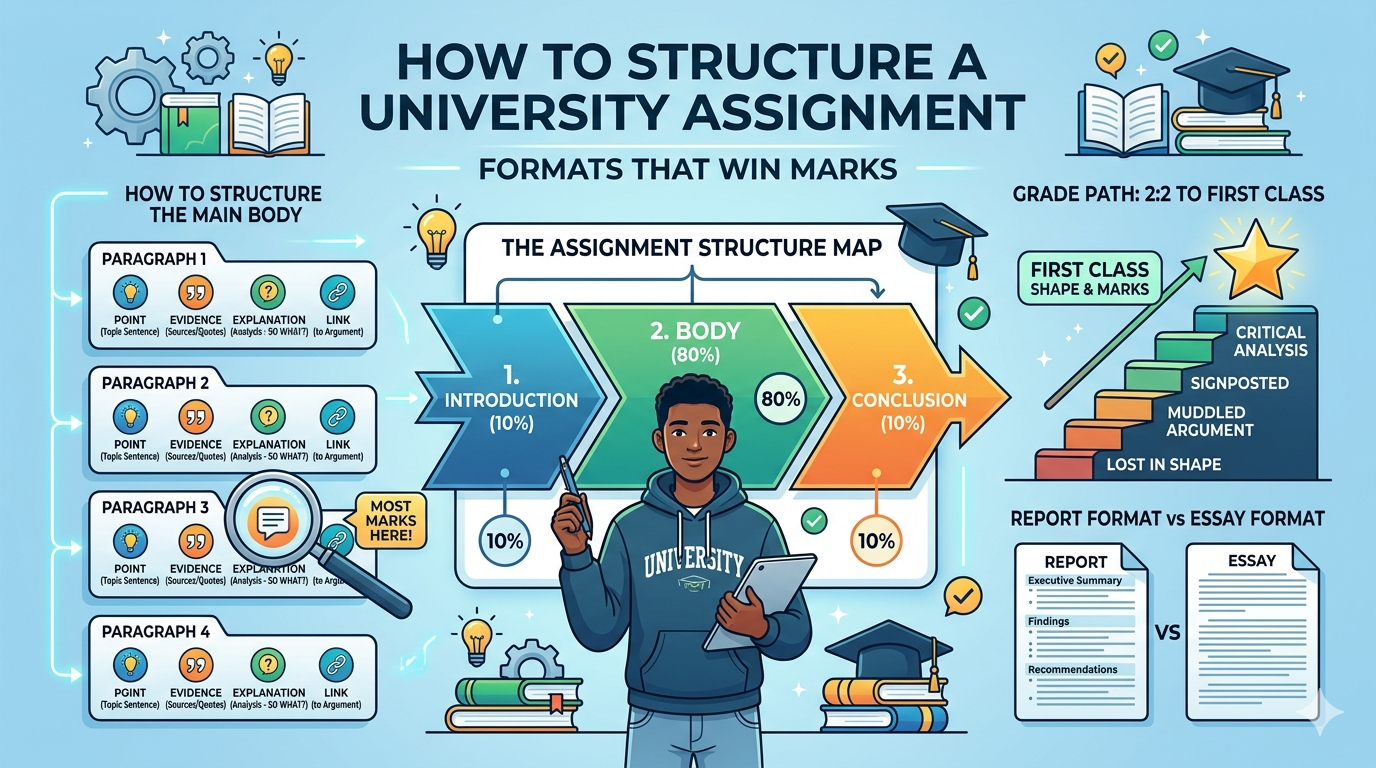
Every standard assignment has three parts that carry roughly fixed proportions. The introduction takes about 10 per cent of your word count. The main body takes around 80 per cent. The conclusion takes the final 10 per cent. For a 2,000 word assignment that means a 200 word introduction, 1,600 words of body, then a 200 word conclusion.
Those proportions matter because markers read for signposting. They want to know your position early, see it built with evidence in the middle, then watch you land it at the end. When a body section swells to fill the introduction’s job, or a conclusion smuggles in new arguments, the reader loses the thread. Holding the proportions keeps your argument visible from the first line to the last.
How do you write an introduction that sets up the marks?
A strong introduction does three jobs in a short space. It frames the topic, states your central argument or thesis, then signposts the order of what follows. Think of it as a map handed to the reader before the journey starts.
First, frame the topic. Open with the specific question or problem, not a broad historical sweep. A line such as “This assignment examines whether flexible working improves productivity in small firms” tells the marker exactly what is coming.
Then state your position. Even a balanced piece needs a thesis, a sentence that says where you will land. Finish the introduction by signposting the sections in order. This is the single fastest way to lift a muddled draft, because it forces you to decide your structure before you write the body. If you want to see how markers translate this into a grade, our guide to what UK university markers actually want breaks down the criteria line by line.
How should you structure the main body?
The body is where most of your marks live, so each paragraph needs to earn its place. The reliable pattern is one idea per paragraph, built with the PEEL shape: Point, Evidence, Explanation, then Link.
What does a PEEL paragraph look like?
Start with a topic sentence that states the point. Bring in evidence, a source, a statistic, or an example. Explain what that evidence means for your argument, which is the analysis markers reward most. Close with a link sentence that connects back to the question or forward to the next paragraph. The explanation step is where weaker work falls down. Describing a source is not the same as analysing it, so always push past “what” into “so what”.
How long should a paragraph be?
Aim for 150 to 200 words, roughly four to six sentences. A paragraph shorter than three sentences usually means the idea is underdeveloped. One that runs past 250 words often hides two separate points that should be split. Reading your body aloud is a quick test: if you run out of breath before the point lands, the paragraph is doing too much.
→ Need a model assignment to study from? Our assignment writing support builds reference answers structured to your exact brief, so you can see how a first class shape works before you write your own.
What makes a strong conclusion?
A conclusion synthesises, it does not summarise. Weak conclusions repeat the introduction in different words. Strong ones pull the threads together to show what the argument adds up to, then answer the question directly. Never introduce new evidence here. If a point matters enough to include, it belongs in the body.
A useful closing move is to state the limitation or the wider implication. A line such as “While the evidence supports flexible working in small firms, the picture may differ in regulated sectors” shows the marker you understand the boundaries of your own argument. That awareness reads as maturity, which sits at the top of most marking rubrics. You can see how this plays out across grade bands in our breakdown of how UK universities mark essays.
How does structure differ by assignment type?
The intro, body, then conclusion spine holds for most work, yet several common formats reshape it.
Reports
A report swaps flowing sections for labelled ones: executive summary, introduction, methodology, findings, discussion, recommendations, then references. Headings are expected, not optional. If your brief uses the word “report”, structure for scannability rather than continuous prose. Our guide to writing coursework that scores a first covers report formatting in more depth.
Reflective writing
Reflective assignments follow a model such as Gibbs, moving through description, feelings, evaluation, analysis, then an action plan. The argument is about your own learning rather than an external debate, so the first person is allowed here when it is rarely allowed elsewhere.
Dissertations and longer projects
A dissertation scales the same logic across chapters rather than paragraphs. Each chapter carries its own mini introduction then conclusion. If you are working toward one, our chapter by chapter walkthrough of dissertation structure shows how the shape expands.
How does good structure affect your grade?
Markers work on time. A clearly structured piece lets them find your argument, your evidence, then your analysis quickly, so they can award the marks you have earned. A disorganised piece forces them to hunt, and marks that are hard to find often go unawarded. Structure is not decoration. It is the delivery system for everything else you have done.
Before you submit, run a structure check. Read only your topic sentences in order. If they tell a coherent story on their own, your structure is sound. If they jump around, the body needs reordering before you worry about wording.
What is a quick structure checklist?
Run this five point check before you submit any assignment. It catches the structural faults that cost the most marks.
- Does the introduction state a clear thesis, then signpost the sections that follow?
- Does each body paragraph open with a topic sentence that makes one point?
- Does every paragraph move past description into analysis, the “so what”?
- Does the conclusion answer the question without introducing new evidence?
- Read in order, do your topic sentences alone tell a coherent story?
If any answer is no, fix the structure before you touch the wording. A well argued point in the wrong place still loses marks, while a plain sentence in the right place earns them. Shape first, polish second.
→ Want your draft checked before it counts? Run a fast Turnitin similarity and AI report to confirm your originality, or order a model answer built to your marking criteria.
Frequently asked questions
How do I structure a 2000 word assignment?
Use roughly 200 words for the introduction, 1,600 for the body across eight to ten PEEL paragraphs, then 200 for the conclusion. State your argument early, develop one idea per paragraph, then synthesise at the end without adding new evidence.
Should a university assignment have headings?
Essays usually flow without headings, while reports, reflective pieces, then case studies expect them. Check your brief. If it asks for a report, use clear labelled sections; if it asks for an essay, signpost with topic sentences instead.
What is the PEEL structure?
PEEL stands for Point, Evidence, Explanation, then Link. It is a paragraph pattern that keeps each point focused: state the point, support it with evidence, explain what the evidence means, then link back to your argument.
How long should an assignment introduction be?
Around 10 per cent of the total word count. For a 2,000 word assignment that is roughly 200 words, enough to frame the topic, state your thesis, then signpost your sections.
Popular posts
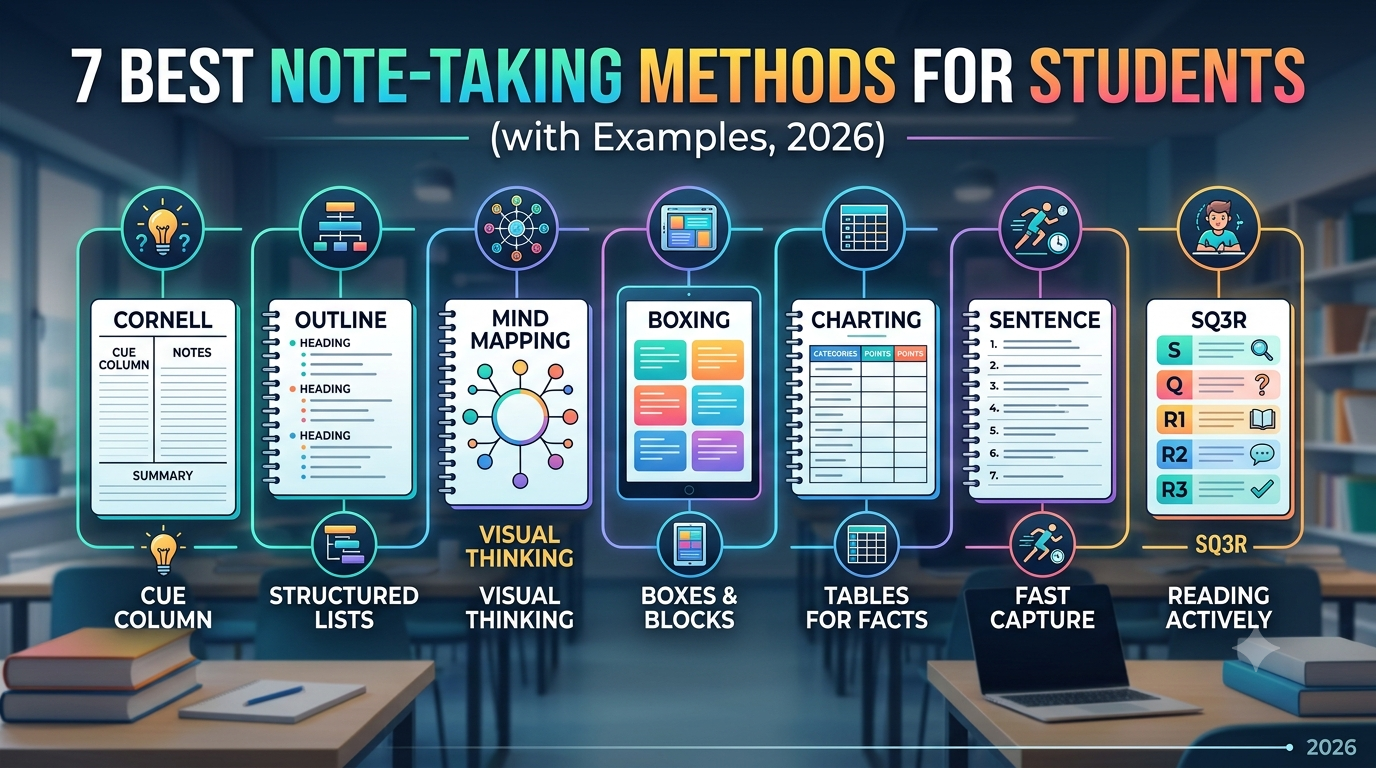
7 Best Note-Taking Methods for Students (with Examples, 2026)
August 21, 2026

How to Write a PESTLE Analysis for an Assignment (with Example, 2026)
August 23, 2026

Harvard Referencing Made Simple: The Only Guide You Will Need in 2026
May 12, 2026
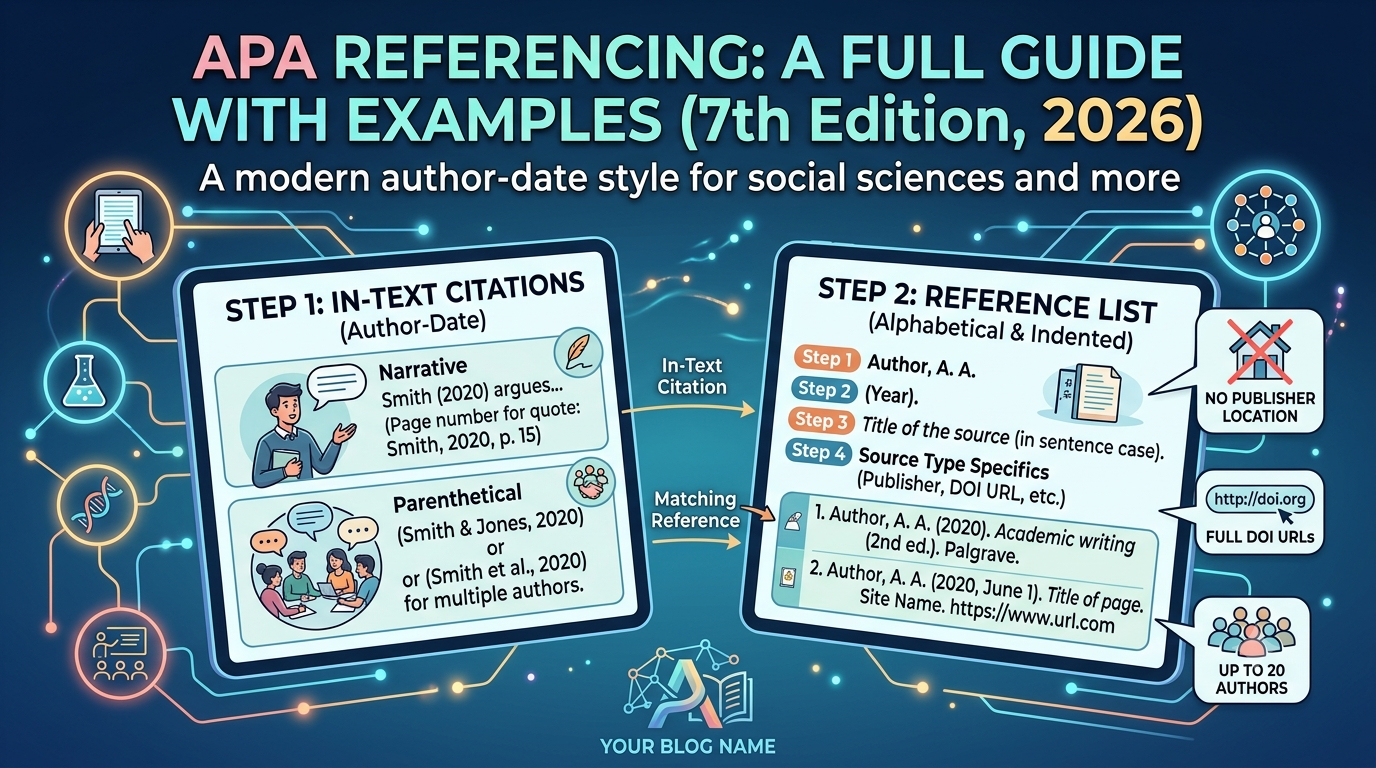
APA Referencing: A Full Guide with Examples (7th Edition, 2026)
September 2, 2026

What Is a Good Turnitin Similarity Score? Percentages Explained (2026)
June 8, 2026
Want more tips & great deals? Get them sent to your inbox
Please enter a valid E-mail
By clicking "Subscribe" you agree to be contacted via e-mail. You can always unsubscribe from the newsletter


