
Ready by 6:02pm Sep 23, 2026
What Is a Capstone Project? Types and Examples
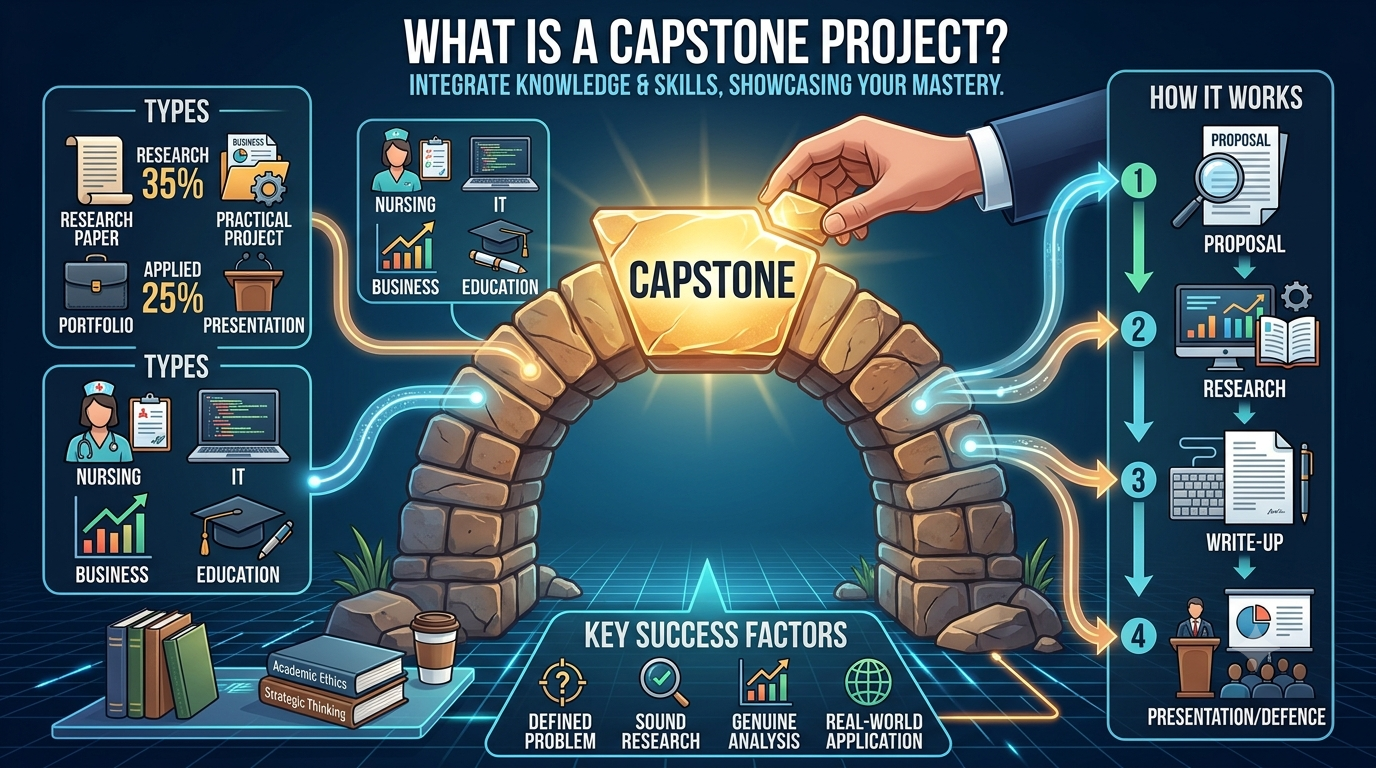
A capstone project is a final piece of work that pulls together everything you learned on your course to solve a real problem. It is common in US programmes and in applied subjects. Unlike a dissertation, it is usually applied and practical rather than purely research based, and you choose the problem yourself.
The word capstone confuses a lot of students, especially those moving between the UK and US systems, because it means slightly different things in different places. At its core, though, a capstone is the same idea everywhere: a final project that proves you can put your whole course to work on something real.
What makes a capstone different from other assignments?
Three things set a capstone apart.
- It is integrative. It draws on your whole course, not one topic.
- It is applied. It solves a real problem rather than answering a set essay question.
- It is independent. You choose the problem and drive the work, where a normal assignment hands you the question.
That independence is the point. The capstone is your chance to show you can work like a professional in your field, making the decisions yourself rather than following a brief.
Why do programmes use capstone projects?
Capstones exist to bridge the gap between studying a subject and doing the job. A traditional exam or essay tests whether you understood the material. A capstone tests whether you can use it, which is what employers actually care about.
That is why they are so common in applied and professional fields. A nursing capstone shows you can improve real patient care. A computer science capstone shows you can build something that works. A business capstone shows you can solve a real commercial problem. In each case, the finished project becomes something you can point to and say, I did this, which is far more useful in an interview than a grade on a transcript.
How is a capstone different from a dissertation?
| Capstone | Dissertation | |
|---|---|---|
| Main aim | Solve a real, applied problem | Answer a research question |
| Style | Practical and professional | Academic and research led |
| Output | A solution, plan, or product | A written research study |
| Common in | US programmes, applied subjects | UK and most research degrees |
| Length | Often shorter | Usually longer |
The two overlap, and some programmes use the words loosely, so always check what your own course means by capstone before you start.
Where does the word capstone come from?
The name is a useful clue to what the project is. A capstone is the final stone placed at the top of a building, the one that locks all the others in place and finishes the structure. A capstone project does the same thing for your degree. It sits at the end and pulls everything together.
That image explains why capstones are integrative by design. They are not meant to test one new thing you learned last term. They are meant to test whether you can bring your whole course to bear on a single real problem, which is exactly what you will have to do once you are working. Keeping that picture in mind helps when you choose a topic, because the best capstones genuinely draw on the breadth of what you studied.
What subjects use capstone projects?
Capstones appear across applied disciplines, where showing you can do the job matters as much as knowing the theory.
- Nursing programmes use them to turn evidence into practice, often paired with nursing paper support.
- Information technology and computer science use them to build or evaluate a system.
- Business and MBA programmes use them for strategy, market analysis, or a business plan, which our MBA guide covers.
- Education, aviation, and public health all use capstones too.
What are the types of capstone projects?
Capstones take different forms depending on the field, but most fall into a few types.
- A research project, which is closest to a small dissertation.
- A practical build, such as a working system or prototype.
- A business or strategy project, solving a real problem for a real organisation.
- A portfolio, pulling together work that shows your skills across the course.
How do you approach a capstone?
Most capstones come with a supervisor or advisor who signs off your proposal and gives feedback at set points. The structure below fits most applied capstones.
- Choose a real problem you care about and can actually study or solve.
- Write a proposal setting out the problem, your approach, and your goal.
- Do the work, checking in with your advisor at the agreed points.
- Present your solution, often with a report and sometimes a presentation.
- Reflect on what worked, what did not, and what you would do differently.
What are examples of capstone projects?
Real examples make the idea concrete. Each of these solves a real problem and draws on a whole course rather than one module.
- Nursing: designing and evaluating a plan to reduce patient falls on a hospital ward.
- Computer science: building a working app that solves a specific user problem.
- Business: creating a full market entry strategy for a real company.
- Education: designing and testing a new teaching approach for a specific group.
- Public health: developing a community programme to address a local health issue.
In every case, the point is the same. You identify a problem, apply what you learned, and produce something that could actually be used.
How is a capstone graded?
Capstones are usually graded on how well you solved the problem, not just on what you wrote. Assessors tend to look at a few things.
- The problem. Was it real, clear, and worth solving?
- The approach. Did your method suit the problem, and did you justify it?
- The solution. Does it actually work, and is it practical?
- The reflection. Do you understand what worked, what did not, and why?
That last point surprises students. A capstone that honestly reflects on what went wrong often scores better than one that pretends everything went perfectly, because reflection shows real professional judgement.
How do you choose a capstone topic?
A good capstone topic sits where your interest, your course, and a real problem meet. Choose something you can genuinely study or solve in your time frame, with access to whatever people, data, or setting it needs. As with a dissertation, a narrow, specific problem beats a broad one every time.
How long does a capstone take to complete?
A capstone usually runs across a full term or semester, with set milestones along the way rather than one final deadline. The exact timeline depends on your programme, but most follow a similar shape.
You typically spend the early weeks choosing your problem and writing a proposal, the middle stretch doing the actual work with check-ins from your advisor, and the final weeks producing your report and, in many cases, a presentation. Because the work is spread out, the students who struggle are usually the ones who treat the early milestones as unimportant and leave everything to the end. The steady approach wins, because a capstone rewards consistent work far more than a last minute sprint, and your advisor’s feedback at each stage is most useful when you actually have time to act on it.
Ready to develop your capstone project? Let our experts help.
Once you’ve chosen your topic, the next step is turning your idea into a structured project with clear research, analysis and presentation. Explore our capstone project writing support for guidance throughout your project.
Frequently asked questions
What is a capstone project in simple terms?
A final project that pulls together everything from your course to solve a real problem. It is usually applied and practical, and you choose the problem yourself.
Is a capstone the same as a dissertation?
No, though they overlap. A capstone is usually applied and practical, aimed at solving a real problem. A dissertation is research led, aimed at answering a research question.
How long is a capstone project?
It is often shorter than a dissertation, but this varies by programme. Always check your own course requirements, because the word is used loosely.
What subjects use capstones?
Applied fields, including nursing, IT, computer science, business, MBA, education, aviation, and public health.
Do I choose my own capstone topic?
Usually yes. Choosing the problem is part of the point, because a capstone is meant to show you can work independently like a professional.
Popular posts

Can Students Access Turnitin Without Their University? Here Is the Truth
April 15, 2026

Finance and Accounting Dissertation Topics You Can Actually Research
March 11, 2026
Dissertation Word Count: How Many Words Each Chapter Should Be
July 27, 2026
APA Referencing: A Full Guide with Examples (7th Edition, 2026)
September 2, 2026
How to Structure a University Assignment: Formats That Win Marks
June 23, 2026


Want more tips & great deals? Get them sent to your inbox
Please enter a valid E-mail
By clicking "Subscribe" you agree to be contacted via e-mail. You can always unsubscribe from the newsletter


