
Ready by 4:06pm Oct 24, 2026
Turnitin for a Full Dissertation: Checking 15,000 Words Before You Submit
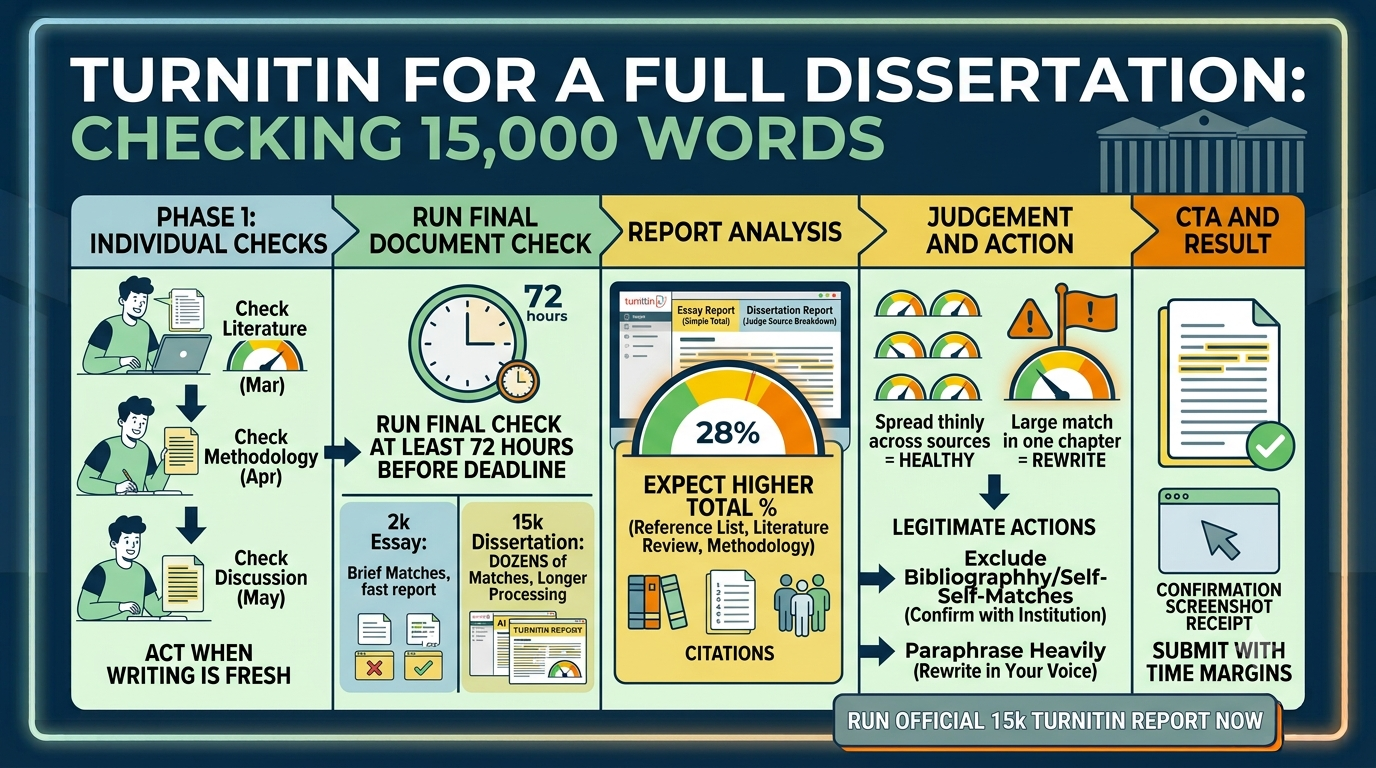
Turnitin treats a dissertation the same way it treats an essay, but the report reads differently. Expect a higher percentage, judge the source breakdown rather than the total, check each chapter as you finish it, then run the whole document at least 72 hours before your deadline.
How does Turnitin handle a 15,000 word document?
Mechanically, identically. It compares your text against archived student papers, licensed published material and the open web, then reports the passages that match. There is no separate dissertation mode and no different threshold.
What changes is the shape of the report. An essay generates a handful of matches you can read through in a minute. A dissertation generates dozens across dozens of sources, which makes the headline percentage close to useless and the source list the only view worth opening.
Processing time also changes, and this catches people out. Long documents take longer, and submission portals slow down as a deadline approaches because every student on the programme is uploading at the same time. If your plan depends on seeing a report before you commit, that plan needs hours of margin rather than minutes.
What similarity score should a dissertation get?
Higher than an essay, and that is expected rather than a problem. The reason is arithmetic. A 2,000 word essay might carry a dozen references. A 15,000 word dissertation carries sixty or more, and every one appears in a reference list that matches other reference lists, because author names and titles are fixed text that cannot be paraphrased.
That block alone accounts for several percentage points before you have written a sentence of your own argument. Add a literature review whose entire purpose is to engage with existing work, and a methodology describing a standard procedure that thousands of others have also described accurately, and a healthy dissertation can sit comfortably in a range that would look alarming on a short essay.
The judgement is the same as for any document, applied at scale. Open the breakdown, find the largest single source, and assess that. Twenty per cent spread across forty sources with nothing above two or three per cent each is a report doing its job. Twenty per cent where one source contributes most of it is a passage to rewrite, whatever the total says.
Why does my literature review match so much?
Because it is supposed to. A literature review quotes selectively, cites constantly and discusses work that other people have also discussed using the standard vocabulary of your field. It will always be your highest matching chapter, and a report where most of the matches sit there is usually behaving correctly.
The thing to look for inside that chapter is concentration. Many small matches across many sources means you are engaged with a wide literature. One large match against a single source means a passage leaned too heavily on one place, and that is worth rewriting whether or not anyone would ever have noticed.
Methodology is the second predictable source, for the same reason. There are only so many ways to describe a standard sampling approach accurately, and describing it accurately is what you are supposed to do. If you want a fuller explanation of why the percentage misleads, our guide to what a good similarity score means covers it.
Should I check chapter by chapter or all at once?
Both, in that order. Checking each chapter as you finish it is the more useful half, because the findings arrive while the writing is still fresh and while you still have months to act on them. A problem found in your literature review in March is a twenty minute fix. The same problem found in July is a crisis.
Then run the full document once at the end regardless, because chapter checks are blind to one specific risk. A phrase or a paragraph reused between two chapters written months apart will not appear in either individual check and will appear immediately when the whole document goes through together. Self-overlap across your own chapters is more common than most students expect, particularly between a literature review and a discussion that revisits the same debates.
Why did my dissertation match my own earlier draft?
Because that draft was archived. When work is submitted through an institution, it may be added to Turnitin’s repository of student papers depending on the settings your department uses. If a chapter went through a formative check with archiving on, and the finished dissertation goes through again at submission, the second check can match against the first.
Students see a large percentage, assume something has gone catastrophically wrong, and start rewriting work that was never a problem. Do not. Institutions can usually exclude a self-match once it is flagged, but only if you flag it, which means knowing this can happen before you see it.
The related point is storage, and it matters more for a dissertation than for anything else you will submit. If your work contains research heading to a journal, or a project you intend to develop further, having it sit permanently in a shared repository is a genuine consideration. Check how any check you run handles your file, and prefer one that deletes the document after producing the report.
When should you run the final check?
At least 72 hours before your deadline. Not because the check takes that long, but because the point of running it is to have time to act on what it says, and a report you receive two hours before submission is information you cannot use.
The sequence that works is to finish the document, do your formatting and referencing pass, then run the full check, then leave the three day gap. If it comes back clean, you have lost an hour. If it does not, you have the one thing that actually solves the problem, which is time.
You can run an official Turnitin report on a finished dissertation for five dollars without needing an institutional login, which is what makes checking before submission possible at all for most students. Our full submission checklist sets out where this fits alongside the other final checks.
What to do if the report comes back high
- Open the source breakdown before doing anything. The total tells you nothing on its own.
- Sort by size and look at the largest single source. If nothing is large, you are almost certainly fine.
- Check whether the matches are your bibliography, your quotations and your reference list. Where your institution allows exclusions, this alone can account for a large share of the figure.
- For any genuinely heavy passage, rewrite it properly in your own words and cite the source. Swapping synonyms leaves the sentence structure of the original intact, which is still the same problem.
- Never delete citations to lower the number. A long document with thin referencing reads as under-researched to a marker, and you create real plagiarism where there was none.
If the passage that needs rewriting is a whole chapter rather than a paragraph, and the deadline is close, that is worth handling directly rather than hoping. Our dissertation support works at chapter level, and if the timeline is already unrecoverable it is better to understand your extension options now than after the deadline.
Ready to take your dissertation further? Get specialist support.
From refining your research question and literature review to methodology, analysis and final structure, dissertation work requires careful planning at every stage. Explore our dissertation writing support for your research project.
Frequently asked questions
What is a normal Turnitin score for a dissertation?
Higher than for an essay, because of the reference list, the literature review and standard methodology descriptions. Judge the source breakdown rather than the headline figure. Matches spread thinly across many sources are healthy.
Can I run my dissertation through Turnitin myself?
Not usually through your university, which is why students check before submission using a service that returns the official report without an institutional login.
Does Turnitin keep a copy of my dissertation?
Institutional submissions are often added to the student paper repository, depending on your department’s settings. For unpublished research this is worth checking. A check that deletes your file after the report avoids the issue.
Why is my literature review matching so much?
Because it quotes, cites and discusses existing work using standard terminology for your field. It will always be your highest matching chapter. Look for concentration in a single source rather than at the chapter total.
How long before submission should I check my dissertation?
At least 72 hours. The value of the check is the time you have to act on it, and a report received hours before the deadline is information you cannot use.
Popular posts
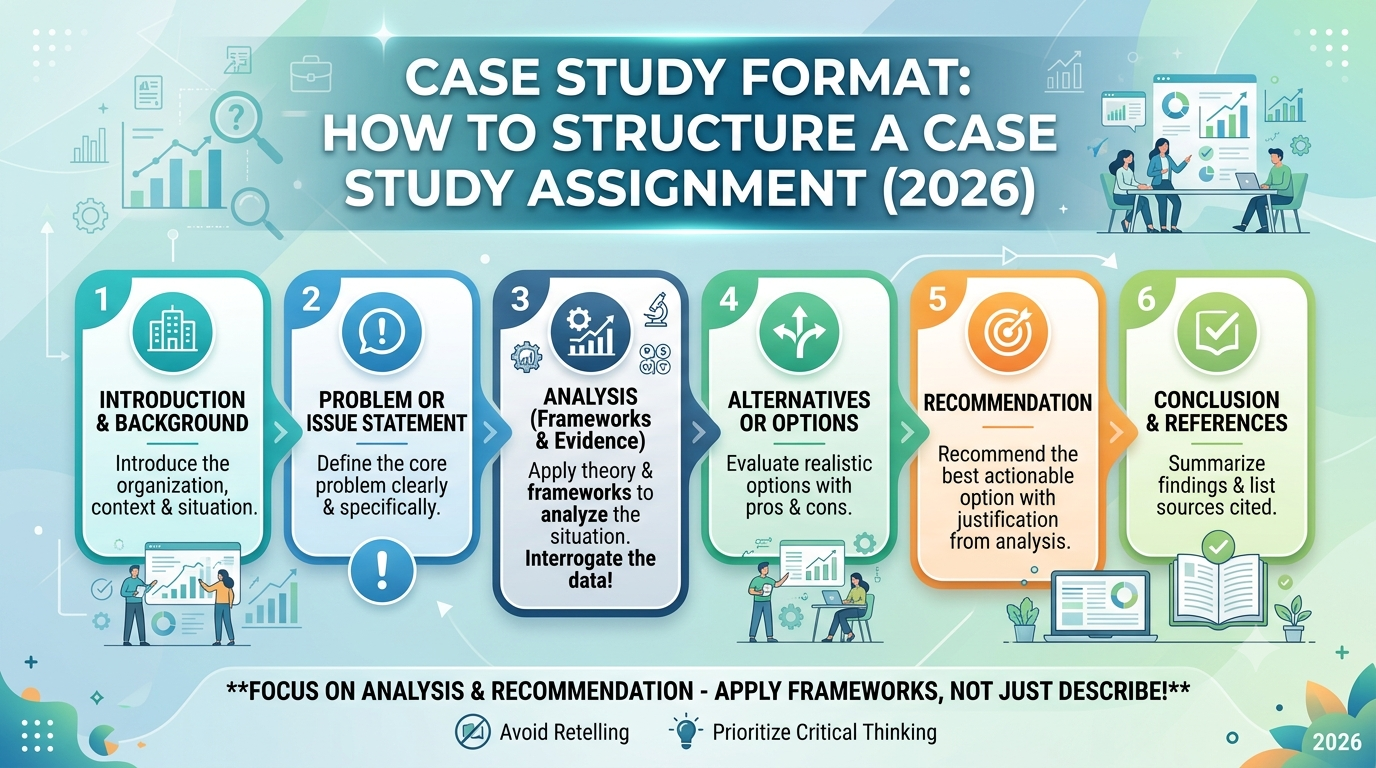
Case Study Format: How to Structure a Case Study Assignment (2026)
August 25, 2026
Harvard Referencing Made Simple: The Only Guide You Will Need in 2026
May 12, 2026

120+ Business Dissertation Topics and Ideas for 2026
March 2, 2026

How to Write a SWOT Analysis for an Assignment (with Example, 2026)
August 24, 2026
How to Write an Annotated Bibliography (with Example, 2026)
September 1, 2026
Want more tips & great deals? Get them sent to your inbox
Please enter a valid E-mail
By clicking "Subscribe" you agree to be contacted via e-mail. You can always unsubscribe from the newsletter


