
Ready by 8:54pm Oct 21, 2026
150 Social Issues Topics for Essays and Papers (2026)
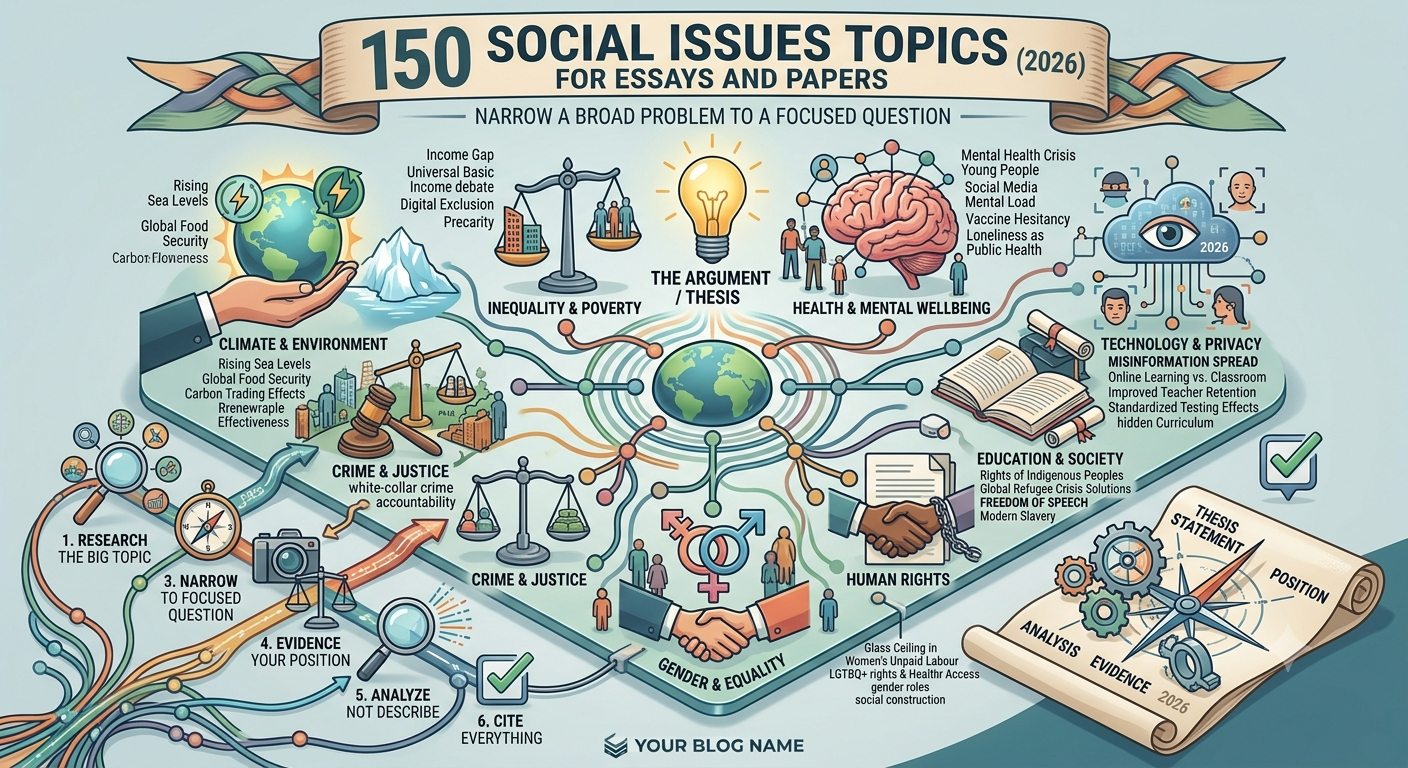
A strong social issues topic is current, arguable and backed by credible evidence. The most fruitful themes right now include climate and the environment, inequality and poverty, health and mental wellbeing, technology and privacy, education, human rights, and gender equality. Narrow a broad problem to a specific, researchable question rather than trying to cover the whole issue.
Social issues make some of the best essay and research paper subjects because they are current, contested and rich in evidence. That same richness is the trap, though: it is easy to pick a problem so broad that you can only describe it, when what earns marks is a focused, arguable question you can defend. A social issues essay is ultimately an argument, so the same habits that lift any essay, a clear position and genuine analysis rather than description, decide the grade here too, which is why it helps to keep the principles of critical writing in mind from the start. This guide sets out the major issues of the moment, gives 150 topics grouped by theme, and shows how to turn one into a strong essay.
The biggest social issues today
Before the full list, it helps to see the major issues shaping public debate right now, since a topic drawn from a live, evidence-rich issue is far easier to research and argue. The most prominent include:
- Climate change: Rising temperatures, extreme weather and the transition to cleaner energy continue to reshape economies and communities.
- Income inequality: The widening gap between rich and poor affects access to housing, education and health.
- Mental health: Rising rates of anxiety and depression, especially among young people, sit alongside gaps in access to care.
- Racial inequality: Disparities persist across education, employment, health and the justice system.
- Gender inequality: Pay gaps, unequal domestic labour and under-representation in leadership remain live concerns.
- Misinformation: False information spreading through social media fuels division on health, politics and science.
- Data privacy: The collection and use of personal data raises growing questions about consent and surveillance.
- Healthcare access: Unequal access to care, within and between countries, remains a major fault line.
- The housing crisis: Rising costs and limited supply push home ownership and secure renting out of reach for many.
- Migration: Conflict, economics and climate drive movement that reshapes both origin and host communities.
- Education inequality: Gaps in opportunity and quality between social groups limit mobility.
- The digital divide: Unequal access to technology deepens disadvantage in education and work.
- Mental load of social media: The effect of constant connectivity on wellbeing and attention is increasingly studied.
- Ageing populations: Longer lives strain health systems, pensions and family care.
- Environmental justice: The unequal way environmental harms fall on the poorest communities.
- LGBTQ+ rights: Ongoing debates over equality, recognition and protection from discrimination.
- Loneliness: Increasingly treated as a public health issue in its own right.
- Food insecurity: Access to sufficient, affordable, nutritious food remains a problem even in wealthy nations.
150 social issues topics by theme
The topics below are grouped by theme. Narrow any of them to a specific group, place or period you can find evidence on, since focus is what turns a broad concern into a remarkable essay.
Climate and the environment
- The impact of climate change on global food security.
- Renewable energy solutions for developing nations.
- How plastic pollution endangers marine life.
- Deforestation and its impact on indigenous communities.
- Whether electric vehicles genuinely cut emissions.
- How rising sea levels threaten coastal cities.
- The role of young people in climate activism.
- Water scarcity as a driver of conflict.
- The effectiveness of carbon trading schemes.
- Fast fashion and its environmental cost.
- Who bears the cost of the energy transition.
- How cities can adapt to extreme heat.
- The politics of climate agreements.
- Corporate responsibility for emissions.
- Environmental justice in low-income communities.
- The impact of meat consumption on the climate.
Inequality and poverty
- The widening gap between rich and poor.
- How automation reshapes income inequality.
- Affordable housing is a growing crisis.
- The case for and against a universal basic income.
- How economic inequality limits access to education.
- In-work poverty and the living wage.
- How wealth is passed between generations.
- The gig economy and precarious work.
- Food banks and rising food insecurity.
- How poverty affects childhood development.
- The social cost of homelessness.
- Access to opportunity in a meritocracy.
- How tax policy shapes inequality.
- Regional inequality within a country.
- The effect of austerity on communities.
- Digital exclusion and disadvantage.
Health and mental wellbeing
- The mental health effects of social media.
- The mental health crisis among young people.
- Access to mental healthcare in rural areas.
- Vaccine hesitancy and public health.
- The challenges of universal healthcare.
- How an ageing population strains health systems.
- The role of telemedicine in modern care.
- Nutrition and public health.
- The opioid and addiction crisis.
- Loneliness as a public health concern.
- Health inequalities by social class.
- The stigma around mental illness.
- How poverty affects health outcomes.
- Burnout in the modern workplace.
- Access to care for marginalised groups.
- The mental health of healthcare workers.
Technology, media and privacy
- The ethics of facial recognition.
- Data privacy on social media platforms.
- How misinformation spreads and how to counter it.
- The digital divide and opportunity.
- The impact of AI on employment.
- Screen time and its effect on children.
- The right to be forgotten online.
- How anonymity affects public discourse.
- Cybersecurity and personal data.
- How algorithms shape what we believe.
- The ethics of AI in decision-making.
- Online harassment and its effects.
- The attention economy and wellbeing.
- Deepfakes and trust in the media.
- Regulation of big technology firms.
- Children’s safety online.
Education and society
- The student debt crisis and solutions.
- Online learning versus traditional classrooms.
- How standardised testing affects students.
- The role of education in reducing inequality.
- Teaching digital literacy in schools.
- How to improve teacher retention.
- The case for teaching financial literacy.
- Bullying and how schools respond.
- How poverty affects attainment.
- Whether higher education should be free.
- The hidden curriculum and social norms.
- How class shapes school achievement.
- Access to higher education across groups.
- The effect of school exclusions.
- Mental health support in schools.
- How technology is reshaping learning.
Human rights and social justice
- The global refugee crisis: causes and solutions.
- Human trafficking and modern slavery.
- Freedom of speech in authoritarian regimes.
- The role of social media in justice movements.
- The rights of indigenous peoples.
- The ethics of the death penalty.
- Tackling child labour in supply chains.
- The rise of populism and democracy.
- Protecting the rights of disabled people.
- Labour rights and the living wage.
- How social movements sustain momentum.
- Corporate accountability for human rights.
- Press freedom around the world.
- The rights of prisoners.
- Access to justice for the poor.
- The ethics of surveillance by the state.
Gender and equality
- The gender pay gap and why it persists.
- Reproductive rights and access to care.
- The role of feminism in modern policy.
- Gender inequality in STEM fields.
- Improving protection for victims of domestic violence.
- Representation of women in politics.
- Sexual harassment in the workplace.
- Women’s unpaid labour and its economic value.
- Closing the gender gap in sport.
- Breaking the glass ceiling in leadership.
- Challenges faced by single mothers.
- The social construction of gender roles.
- Transgender rights and healthcare access.
- LGBTQ+ representation in media.
- Discrimination against LGBTQ+ employees.
- The intersection of gender and class.
Crime, justice and community
- The social causes of youth crime.
- How poverty relates to offending.
- Media portrayals of crime and public fear.
- Rehabilitation versus punishment.
- White-collar crime and accountability.
- Policing and public trust.
- The debate over gun control.
- Knife crime and its social roots.
- How communities can reduce crime.
- Racial disparities in sentencing.
- The ethics of predictive policing.
- Reintegrating former offenders.
- Domestic abuse and support services.
- How addiction relates to crime.
- Restorative justice approaches.
- The social cost of mass incarceration.
Global and future issues
- The social effects of globalisation.
- How pandemics reshape society.
- The future of work in an automated economy.
- Global inequality between nations.
- The social impact of migration.
- How technology widens or closes global gaps.
- The ethics of humanitarian intervention.
- Population growth and resources.
- The digital economy and developing nations.
- How countries cooperate on shared problems.
- The rise of nationalism.
- Sustainable development goals in practice.
- The social effects of urbanisation.
- How climate migration will reshape the world.
How to write a strong social issues essay
A social issues essay lives or dies on argument, not coverage. Start by narrowing your chosen issue to a specific, arguable question and stating your position as a clear thesis statement, so the reader knows from the outset what you will prove. Build the essay on credible, academic sources rather than the media alone, and treat every point as something to evidence and analyse rather than merely assert, which is exactly the descriptive-to-analytical shift covered in our critical writing guide. Give the opposing view a fair hearing before explaining why your position holds, since a one-sided essay reads as a rant rather than an argument. Organise it all within a clear structure, and because these essays draw heavily on other people’s research and data, cite everything carefully so you avoid plagiarism. Do those things and a good topic becomes a strong essay.
Choosing the right topic for your assignment
With 150 options above, the deciding factors are evidence and fit. Favour an issue with a genuine debate and plenty of credible sources, since a topic no one disagrees with gives you nothing to argue, and one with thin evidence leaves you stranded. Check that the issue suits your course and the length you have been set, and narrow it to a specific angle, group or country you can actually research. A focused question on a well-evidenced issue will always beat a broad take on a fashionable one. Whichever theme you choose from the lists above, the same rule holds: narrow it, evidence it, and let your argument, not your description, carry the essay.
Popular posts

How to Write a PESTLE Analysis for an Assignment (with Example, 2026)
August 23, 2026

Can Students Access Turnitin Without Their University? Here Is the Truth
April 15, 2026

How to Write a SWOT Analysis for an Assignment (with Example, 2026)
August 24, 2026

Scribbr vs Turnitin: Which Plagiarism Checker Is Better? (2026)
June 5, 2026

IEEE Referencing: A Full Guide with Examples (2026)
September 6, 2026

Want more tips & great deals? Get them sent to your inbox
Please enter a valid E-mail
By clicking "Subscribe" you agree to be contacted via e-mail. You can always unsubscribe from the newsletter


