
Ready by 2:06am Oct 4, 2026
How to Reduce Plagiarism in a Dissertation
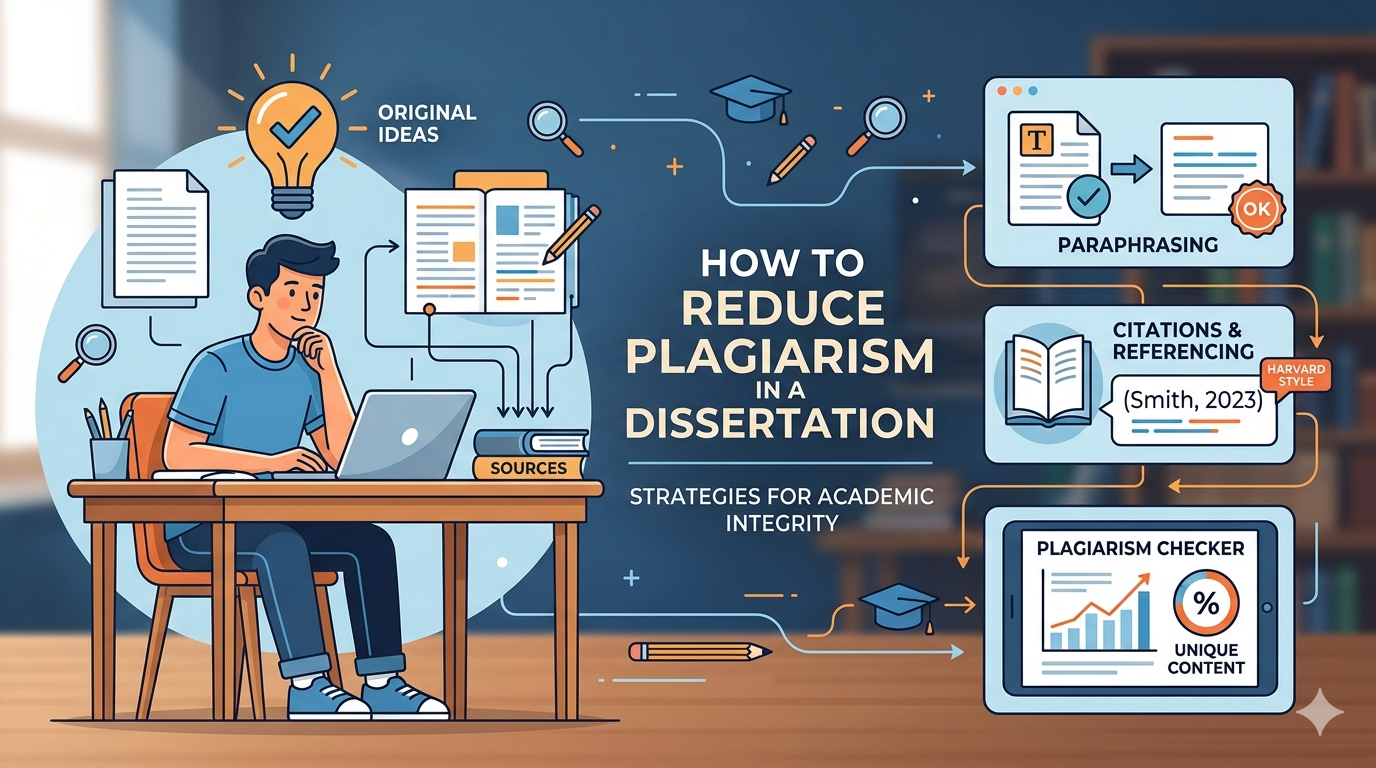
To reduce plagiarism in a dissertation, cite every source as you write, paraphrase from memory rather than editing the original sentence, quote sparingly with quotation marks, then run a genuine Turnitin check before submission. A long project naturally carries some similarity, so the goal is honest attribution and original analysis, not a zero score.
Why dissertations flag more than essays
A dissertation runs for thousands of words across a literature review, a methodology, results, then discussion. It cites dozens, sometimes hundreds, of sources. That volume alone pushes the similarity score up, because every reference, every standard method description, every common phrase in your field can match something in the database. A small percentage on a long document is normal. The trick is making sure the matches are the harmless kind.
Harmless matches are properly cited quotes, reference list entries, plus standard terminology. Risky matches are passages you paraphrased too closely, or text you pulled in without attribution. Reducing plagiarism really means converting the risky matches into honest, original writing before anyone reviews them.
Cite as you write, never after
The single biggest cause of accidental plagiarism in dissertations is leaving citations until the end. You copy a useful passage into your notes, plan to reference it later, then forget which idea came from were. By submission you cannot tell your own thinking from a source. Fix this by citing the moment you use a source, every time, even in rough drafts. A reference manager helps, yet even a simple habit of bracketing the author and year as you type prevents most problems.
If you’re referencing itself is shaky, our Harvard referencing guide walks through in-text citations and reference list formatting with examples for books, journals, then websites.
Paraphrase properly, from memory
Weak paraphrasing is the most common reason a cited passage still flags. Swapping a few words for synonyms while keeping the original sentence structure fools nobody, least of all Turnitin. The reliable method is to read the source, understand it, close the document, then write the idea in your own words without looking. Open it again only to check you got the facts right. The result reads as your own voice, because it is, while still crediting the original author with a citation.
This matters even more in 2026, because Turnitin now detects AI text that has been run through a paraphrasing tool. Genuine human paraphrasing, written from understanding, is the only approach that holds up under both the similarity check and the AI check.
Quote sparingly, format correctly
Direct quotes have their place, in law especially, where exact wording matters. Used well they are fine, even at higher volumes. Used lazily, as filler instead of analysis, they inflate your score while weakening your argument. Every quote need quotation mark, a page number, then a sentence of your own explaining why it matters. If a quote is not earning its place through analysis, paraphrase it instead.
Structure protects originality
A well-structured dissertation naturally contains more of your own words, because each section demands your interpretation. A literature review that only summarises sources will flag heavily. A literature review that compares, contrasts, then critiques those sources reads as analysis, which is original by definition. The same is true of your discussion chapter, where linking results back to your research question is your work, not anyone else’s.
If structuring the project feels overwhelming, our dissertation writing help supports you chapter by chapter, from the proposal through to the conclusion, with a free originality report on every order.
A worked example of fixing a flagged passage
Imagine your literature review contains this line, flagged at high similarity: “Social media has been shown to have a significant impact on the mental health of young people, with studies indicating a correlation between usage and anxiety.” The report shows it matches a journal article almost word for word, with no citation. That is a risky match, the kind that triggers a misconduct review.
The weak fix is to swap a few words: “Social media has been proven to have a notable effect on the wellbeing of younger people.” The structure is identical, so Turnitin still flags it, then the AI check may catch it too if a tool did the rephrasing. The proper fix is to read the source, understand the finding, close the document, then write what you actually took from it: “Several studies link heavy social media use among teenagers to higher reported anxiety, though the direction of that relationship remains contested (Author, 2023).” Now it is your sentence, your framing, your citation, then it even reads as stronger analysis because you noted a limitation.
Do that across every flagged passage, then the score falls naturally without a single trick. That is the whole method in miniature: understand, rewrite from memory, cite, repeat.
Tools that help, then tools that hurt
A reference manager such as Zotero or Mendeley genuinely reduces accidental plagiarism, because it keeps every source attached to its citation from the moment you save it. You never lose track of where an idea came from, which is the root cause of most accidental copying in long projects. These tools are free, then worth the hour it takes to learn one before a dissertation rather than during it.
The tools that hurt are the ones that promise to lower your score without changing your understanding. Spinners, paraphrasing bots, then so-called humanisers rewrite sentences mechanically, which Turnitin’s 2026 model is specifically built to catch. Worse, they often introduce subtle errors into your meaning, so a passage that scanned fine becomes factually wrong. A marker reading nonsense dressed in fancy words spots it immediately. There is no shortcut that beats understanding your own sources, then writing about them in your own words. Every reliable method in this guide comes back to that single principle.
Check before you submit
Guessing your score is a gamble on the most important piece of work in your degree. Run a genuine Turnitin check on the finished draft, read the source breakdown, then fix the flagged passages while you still can. Our full walkthrough on how to
A realistic target
Do not chase zero. A dissertation at 0% similarity often means the reference list was excluded, or the work was barely engaging with existing research, which markers dislike. A healthy dissertation usually sits somewhere in the low to mid-teens once citations and the bibliography are counted. Focus on honest attribution plus original analysis. Get those right, the score takes care of itself.
Ready to take your dissertation further? Get specialist support.
From refining your research question and literature review to methodology, analysis and final structure, dissertation work requires careful planning at every stage. Explore our dissertation writing support for your research project.
FAQ section
What is an acceptable plagiarism percentage for a dissertation?
There is no fixed UK threshold, but low to mid-teens is common once citations and the reference list are counted. What matters is the source of each match. Properly cited quotes are fine, while uncited or closely paraphrased passages are the real risk regardless of the headline percentage.
How do I paraphrase without plagiarising?
Read the source, understand it, then close it and write the idea in your own words from memory. Reopen it only to check facts. Swapping synonyms while keeping the original sentence structure does not work and is detected easily, so genuine rewriting from understanding is the reliable method.
Does Turnitin count my reference list in the score?
It depends on the institution. Many exclude the bibliography automatically, but not all. If your reference list is inflating your score, ask your module tutor whether exclusions apply to your assignment before you start cutting genuine references.
Should I aim for a zero percent similarity score?
No. A zero score often signals an excluded reference list or weak engagement with existing research, which markers view negatively. Aim for honest attribution and strong original analysis instead, then accept the modest similarity that good academic writing naturally produces.
Popular posts

Does Turnitin Detect AI and ChatGPT Writing?
June 22, 2026
40 Dissertation Viva Questions and How to Answer Them
July 9, 2026
Plagiarism Checker for Researchers: How to Screen Your Manuscript
July 19, 2026
Harvard Referencing Made Simple: The Only Guide You Will Need in 2026
May 12, 2026
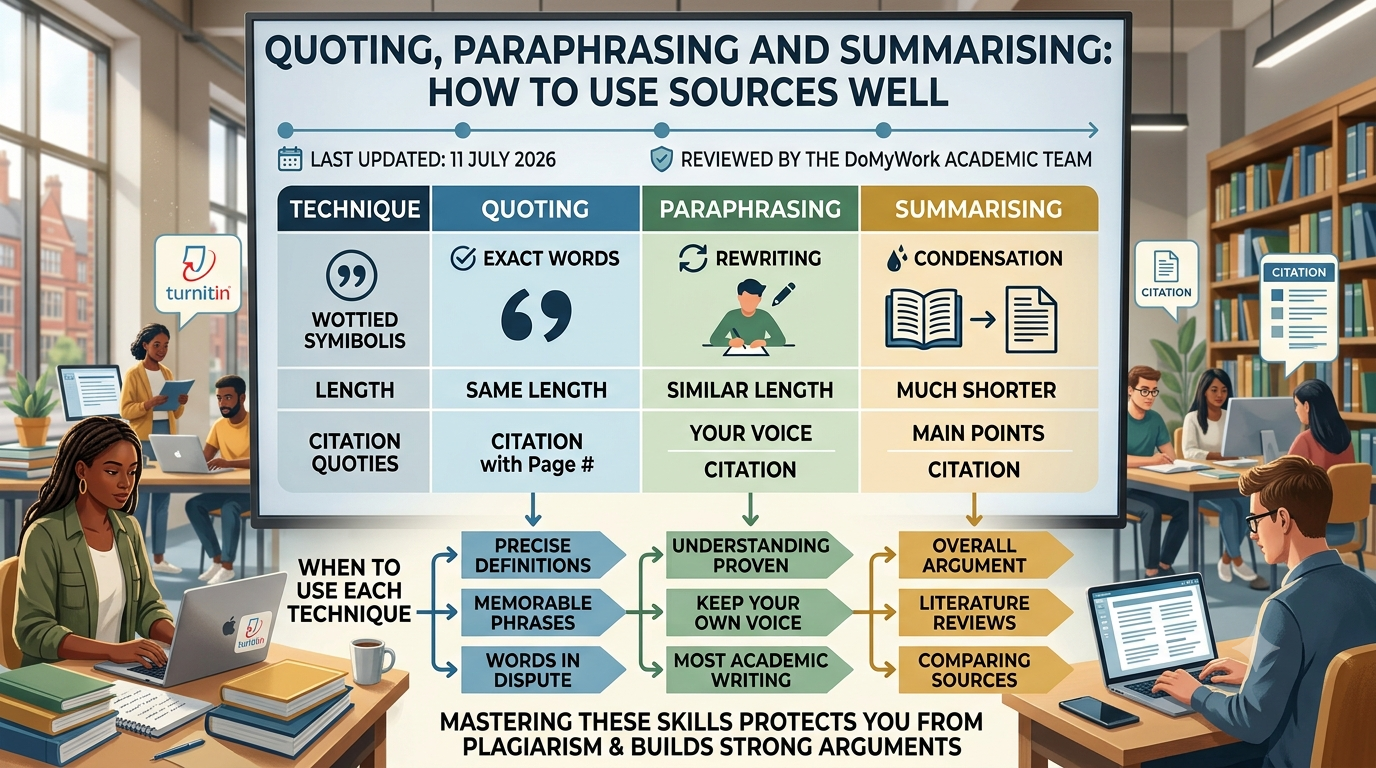
Quoting, Paraphrasing and Summarising: How to Use Sources Well
July 22, 2026
Want more tips & great deals? Get them sent to your inbox
Please enter a valid E-mail
By clicking "Subscribe" you agree to be contacted via e-mail. You can always unsubscribe from the newsletter


