On this page
The short answer
You can predict your grade before you submit by marking your own draft against the rubric, the same way a marker will. Read the criteria, score each one honestly against the grade bands, and add them up. For a faster, outside read, upload your draft, brief and rubric to a grade prediction tool and compare the two. The point is to find the weak spots while you still have time to fix them.
Guessing your grade from a gut feeling is unreliable, because you are too close to your own work. A structured self-check against the marking criteria gets you much closer, and it tells you exactly where to improve.
Can you really predict your grade?
You can get a close estimate, not a guarantee. Markers judge your work against a published rubric, so the more honestly you read your draft against that same rubric, the closer your estimate will be. What you cannot do is predict the exact mark, because judgement varies between markers and some criteria are subjective. Treat a prediction as a guide to where your work sits and what to improve, rather than a promise of the final number.
How do you predict your own grade, step by step?
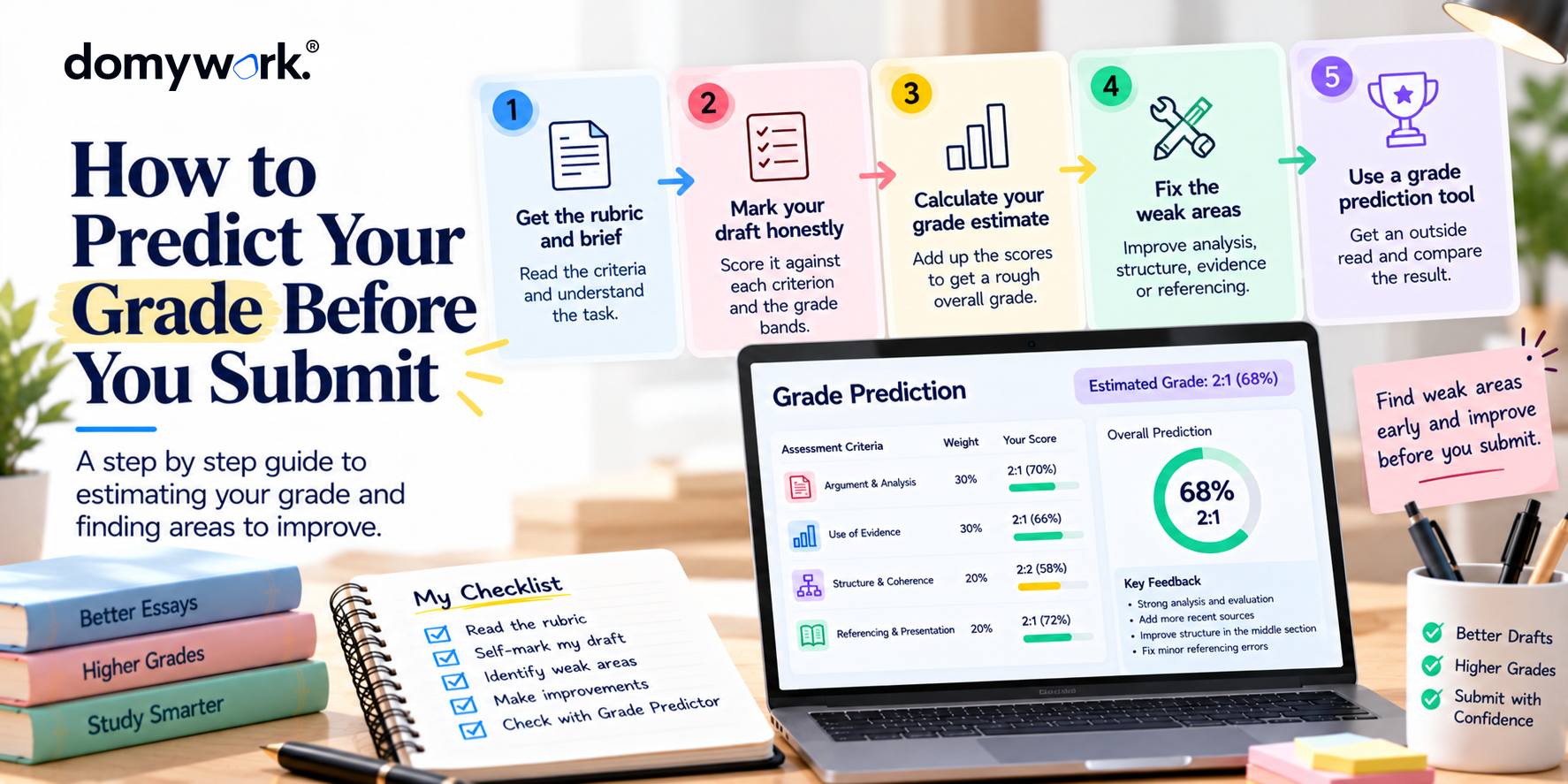
- Find the rubric and the brief. Both usually sit in your module handbook or assignment page.
- Read the top band for each criterion. That is the standard a top grade needs, in the marker’s own words.
- Mark your draft against each criterion honestly, as if it were not yours.
- Match your scores to the grade bands to get a rough overall grade.
- List the criteria where you fell short, and fix those first.
Our guide to understanding your marking rubric shows how to turn each criterion into a question about your draft, which is the core of a good self-prediction.
What do you compare your draft against?
The grade bands your university uses. In the UK that is the classification scale, where 70 and above is a First and 60 to 69 is a 2:1. Other countries use a GPA or a percentage. Knowing which scale applies, and what each band expects, is half of predicting your grade, which our guides to university grading systems and what UK markers look for set out. Once you know the band you are aiming at, you can see how far your draft sits from it.
Why is it hard to judge your own work?
Because you know what you meant to say, so you read it into the page even when it is not there. A marker only sees the words in front of them. This is why a structured check against the rubric beats a gut feeling, and why a second opinion helps. Reading only your topic sentences is one quick test: if they carry your argument on their own, your structure is sound; if they wander, a marker will struggle to follow it.
How does a grade prediction tool help?
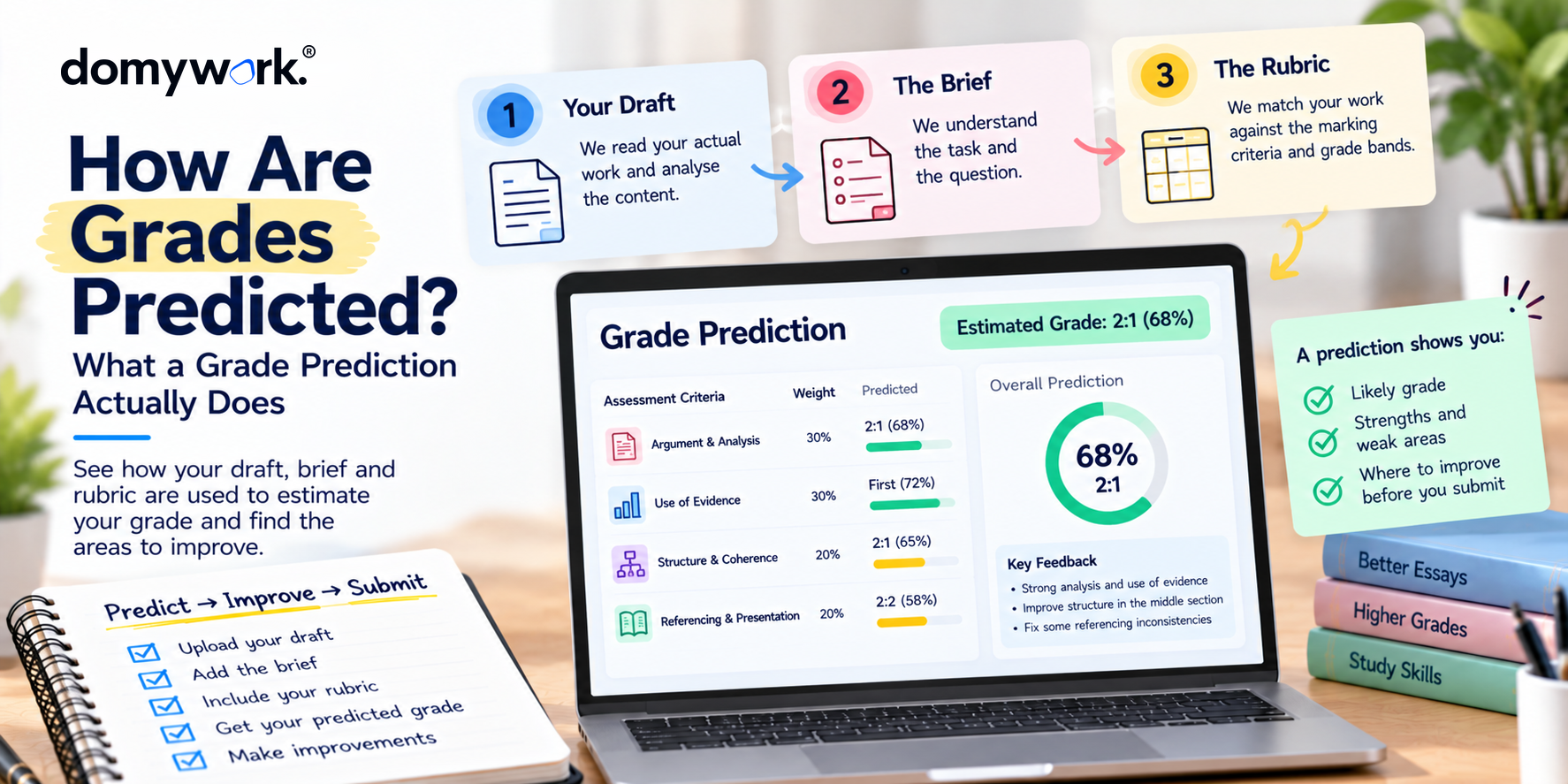
It gives you an outside read in minutes. Upload your draft, the brief and the rubric to Grade Predictor, and it shows your likely grade against the criteria, so you can see the weak areas before a marker does. The first two predictions are free with no card, it is a one-off payment after that rather than a subscription, and your files are kept private and never shared. Use it alongside your own rubric check, not instead of it, so you are comparing two reads of the same work.
What do you do with the prediction?
Act on the weakest criteria first, because that is where the easiest marks are. If analysis is low, add evaluation after your evidence. If structure is low, reorder so each paragraph makes one clear point. If referencing is low, fix the citations, which our guide to what counts as a passing grade and your rubric both reward. Predict, fix, then check again, rather than predicting once and hoping.
Frequently Ask Questions
Can I predict my university grade accurately?
You can get a close estimate by marking your draft against the rubric, but not an exact mark, since marker judgement varies.
What is the best way to predict my grade?
Self-mark against the rubric’s grade bands, then compare with a prediction tool for an outside read.
Does predicting my grade improve it?
Indirectly. The value is spotting weak criteria early, while there is still time to fix them.
Is a grade prediction the same as my final mark?
No. It is a guide to where your work sits, not a guarantee of the grade a marker will give.
Written by the DoMyWork team. First published 30 Oct 2026.