
Ready by 10:16am Jun 20, 2026
Capstone Project Help: A Stage-by-Stage Guide
Capstone project help is about learning how to plan, research, analyse, and present a final-year project that demonstrates everything you’ve learned throughout your degree. From choosing a strong topic to writing the literature review, methodology, analysis, and conclusion, each stage requires careful planning and independent thinking. This guide explains the complete capstone process, highlights common mistakes to avoid, and shares practical strategies to help you complete your project with confidence while meeting university expectations.
What is a capstone project?
A capstone is a final project that demonstrates what you have learned across your programme. Depending on your course it might be a research study, a business plan, a piece of applied work, or a portfolio. Whatever the form, it is assessed on your ability to plan, research, analyse and present independent work, which is why it carries so much weight.
How do you choose a capstone topic?
Pick a topic that is narrow enough to finish and interesting enough to sustain you. A common mistake is choosing a question so broad that it cannot be answered in the word count or the timescale. Check that you can actually gather the evidence you need, whether that is data, interviews or sources, before you commit. A focused question with reachable evidence beats an ambitious one you cannot complete.
What are the stages of a capstone project?
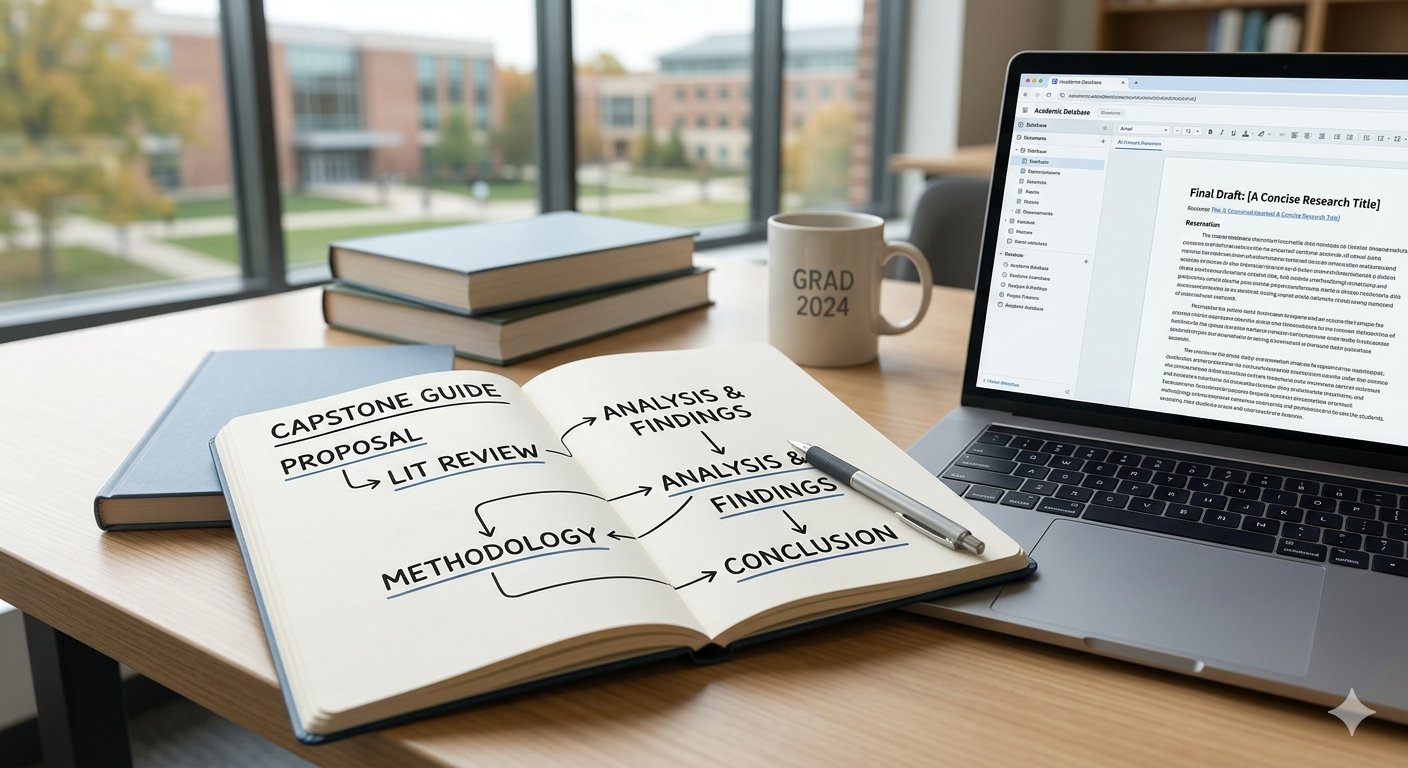
Most capstones move through the same stages, and planning each one keeps the project under control.
Proposal
You set out your question, why it matters and how you will approach it. A clear proposal is the foundation for everything that follows, so it is worth getting right.
Literature review
You show what is already known and where your work fits. The aim is a critical discussion of sources, not a list of summaries.
Methodology
You explain how you will gather and analyse your evidence, and why that approach suits your question. Markers look for justified choices, not just described ones.
Analysis and findings
You present what you found and what it means. This is the heart of the project, so give it the most space.
Conclusion
You answer your original question, acknowledge limitations and suggest what could come next.
“Can someone do my capstone project for me?”
This is the question many students type when the deadline looms, so it is worth answering honestly. Your capstone has to be your own work, and handing in something written by someone else is academic misconduct that can end a degree. What does help is support that keeps you in control: a worked model on a similar topic to learn structure from, feedback on your draft, or guidance through a stage you are stuck on. Used that way, help moves your own project forward rather than replacing it.
What are the most common capstone mistakes?
- Choosing a topic that is too broad to finish in the time and word count.
- Leaving the work too late, so the analysis gets squeezed at the end.
- A literature review that summarises sources instead of comparing them.
- A methodology that describes what you did without justifying why.
- A conclusion that adds new points rather than answering the question.
How do you present your findings clearly?
The findings section is where your project proves its worth, so make it easy to follow. Lead with what you found, use tables or figures to carry the data rather than burying it in long prose, and then explain what each result means for your question. Keep description and interpretation distinct, so the marker can see both the evidence and your reading of it. A findings section that reports numbers without drawing meaning from them leaves the most valuable marks on the table, while one that pairs each result with a clear takeaway shows the independent thinking a capstone is meant to demonstrate.
How do you manage your time on a capstone?
The biggest risk to a capstone is not difficulty but time. Because the deadline is far away at the start, the early stages slip, and the analysis gets squeezed at the end when it needs the most thought. Work backwards from your submission date and set your own deadlines for the proposal, the literature review, data collection and a complete first draft. Build in time for your supervisor to read drafts and for the unexpected, since data, interviews and access rarely run exactly to plan.
It also helps to keep a simple log of your sources and decisions as you go. A capstone runs long enough that you will forget why you chose a method or where a particular figure came from. A running record saves hours near the deadline, keeps your referencing accurate, and protects you against accidental integrity issues when you pull the final draft together.
How do you write a literature review that compares rather than summarises?
A weak literature review is a list: this author said one thing, that author said another. A strong one groups sources by theme, shows where they agree and disagree, and uses that to reveal the gap your project fills. Read with a question in mind, such as what is still unresolved in this area, and let your review build towards your own work. Done well, the literature review is not a hurdle before the real project, it is the foundation that justifies why your question is worth asking.
Where can you get capstone project help?
Your supervisor is your most valuable resource, since they guide and often mark the work. Use your scheduled meetings well, and bring specific questions. Your library can help with the literature review and referencing, and your academic skills team can help with planning a long project. Beyond that, a study-support service can provide a worked model or stage-by-stage guidance, so you can see how a strong capstone is built before you write your own. As a reference and a learning aid, this keeps the project yours.
DoMyWork offers model-answer and guidance support for capstone students, with a Trustpilot rating of 4.2 from 47 reviews. Our capstone project help page explains how the support works, stage by stage.
Frequently asked questions
How long does a capstone project take?
Most run over several weeks or a full term. Treat it as a series of stages with their own deadlines rather than one task, since the analysis always needs more time than students expect.
Can someone write my capstone project for me?
Your capstone must be your own work, and submitting work written by someone else is academic misconduct. Support such as a worked model, draft feedback or stage guidance is a study aid that keeps the project yours.
What is the hardest part of a capstone?
For many students it is the analysis, where you turn findings into meaning, and the literature review, which needs critical comparison rather than summary. Planning time for both early helps a great deal.
How do I start a capstone project?
Begin with a focused question and a clear proposal, then check you can reach the evidence you need before going further. A narrow, answerable topic is far easier to finish well than a broad one.
Popular posts

Best Student Side Hustles in the UK That Actually Pay in 2026
May 18, 2026

15 Dissertation Topics Trending in 2026
April 20, 2026

How to Check Your Turnitin Score Before Submitting
April 7, 2026

How to Write a First Class Essay at a UK University: A Complete Guide for Students
May 11, 2026
What Do UK University Markers Actually Look For? Inside the Marking Criteria
May 22, 2026



Want more tips & great deals? Get them sent to your inbox
Please enter a valid E-mail
By clicking "Subscribe" you agree to be contacted via e-mail. You can always unsubscribe from the newsletter