
Ready by 9:18am Oct 6, 2026
Aims, Objectives and Research Questions Explained (2026)
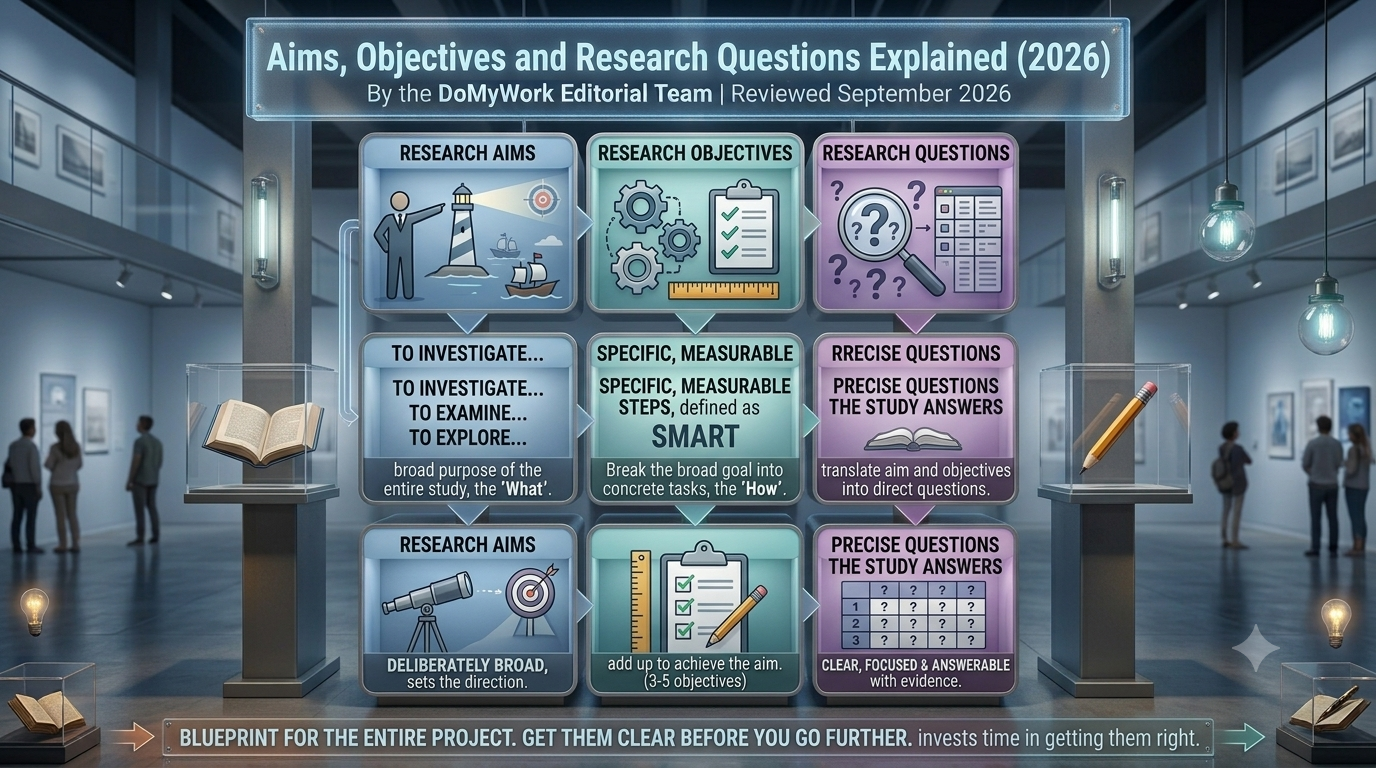
A research aim is the overall goal of your project, what you want to achieve. Objectives are the specific, measurable steps you will take to achieve the aim. Research questions are the precise questions your study will answer. The aim is broad, the objectives break it down, and the questions define exactly what you will investigate.
Aims, objectives and research questions are the foundation of any dissertation or research project, yet students frequently confuse them, which leads to muddled proposals and unfocused research. Getting them clear and distinct is one of the most important early steps, because they set the direction for everything that follows. This guide explains what each one is, how they differ, how they connect, and how to write clear ones, with examples. They grow out of the gap identified in your literature review and are set out in your research proposal.
What is a research aim?
A research aim is the overall goal of your project: a broad statement of what you want to achieve or find out. It captures the purpose of the whole study in one or two sentences, usually beginning with a verb such as to examine, to investigate, to explore or to evaluate. For example: to investigate how flexible working affects employee productivity in UK technology firms. The aim is deliberately broad, since it sets the direction rather than the detail, and a dissertation typically has one clear aim. Everything else, your objectives and questions, flows from it, so getting a clear, focused aim is the essential first step.
What are research objectives?
Research objectives are the specific, measurable steps you will take to achieve your aim. If the aim is the destination, the objectives are the route: they break the broad goal into concrete tasks, so you and your reader can see how the aim will be met. Good objectives are specific and achievable, often described as SMART, and there are usually three to five of them. For the aim above, objectives might be: to examine current flexible working practices in the sector; to assess their relationship with productivity; and to identify the factors that make flexible working effective. Notice how each is a concrete step towards the aim, and how together they add up to it.
What are research questions?
Research questions are the precise questions your study sets out to answer, and they are what your findings will ultimately address. They translate your aim and objectives into direct questions, phrased so that evidence can answer them. For the example above, a research question might be: how does flexible working affect employee productivity in UK technology firms? Some studies use research questions instead of objectives, some use both, and some quantitative studies use hypotheses instead. Your research questions should be clear, focused and answerable, since a vague or unanswerable question leads to an unfocused study. They are the sharpest expression of exactly what your dissertation will investigate.
How aims, objectives and questions connect
The three work as a hierarchy, from broad to specific. The aim states the overall goal; the objectives break that goal into specific steps; and the research questions define exactly what will be answered. They should align tightly: every objective should serve the aim, and every research question should relate to an objective, so that together they form a coherent plan. If an objective does not contribute to the aim, or a question does not connect to your objectives, something is misaligned. Checking that your aim, objectives and questions line up cleanly is one of the best ways to ensure your whole study is focused and coherent from the start.
How to write clear aims and objectives
Write your aim first, as a single, focused statement of what you want to achieve, using a clear verb and a specific context. Then write your objectives as the specific steps needed to achieve that aim, keeping each one concrete, measurable and achievable, and making sure they cover everything the aim requires without straying beyond it. Aim for around three to five objectives, since too few may not cover the aim and too many suggest the scope is too broad. Use precise verbs, to examine, to assess, to identify, to evaluate, and avoid vague ones. Clear, well-aligned aims and objectives are what give a dissertation its direction.
Common mistakes to avoid
● Confusing the aim (the broad goal) with the objectives (the specific steps).
● Writing objectives that are vague or unmeasurable, rather than concrete.
● Setting too many objectives, which signals an over-broad scope.
● Aims, objectives and questions that do not align with each other.
● Research questions that are too broad or cannot be answered with evidence.
Aims and objectives versus a hypothesis
Students sometimes wonder how a hypothesis fits alongside aims, objectives and research questions, and the distinction is worth clarifying. A hypothesis is a specific, testable prediction about the relationship between variables, used mainly in quantitative research, for example that flexible working increases productivity. When a research question asks something open, how does flexible working affect productivity, a hypothesis states an expected answer to be tested, that it increases it. So some studies, particularly experimental and quantitative ones, use hypotheses in place of or alongside research questions, while qualitative and exploratory studies usually use research questions, since they explore rather than test. Which you use depends on your research approach, and our qualitative vs quantitative research guide helps you decide. The aim and objectives, however, remain the same whichever you use: the aim states your overall goal and the objectives break it into steps, and then either research questions or hypotheses define precisely what you will investigate or test.
In short, treat your aims, objectives and research questions as the blueprint for the entire project, and get them clear before you go further. Time spent sharpening them at the proposal stage is repaid many times over, because a study with a focused aim, well-aligned objectives and answerable questions almost writes its own structure, while one built on vague or conflicting foundations forces constant backtracking. When your supervisor reviews your proposal, these are among the first things they check, so getting them right early also makes that crucial first approval far smoother.
Why getting these right matters
Clear aims, objectives and research questions are worth the effort because they shape your entire project. They define your scope, so you know what to research and what to leave out; they guide your methodology, since how you answer your questions determines your methods, as our how to write a dissertation methodology guide covers; and they give your dissertation a clear thread from introduction to conclusion. A study built on muddled or misaligned aims and objectives tends to wander, while one built on clear, aligned ones stays focused and coherent. So invest time in getting them right at the start, since almost everything in your dissertation depends on them.
Popular posts

Can Students Access Turnitin Without Their University? Here Is the Truth
April 15, 2026
Quoting, Paraphrasing and Summarising: How to Use Sources Well
July 22, 2026
How to Write Dissertation Acknowledgements
September 23, 2026

Harvard Referencing Made Simple: The Only Guide You Will Need in 2026
May 12, 2026
Want more tips & great deals? Get them sent to your inbox
Please enter a valid E-mail
By clicking "Subscribe" you agree to be contacted via e-mail. You can always unsubscribe from the newsletter


