
Ready by 8:04pm Oct 22, 2026
Psychology Dissertation Topics: 110+ Ideas with Research Aims (2026)
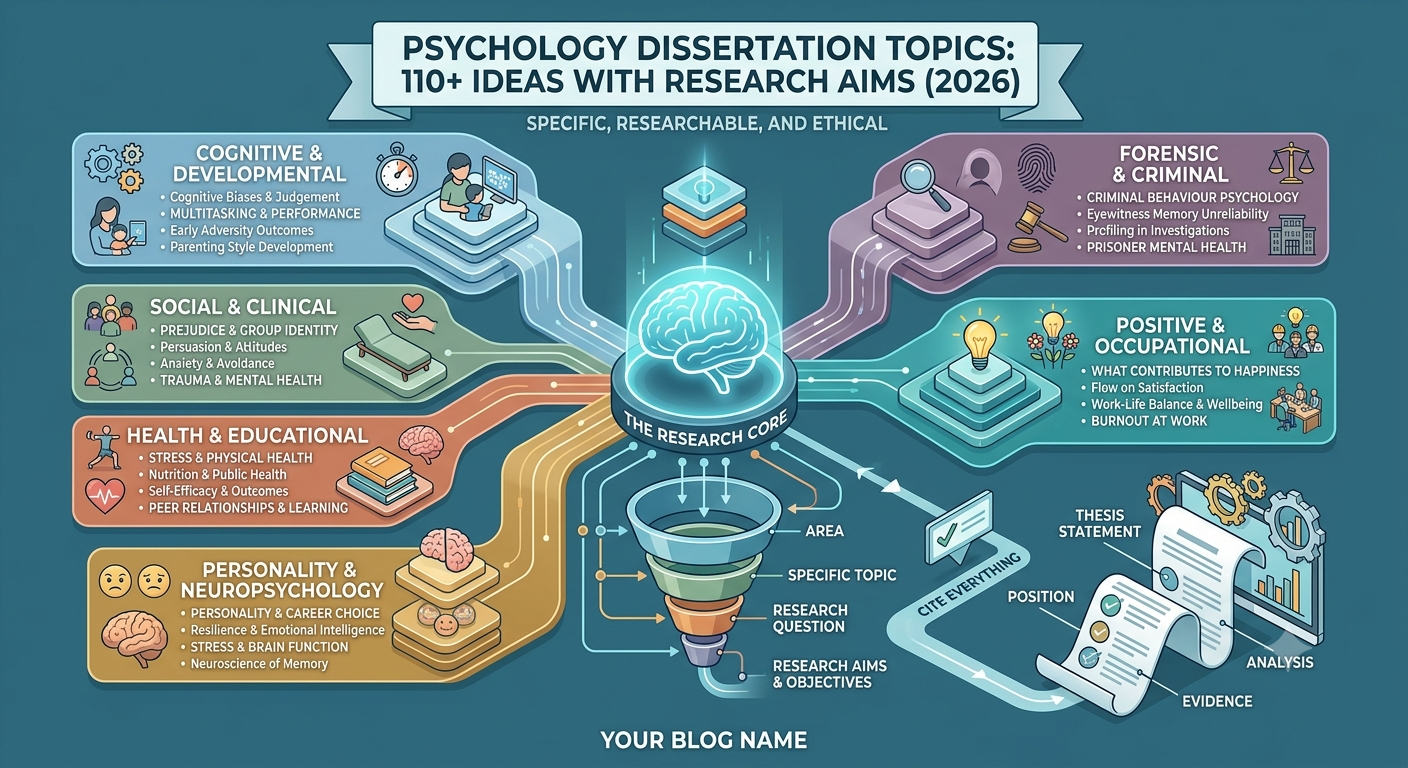
A strong psychology dissertation topic is specific, researchable and ethical, focused on a clear relationship you can test with data you can gather. Fruitful areas include cognitive, developmental, social, clinical, health, educational and forensic psychology. This guide gives 110+ topics with six developed examples and a method for shaping any idea into a research question.
Choosing a psychology dissertation topic is the first real decision of your project, and it shapes everything that follows. Psychology is broad and empirical, so the best topic is not the most ambitious but the one you can research well: focused on a specific relationship, testable with data you can gather ethically, and connected to a current issue. Because psychology usually involves people, the choice between measuring behaviour and understanding experience shapes the whole design, which our qualitative vs quantitative research guide helps you weigh, and ethics is central throughout. This guide walks through how to choose, develops six topics to full aim-and-objectives level, then lists more than 110 further ideas grouped by area.
How do you choose a strong psychology dissertation topic?
A good topic meets several conditions at once. It should be relevant to your course and current, interesting enough to sustain you for months, and narrow enough to answer within a dissertation. Above all it must be researchable and ethical: a topic is only workable if you can recruit participants and gather data within ethical guidelines, and sensitive topics or vulnerable groups raise requirements you must plan for. A strong topic also addresses a live debate or a gap, which reading recent studies, much as you would when writing a literature review, helps you find. The most common mistake is choosing something too broad: ‘social media and mental health’ is a field, while ‘how time spent on Instagram relates to body image in young women’ is a question you can investigate.
Six developed psychology dissertation topics (with aims and objectives)
The six topics below are worked to the level your proposal will need, each with a research aim and three objectives, so you can see how a broad idea becomes a defined study.
1. The impact of social media use on adolescent mental health
Research aim: To examine how social media use affects the mental health and wellbeing of adolescents.
- To assess patterns of social media use among adolescents.
- To examine the relationship with wellbeing.
- To identify the factors that moderate this effect.
2. How sleep affects memory and cognitive performance
Research aim: To investigate how sleep quality affects memory and cognitive performance.
- To review the theory linking sleep to cognition.
- To measure the relationship with performance.
- To assess how the effect varies between people.
3. The effect of childhood attachment on adult relationships
Research aim: To examine how childhood attachment style affects adult relationships.
- To define the main attachment styles.
- To assess their relationship with adult attachment.
- To consider how attachment can change over time.
4. How stress affects decision-making
Research aim: To investigate how stress affects the quality of decision-making.
- To examine how stress influences cognitive processes.
- To assess its effect on decision quality.
- To identify factors that reduce its impact.
5. The relationship between exercise and depression
Research aim: To analyse the relationship between regular exercise and symptoms of depression.
- To review the theory linking exercise to mood.
- To assess the relationship using available evidence.
- To consider the mechanisms behind the effect.
6. How cognitive biases affect judgement
Research aim: To examine how cognitive biases affect everyday judgement and decisions.
- To identify the main cognitive biases.
- To assess their effect on judgement.
- To consider how their impact can be reduced.
110+ psychology dissertation topics by area
The ideas below are grouped by sub-area. Treat each as a starting point to narrow around a group and setting you can access ethically. The universal skills of designing and writing up research apply across all of them, and our how to structure an assignment guide helps with the write-up.
Cognitive psychology
- How sleep affects memory and cognition.
- The effect of stress on attention.
- How cognitive biases affect judgement.
- The impact of multitasking on performance.
- How aging affects memory.
- The effect of mood on decision-making.
- How language shapes thought.
- The impact of distraction on learning.
- How working memory affects problem-solving.
- The effect of expertise on perception.
Developmental psychology
- How childhood attachment affects adult relationships.
- The impact of parenting style on development.
- How screen time affects child development.
- The effect of early adversity on outcomes.
- How play supports cognitive development.
- The impact of siblings on development.
- How language develops in early childhood.
- The effect of daycare on social development.
- How adolescence shapes identity.
- The impact of bilingualism on development.
Social psychology
- How social media affects self-esteem.
- The impact of conformity on behaviour.
- How group identity shapes prejudice.
- The effect of social norms on behaviour.
- How persuasion changes attitudes.
- The impact of stereotypes on judgement.
- How obedience affects behaviour.
- The effect of social comparison on wellbeing.
- How prosocial behaviour is encouraged.
- The impact of online interaction on relationships.
Clinical and abnormal psychology
- The effectiveness of cognitive behavioural therapy.
- How stigma affects help-seeking.
- The relationship between anxiety and avoidance.
- How trauma affects mental health.
- The impact of mindfulness on wellbeing.
- How therapy outcomes are measured.
- The effect of social support on recovery.
- How resilience protects mental health.
- The impact of early intervention.
- How comorbidity affects treatment.
Health psychology
- The relationship between exercise and depression.
- How stress affects physical health.
- The impact of health beliefs on behaviour.
- How social support affects coping.
- The effect of lifestyle on wellbeing.
- How chronic illness affects mental health.
- The impact of health campaigns on behaviour.
- How sleep affects wellbeing.
- The effect of diet on mood.
- How pain is perceived and managed.
Educational psychology
- How motivation affects academic achievement.
- The impact of a growth mindset on learning.
- How test anxiety affects performance.
- The effect of feedback on learning.
- How self-efficacy affects outcomes.
- The impact of peer relationships on learning.
- How learning styles affect achievement.
- The effect of the classroom environment.
- How memory strategies affect revision.
- The impact of teacher expectations.
Forensic and criminal psychology
- The psychology of criminal behaviour.
- How eyewitness memory can be unreliable.
- The effectiveness of offender rehabilitation.
- How childhood affects offending.
- The psychology of jury decision-making.
- How risk of reoffending is assessed.
- The impact of imprisonment on mental health.
- How profiling is used in investigations.
- The psychology of aggression.
- How addiction relates to offending.
Personality and individual differences
- How personality affects wellbeing.
- The relationship between personality and stress.
- How individual differences affect learning.
- The impact of self-esteem on behaviour.
- How personality affects career choice.
- The effect of resilience on outcomes.
- How emotional intelligence affects relationships.
- The impact of introversion and extroversion.
- How optimism affects health.
- The role of self-control in behaviour.
Biological and neuropsychology
- How sleep deprivation affects the brain.
- The effect of exercise on brain function.
- How stress affects the brain.
- The impact of diet on cognition.
- How the brain processes emotion.
- The effect of aging on the brain.
- How addiction affects the brain.
- The neuroscience of memory.
- How the brain adapts after injury.
- The effect of hormones on behaviour.
Positive psychology and wellbeing
- What contributes to happiness.
- How gratitude affects wellbeing.
- The impact of mindfulness on stress.
- How meaning affects life satisfaction.
- The effect of nature on wellbeing.
- How social connection affects happiness.
- The impact of kindness on wellbeing.
- How resilience is built.
- The effect of flow on satisfaction.
- How optimism affects outcomes.
Occupational and applied psychology
- How workplace stress affects performance.
- The impact of leadership on employee wellbeing.
- How motivation affects job performance.
- The effect of remote work on wellbeing.
- How burnout develops at work.
- The impact of job satisfaction on retention.
- How team dynamics affect performance.
- The effect of workplace culture on behaviour.
- How work-life balance affects wellbeing.
- The psychology of decision-making at work.
What makes a strong psychology dissertation topic?
Beyond meeting the practical conditions above, the strongest topics share a clear angle. They focus on a specific relationship, such as how one variable affects another, rather than describing a broad area, which gives you something to test rather than summarise. They are grounded in a definable population, an age group, a clinical group or a setting, which keeps the scope manageable and recruitment realistic. And they connect to a current issue or a gap in the literature, which gives the work relevance. A topic that combines a focused relationship, a clear population and an ethical, feasible design will nearly always make a stronger dissertation than a broad or descriptive one.
How do you turn a topic into a research question?
A topic is a starting area; a research question is what your dissertation answers, so the next step is to sharpen one into the other. Take your chosen area, add a specific population and a relationship to investigate, and phrase it as a question evidence can answer, so ‘social media and mental health’ becomes ‘how does daily Instagram use relate to body image among young women aged 18 to 25?’. From there you decide what data you need and whether you will gather it yourself or draw on existing datasets, a choice our primary vs secondary research guide helps you make, and you build ethics into the plan before setting it out in a research proposal. Grounding the question in psychological theory is what turns it into research rather than opinion.
Tips for refining your topic
- Start from an area that interests you, then narrow to a specific, testable relationship.
- Check you can recruit participants and gather data within ethical guidelines.
- Plan for ethics early, especially with sensitive topics or vulnerable groups.
- Read recent psychology journals to spot gaps and current debates.
- Keep the scope tight; a narrow question answered well beats a broad one answered thinly.
Once you have a topic and question, the next steps are designing the study and organising the write-up. Our how to write a dissertation methodology guide covers the research design and its ethics. Before you submit, it is worth checking your own finished draft for originality, which you can do with our plagiarism check. Whichever area you choose above, the same principle holds throughout: narrow the topic, design it ethically, and let a clear, evidenced study carry the work.
Ready to take your dissertation further? Get specialist support.
From refining your research question and literature review to methodology, analysis and final structure, dissertation work requires careful planning at every stage. Explore our dissertation writing support for your research project.
Popular posts

Dissertation Topics 2026: How to Choose the Best Topic + 150 Ideas
February 21, 2026
140 Communication Research Topics (2026)
September 16, 2026

Can Students Access Turnitin Without Their University? Here Is the Truth
April 15, 2026

How to Write a Dissertation Proposal: Step by Step With an Example
April 17, 2026
How to Structure a University Assignment: Formats That Win Marks
June 23, 2026
Want more tips & great deals? Get them sent to your inbox
Please enter a valid E-mail
By clicking "Subscribe" you agree to be contacted via e-mail. You can always unsubscribe from the newsletter


