
Ready by 10:00am Oct 2, 2026
How to Write a 3-Paragraph Essay (2026)
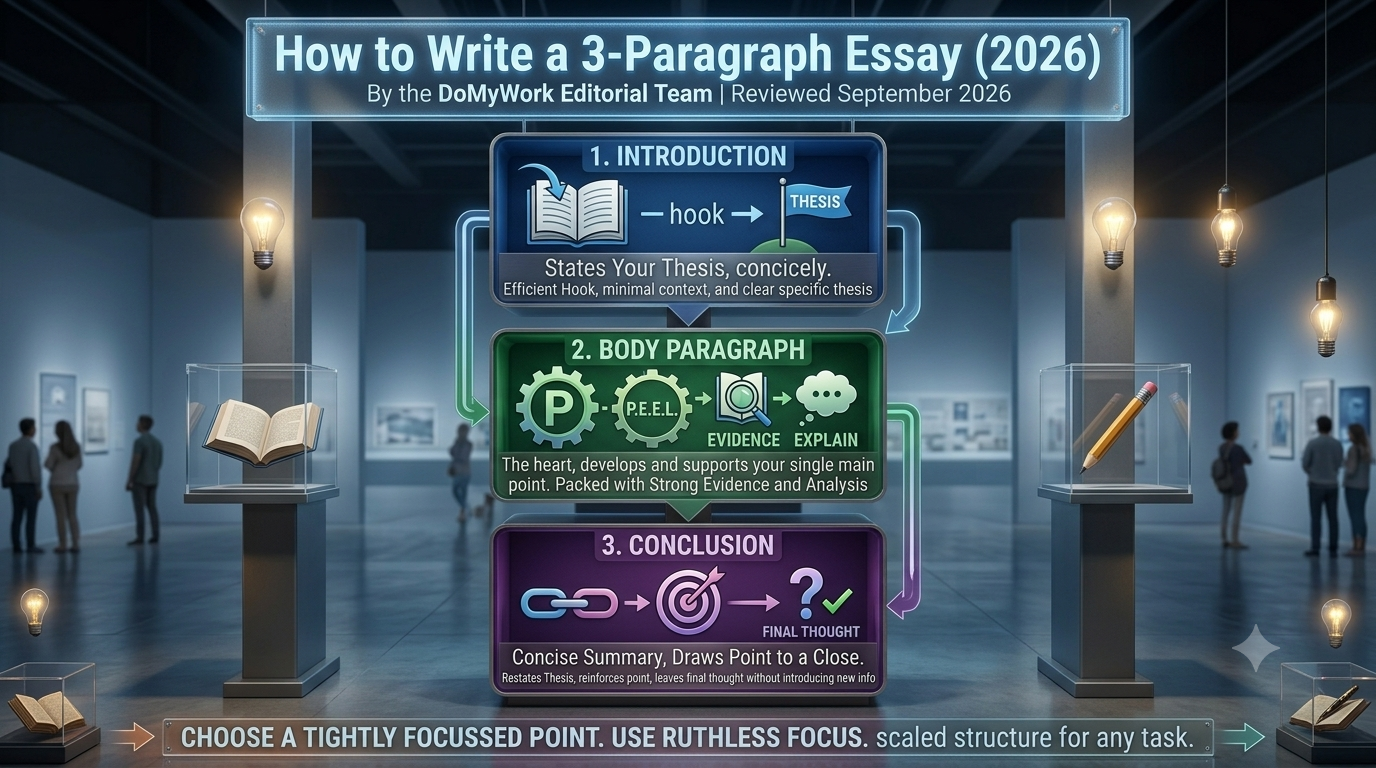
A 3-paragraph essay has an introduction, one body paragraph, and a conclusion. The introduction states your thesis, the single body paragraph makes and supports your main point, and the conclusion restates your position. It suits short assignments, exam answers and younger writers, and it teaches essay structure in its simplest form.
The 3-paragraph essay is the simplest complete essay form, with just an introduction, one body paragraph, and a conclusion. It is often used for short assignments, exam answers, and as a way of teaching essay structure before students move on to longer forms. Its brevity is a challenge as much as a help, since you have very little space to make and support your point. This guide explains how to write a 3-paragraph essay, how to structure each part, and when the format is used. It builds on the essay structure and how to structure an assignment guide.
What is a 3-paragraph essay?
A 3-paragraph essay is a short essay with exactly three paragraphs: an introduction, a single body paragraph, and a conclusion. It follows the same beginning-middle-end logic as any essay, but compressed into its most basic form. Because there is only one body paragraph, a 3-paragraph essay makes a single main point or a tightly focused argument, rather than developing several. This makes it ideal for short tasks and for learning the fundamentals of essay structure, since it contains all the essential parts, a thesis, supporting evidence and analysis, and a conclusion, without the complexity of a longer essay.
When is the 3-paragraph format used?
The 3-paragraph essay suits several situations. It is common in short assignments and quick written responses, where a full-length essay is not required. It is useful in exams, where time is limited and a concise, well-structured answer is more achievable than a long one. It is often used to teach essay writing, since it introduces the core structure in a manageable form before students tackle five-paragraph and longer essays. And it works well for a simple, focused argument that needs only one main point. Knowing when a short, focused essay is appropriate, rather than a longer one, is part of matching your writing to the task.
How to write the introduction
The introduction of a 3-paragraph essay does the same job as any introduction, but concisely. In a few sentences, it should engage the reader, introduce the topic briefly, and state your thesis, the clear point your essay will make. With so little space overall, the introduction must be efficient: a short hook, minimal context, and a clear thesis are enough. The thesis is especially important in such a short essay, since it is the single claim your one body paragraph will support, so make it clear and specific, as our thesis statement guide explains. A focused introduction sets up the whole short essay.
How to write the body paragraph
The single body paragraph is the heart of a 3-paragraph essay, and it must make and support your main point on its own. A reliable approach is to make your point, provide evidence or examples to support it, explain what that evidence shows, and connect it back to your thesis, which is exactly the PEEL structure our how to write a PEEL paragraph guide covers. Because you have only one body paragraph, it needs to be well-developed and focused, packing your strongest evidence and clearest analysis into a single, coherent argument. This is where the real content of the essay lives, so give it the most words and the most care.
How to write the conclusion
The conclusion of a 3-paragraph essay draws your point to a close. In a few sentences, restate your thesis in the light of what you have argued, briefly reinforce your main point, and end with a final thought, without introducing new information. Because the essay is short, the conclusion should be concise and should not simply repeat the introduction word for word; instead, it should show that your point has been made. A tight, purposeful conclusion completes the essay’s beginning-middle-end shape and leaves the reader clear on what you have argued, which is all a short essay’s conclusion needs to do.
The challenge of the 3-paragraph essay
Do not mistake short for easy. The main challenge of a 3-paragraph essay is that its brevity leaves no room for padding or wandering, so every sentence has to earn its place. With a single body paragraph, you must choose your strongest point and your best evidence, since there is no space to develop several ideas. This forces a discipline that longer essays do not: ruthless focus. The skill of a good short essay is selection, deciding what to include and, just as importantly, what to leave out, so that the one point you make is made as convincingly as possible in the space available.
3-paragraph versus 5-paragraph essay
It helps to see the 3-paragraph essay alongside its larger sibling, the 5-paragraph essay, since the two share a logic and differ only in scale. The 5-paragraph essay has an introduction, three body paragraphs and a conclusion, giving it room to develop three separate points in support of its thesis. The 3-paragraph essay compresses this to a single body paragraph and therefore a single main point, which makes it suitable for shorter tasks and quicker responses but leaves no room to develop multiple lines of argument. In practice, you choose between them based on the length and demands of the task: a brief exam answer or a short assignment suits three paragraphs, while a fuller essay that needs to argue several points calls for five or more. Both teach the same underlying structure, a clear thesis, supported body, and conclusion, which is why the 3-paragraph form is often a stepping stone to longer essays. Understanding that the two are the same shape at different sizes helps you scale your writing up or down to fit whatever the task requires.
Tips for a strong 3-paragraph essay
Keep your focus tight, choosing one clear point your body paragraph can fully support. Make your thesis specific, since a vague thesis has no room to be developed in such a short essay. Use your strongest evidence, and spend most of your words on the body paragraph, where the argument lives. Keep the introduction and conclusion concise, and make sure every sentence contributes. If you find you have more to say than one body paragraph allows, the task may call for a longer essay, such as the five-paragraph or 1500-word forms or how to write a 1500-word essay guide. Used for the right task, the 3-paragraph essay is a clear, disciplined way to make a focused point.
Popular posts
How to Structure a University Assignment: Formats That Win Marks
June 23, 2026

How to Write a PESTLE Analysis for an Assignment (with Example, 2026)
August 23, 2026

Cookery Assignment Help: A Complete Guide for Commercial Cookery and Hospitality Students
June 16, 2026
Quoting, Paraphrasing and Summarising: How to Use Sources Well
July 22, 2026

How to Write a SWOT Analysis for an Assignment (with Example, 2026)
August 24, 2026
Want more tips & great deals? Get them sent to your inbox
Please enter a valid E-mail
By clicking "Subscribe" you agree to be contacted via e-mail. You can always unsubscribe from the newsletter


