On this page
The short answer
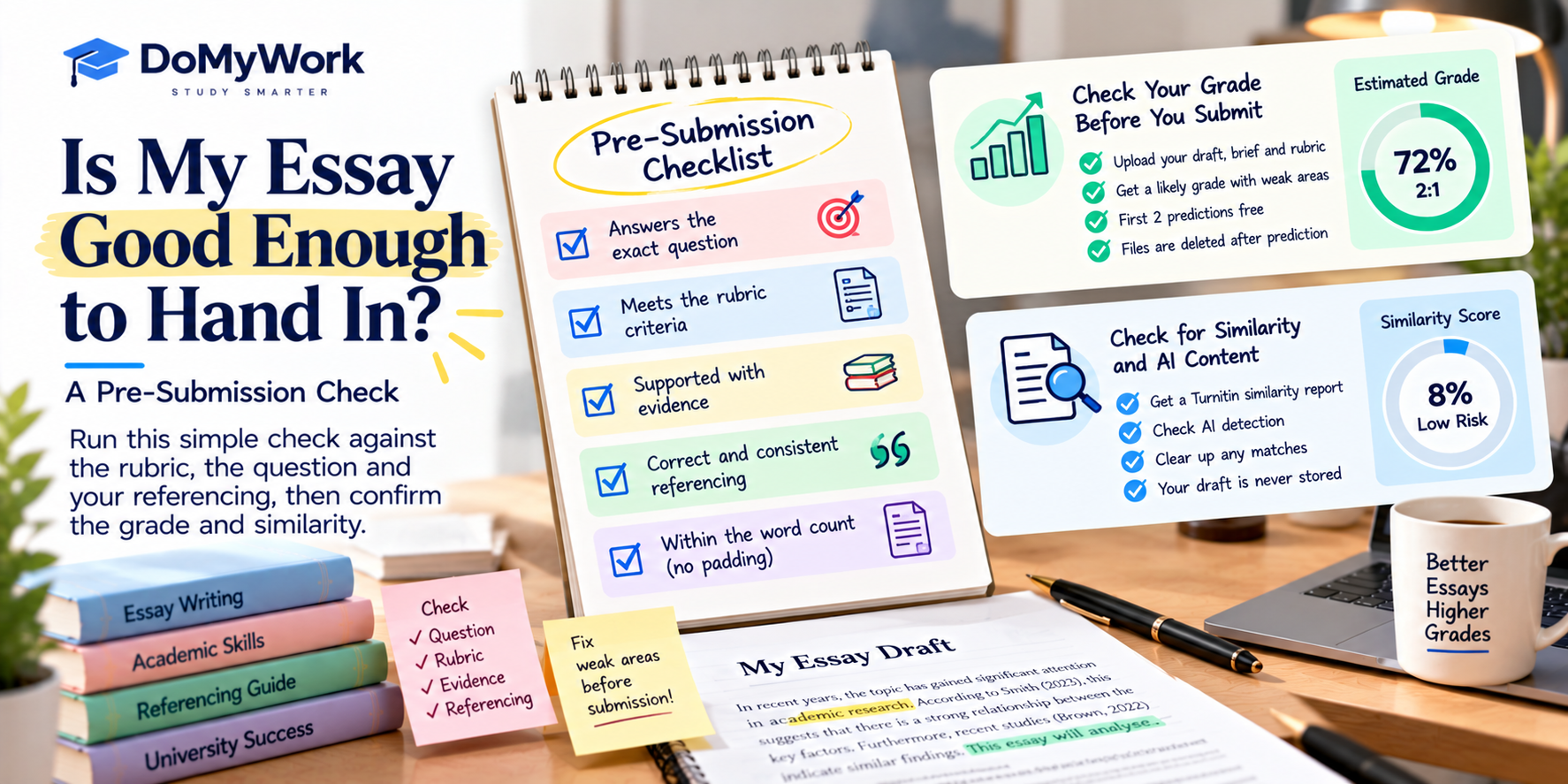
Your essay is good enough to hand in when it answers the exact question, meets every criterion on the rubric, supports each point with evidence, and is referenced consistently. The quickest way to know is to run a short pre-submission check against those four things, then confirm the likely grade and the similarity before you upload. If a check turns up a gap, you fix it now rather than reading about it in the feedback.
Most students submit on a feeling of being finished, which is not the same as being ready. A structured check replaces that feeling with something you can act on.
How do you know if an essay is good enough?
Judge it against the standard it will be marked by, not against how much effort it took. The marker uses a rubric and the question, so those decide whether it is ready. The four tests below cover most of what separates a strong submission from a risky one, and each has an easy fix if it fails.
Does it answer the exact question?
This is the first thing to check, because a well-written essay that answers the wrong question still loses heavily. Reread the question, note the task word (analyse, compare, discuss, evaluate), and confirm every section serves it. If a paragraph does not help answer the question, it is padding, however good it reads. Our guide to writing a first-class essay shows how the strongest answers stay tied to the question throughout.
Does it meet the rubric?
Go through the rubric line by line with your finished draft open, and find where you meet each criterion. If you cannot point to where you meet one, you probably have not, and that is a fixable gap while there is still time. Pay most attention to analysis, which is where the biggest marks sit and where most essays fall short, and to the grade bands, which our guides to grading rubrics and what markers look for explain.
Is every point supported and referenced?
Each claim needs evidence, and each source needs a citation in your required style. Weak paraphrasing and missing citations are common and quietly cost marks, so check that every borrowed idea is credited and that your reference list matches the text. A clean, consistent reference list is one of the easiest ways to protect presentation marks.
How do you confirm the grade and the similarity?
Two quick checks close the gap between finished and ready. Upload your draft, the brief and the rubric to Grade Predictor to see the likely grade and the weak criteria. The first two predictions are free with no card, it is a one-off payment after that rather than a subscription, and your uploads are deleted after the prediction. Then run the draft through Plag Check for a Turnitin similarity and AI report in about fifteen minutes, so you can clear up accidental matching before you submit. Your draft is never stored, so it cannot come back as a match when you hand in for real.
What is the final pre-submission checklist?
- It answers the exact question, with every section serving it.
- It meets each criterion on the rubric, especially analysis.
- Every point has evidence, and every source is cited consistently.
- It hits the word count without padding.
- You have confirmed the likely grade and the similarity.
Clear all five and your essay is ready. Fail one and you know exactly what to fix.
Frequently Ask Questions
How do I know if my essay is good enough?
Check it answers the question, meets the rubric, supports every point, and is referenced consistently, then confirms the grade and similarity.
What is the most common reason essays lose marks?
Description instead of analysis, and answering the question only loosely. Both are fixable before you submit.
Should I check my grade before submitting?
Yes. A prediction on your draft shows the weak criteria while you can still act on them.
Will checking for plagiarism store my work?
With a tool that deletes your draft after the report, no. That matters, because a stored draft can match against your final submission.
Written by the DoMyWork team. First published 3 Nov 2026.