
Ready by 3:16pm Oct 11, 2026
Russell Group Universities: The Full List and What It Means (2026)
The Russell Group is an association of 24 research-intensive universities in the United Kingdom, including Oxford, Cambridge, Imperial, UCL and Manchester. Its members are known for research strength, high entry requirements and strong reputations. Being in the Russell Group signals research intensity, but it is not an official ranking, and excellent courses exist outside it too.
If you are choosing a UK university, you will hear the phrase Russell Group a lot, often as shorthand for prestige. But what the Russell Group actually is, and what membership means for you, is more specific than that. This guide explains what the group is, lists all 24 members, and gives an honest view of what it does and does not tell you when choosing a course. Always check the official Russell Group website for the current membership, as it can change.
What is the Russell Group?
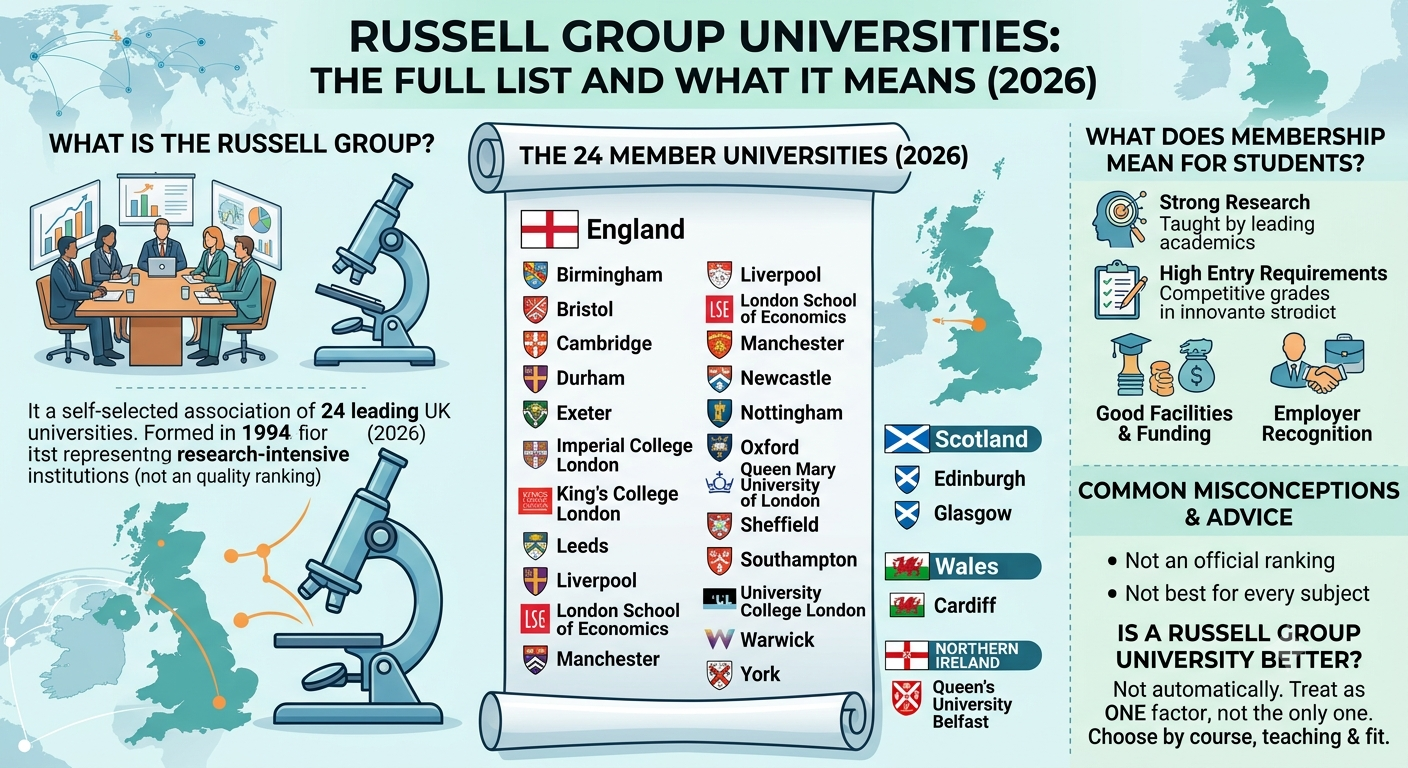
The Russell Group is a self-selected association of 24 leading UK universities, formed in 1994 to represent research-intensive institutions. It takes its name from the London hotel where its founding members first met. The group’s universities carry out a large share of the UK’s research and tend to have high entry requirements, extensive facilities and strong graduate reputations. It is essentially a membership body that lobbies on behalf of research-focused universities, not an official quality ranking.
Which universities are in the Russell Group?
There are 24 members. The table lists them, grouped by nation.
| Nation | Russell Group universities |
|---|---|
| England | Birmingham, Bristol, Cambridge, Durham, Exeter, Imperial College London, King’s College London, Leeds, Liverpool, London School of Economics, Manchester, Newcastle, Nottingham, Oxford, Queen Mary University of London, Sheffield, Southampton, University College London, Warwick, York |
| Scotland | Edinburgh, Glasgow |
| Wales | Cardiff |
| Northern Ireland | Queen’s University Belfast |
That makes 20 in England and one each in Scotland (two, in fact: Edinburgh and Glasgow), Wales and Northern Ireland. Membership has changed over time, most recently expanding in 2012, so confirm the current list on the official Russell Group site.
What does Russell Group mean for students?
For applicants, Russell Group membership signals a few things: strong research, which can mean being taught by leading academics; high entry requirements, so competitive grades; good facilities and funding; and a widely recognised name with employers. Many students see it as a mark of quality, and some graduate schemes historically favoured these universities. Those are real advantages worth weighing.
Is a Russell Group university better?
Not automatically, and this is the honest part. The Russell Group is about research intensity, not teaching quality or student experience, and it is not a league table. Many excellent courses, and some of the best in the country for specific subjects, are at universities outside the group. The right university depends on the course, the teaching, the location, the support and the fit for you, not just the label. Use subject-level league tables and open days, and treat Russell Group membership as one factor among several rather than the deciding one.
Common misconceptions about the Russell Group
- It is not an official ranking; it is a membership association of research-intensive universities.
- It does not mean the best university for every subject; specialist and non-member universities often lead in particular fields.
- It is not the same as the Oxbridge or the ‘top’ universities; the list is broader and fixed at 24 members.
- Membership does not guarantee the best teaching or student experience, which varies by course.
Wherever you study, strong study skills matter most once you are there. When you apply, our personal statement examples guide can help you write a strong application, and once you start, our how to write a first-class essay guide helps you get the most from your course.
Frequently asked questions
What is the Russell Group?
The Russell Group is an association of 24 research-intensive UK universities, formed in 1994, known for research strength, high entry requirements and strong reputations. It is a membership body, not an official ranking.
How many universities are in the Russell Group?
There are 24 member universities across England, Scotland, Wales and Northern Ireland, including Oxford, Cambridge, Imperial, UCL and Manchester.
Is a Russell Group university better than others?
Not automatically. Russell Group membership reflects research intensity, not teaching quality or student experience, and many excellent courses exist outside it. Choose by course, teaching and fit, not just the label.
Is the Russell Group a ranking?
No. It is a membership association of research-intensive universities, not a league table. For quality by subject, use subject-level university rankings instead.
Popular posts

How to Structure a University Assignment: Formats That Win Marks
June 23, 2026

How to Write a Dissertation in Four Weeks: A Realistic Week by Week Plan
July 24, 2026

What Happens If You Miss Your Dissertation Deadline in the UK
July 25, 2026

How Student Content Creators Can Get Paid Brand Deals in 2026
March 23, 2026

How to Write a Dissertation Introduction That Sets Up Your Whole Project
July 31, 2026



Want more tips & great deals? Get them sent to your inbox
Please enter a valid E-mail
By clicking "Subscribe" you agree to be contacted via e-mail. You can always unsubscribe from the newsletter


