
Ready by 8:02am Oct 3, 2026
MHRA Referencing: A Guide with Examples (2026)
MHRA referencing is a footnote style used in the arts and humanities, especially English and modern languages. You place a superscript number in the text and give the full citation in a footnote at the bottom of the page, then list all sources in a bibliography at the end. It differs from author-date styles like Harvard by using footnotes rather than in-text citations.
MHRA referencing, from the Modern Humanities Research Association, is the standard style for many arts and humanities courses, particularly English, history and modern languages. If you have only used author-date styles like Harvard, MHRA feels different, because it uses footnotes rather than in-text citations. This guide explains how MHRA works, how to format footnotes and the bibliography, with examples, and how it compares to other styles. It fits within the wider family of styles our referencing styles explained guide covers.
What is MHRA referencing?
MHRA is a footnote-based referencing style used widely in the humanities. Instead of an in-text citation giving the author and year, you place a small superscript number in your text at the point you use a source, and give the full reference in a footnote at the bottom of the page. All sources are then listed in a bibliography at the end. Its footnote system suits humanities writing, where detailed references and discursive notes are common, and it allows for commentary within footnotes as well as citations. This makes it quite different from author-date styles, which is the main adjustment students make when they first use MHRA.
How MHRA footnotes work
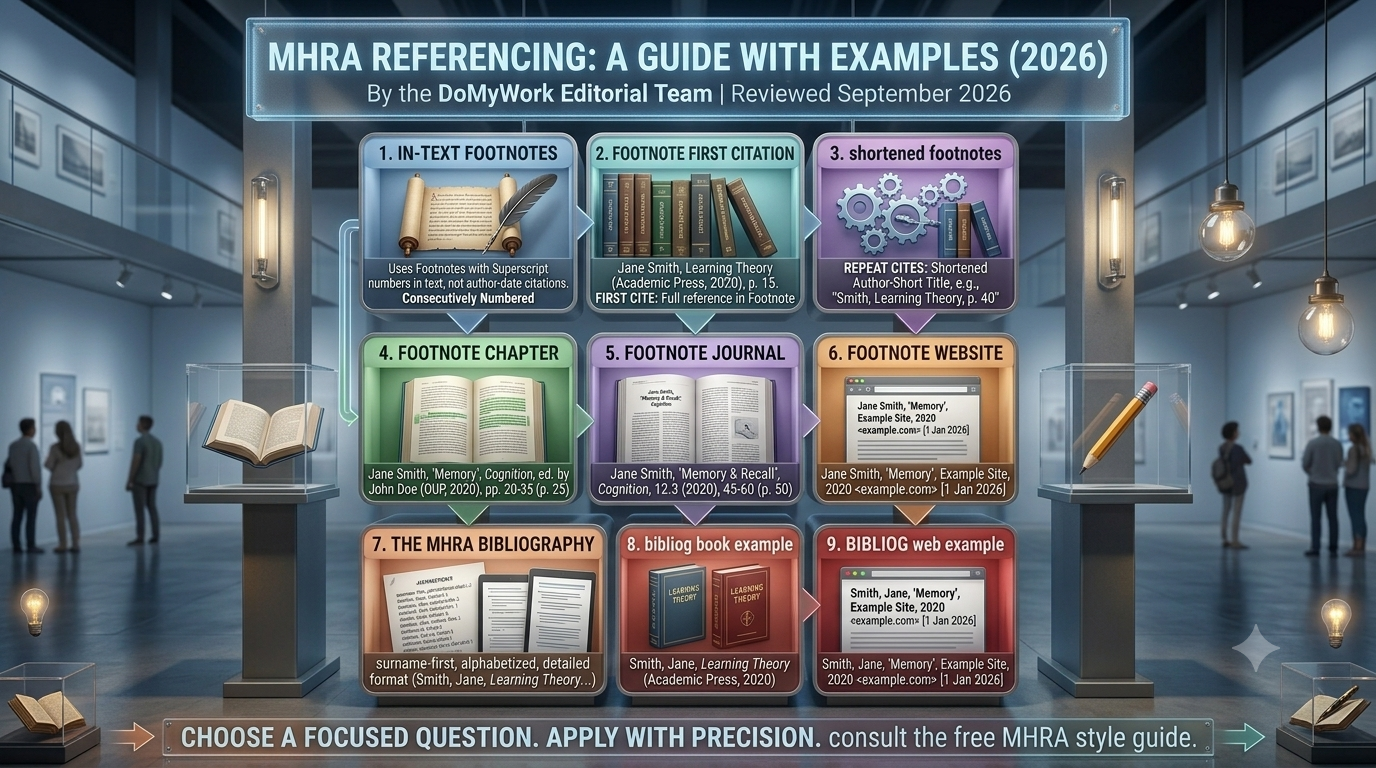
In MHRA, each time you cite a source, you insert a superscript number in the text, and a correspondingly numbered footnote appears at the bottom of the page with the full citation. The numbers run consecutively through your work. The first time you cite a source, you give the full reference in the footnote; for later citations of the same source, you use a shortened form, usually the author’s surname and a short title, to avoid repeating the full details. This first-full-then-short pattern is central to MHRA, and it keeps footnotes manageable while still letting the reader identify every source.
MHRA footnote formats
The footnote format differs by source type. Here are the common formats for a first, full citation:
Book: Jane Smith, Learning Theory (London: Academic Press, 2020), p. 15.
Chapter: Jane Smith, ‘Memory’, in Cognition, ed. by John Doe (Oxford: OUP, 2020), pp. 20-35 (p. 25).
Journal: Jane Smith, ‘Memory and Recall’, Cognition, 12.3 (2020), 45-60 (p. 50).
Website: Jane Smith, ‘Understanding Memory’, Example Site, 2020 <https://example.com> [accessed 1 January 2026].
Note that MHRA gives the author’s name in normal order (first name first) in footnotes, uses a page number for the specific reference, and encloses web URLs in angle brackets with an access date. These details matter, since MHRA is precise about punctuation and format.
The MHRA bibliography
As well as footnotes, MHRA requires a bibliography at the end, listing every source you have cited, ordered alphabetically by the author’s surname. The bibliography format differs slightly from the footnote format: crucially, the author’s name is inverted (surname first) so the list can be alphabetised, and page numbers for the specific reference are usually omitted. For example, a book that appeared in a footnote as ‘Jane Smith, Learning Theory…’ becomes, in the bibliography, ‘Smith, Jane, Learning Theory (London: Academic Press, 2020)’. Keeping the two formats straight, first-name-first in footnotes, surname-first in the bibliography, is one of the details students most often slip on in MHRA.
Shortened footnotes for repeat citations
Because giving the full reference every time would clutter the footnotes, MHRA uses shortened forms for any source cited more than once. After the first full footnote, later citations of the same work use just the author’s surname and a short version of the title, followed by the page number, for example: ‘Smith, Learning Theory, p. 40’. This keeps footnotes concise while still identifying the source clearly. Older guidance sometimes used Latin terms such as ibid. for consecutive references to the same work, though modern MHRA generally prefers the short author-and-title form throughout, so check the current MHRA Style Guide, which is freely available, for the up-to-date convention.
How MHRA differs from other styles
The biggest difference is that MHRA uses footnotes rather than in-text citations. Author-date styles like Harvard and APA place a brief (author, year) citation in the text and give full details in a reference list, as our Harvard referencing guide shows. MHRA instead uses a superscript number leading to a footnote, which suits the humanities. It is closer in spirit to OSCOLA, the footnote style used in law, though the formats differ. Knowing that MHRA belongs to the footnote family, alongside OSCOLA and Chicago’s notes system, rather than the author-date family, helps you understand why it works so differently from the referencing you may have used before.
When will you use MHRA, and where to find the rules
You are most likely to meet MHRA if you study English literature, modern languages, medieval or early-modern studies, or certain history and arts courses, since it is the house style of many humanities departments and journals in these fields. If your course specifies MHRA, it is because the footnote system suits writing that quotes and discusses texts closely, where a reader benefits from full references and the occasional explanatory note at the foot of the page. The definitive source is the MHRA Style Guide, which the Association publishes and makes freely available online, and it is worth consulting directly whenever you are unsure of a format, since it covers source types this guide does not, from manuscripts to films, and is periodically updated. Because MHRA is precise about punctuation and the difference between footnote and bibliography formats, keeping the official guide to hand as you write, rather than relying on memory, is the surest way to apply it correctly and consistently across a whole piece of work.
Tips for using MHRA correctly
MHRA rewards precision, so consistency in formatting and punctuation matters. Give full citations the first time and shortened forms thereafter, keep footnotes and the bibliography in their correct, distinct formats, and order the bibliography alphabetically by surname. Use the free MHRA Style Guide to check any format you are unsure of, since the details are specific. And, as with any style, cite every source you use, both to credit it and to avoid plagiarism. Before submitting, our plagiarism check confirms your referencing is complete. Applied carefully and consistently, MHRA is straightforward once its footnote logic clicks into place, and the effort of learning it pays off across every humanities essay you write in a style that expects it.
Popular posts

Does Turnitin Detect AI and ChatGPT Writing?
June 22, 2026

40 Dissertation Viva Questions and How to Answer Them
July 9, 2026
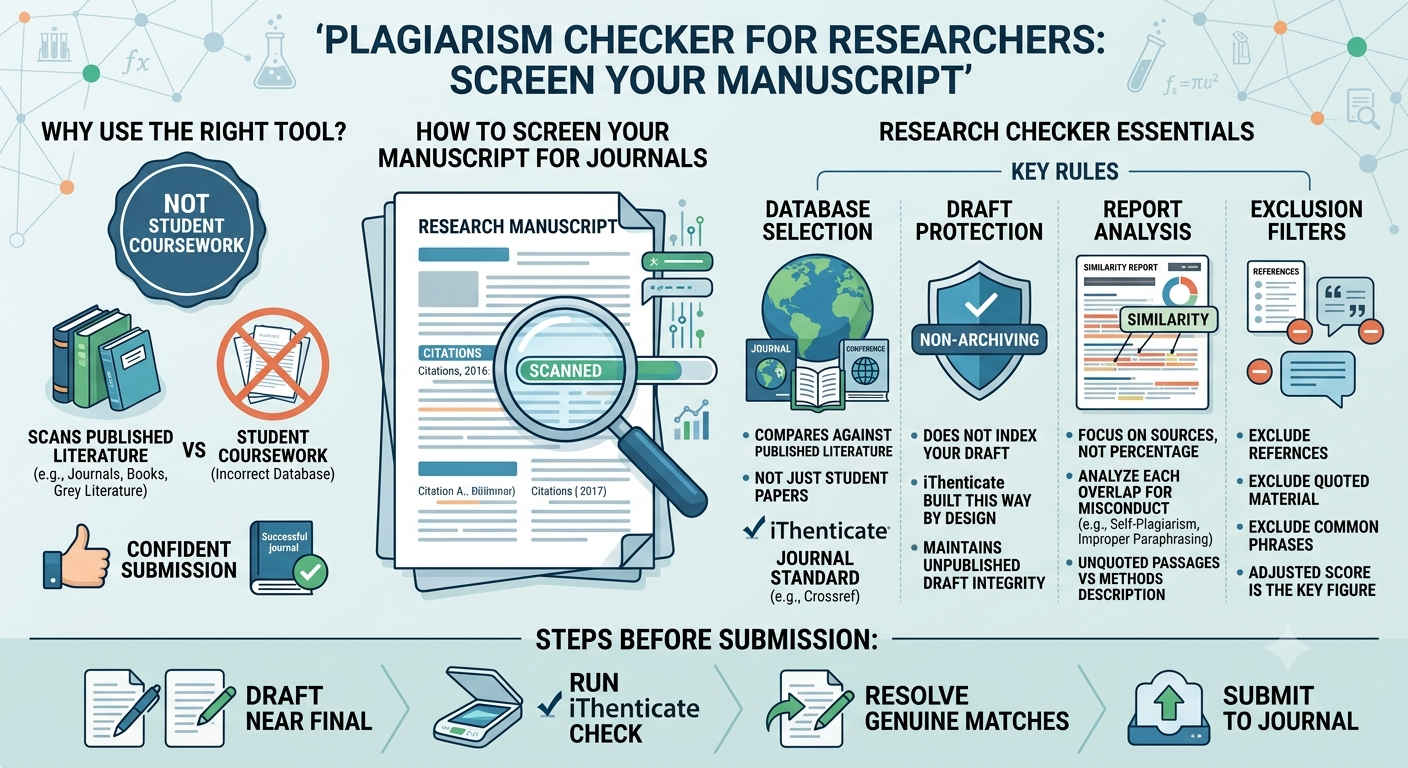
Plagiarism Checker for Researchers: How to Screen Your Manuscript
July 19, 2026

Harvard Referencing Made Simple: The Only Guide You Will Need in 2026
May 12, 2026

Quoting, Paraphrasing and Summarising: How to Use Sources Well
July 22, 2026

Want more tips & great deals? Get them sent to your inbox
Please enter a valid E-mail
By clicking "Subscribe" you agree to be contacted via e-mail. You can always unsubscribe from the newsletter


