
Ready by 7:27am Oct 25, 2026
Mosaic and Patchwork Plagiarism Explained
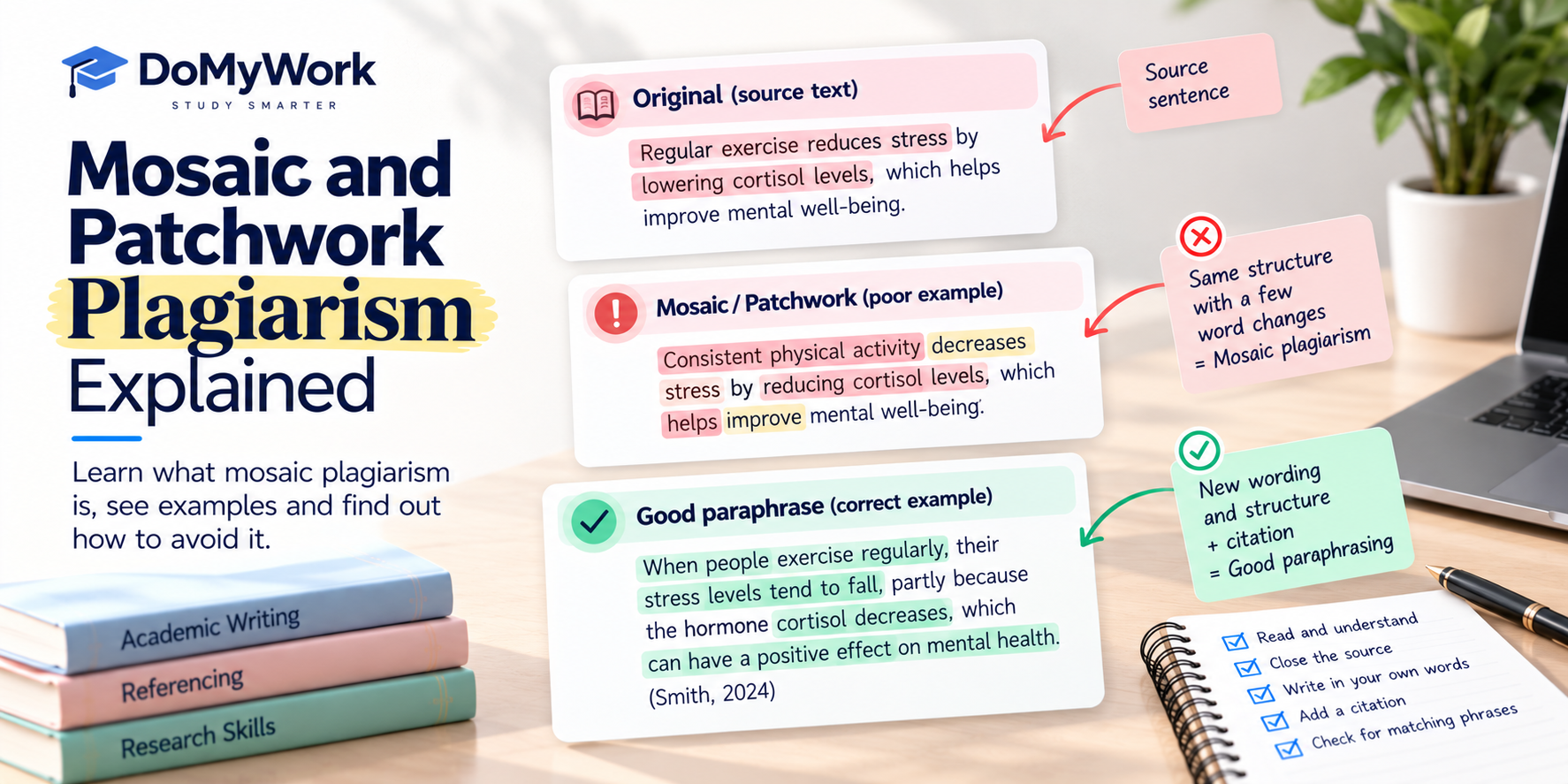
Mosaic or patchwork plagiarism is mixing copied phrases from a source with your own words, often by swapping a few words while keeping the original structure. It is easy to do by accident through close paraphrasing, and it still counts as plagiarism even when cited. The fix is to rebuild the idea fully in your own words from understanding.
Mosaic plagiarism is one of the sneakiest forms, because it does not feel like copying while you are doing it. You take a source, change some words, keep the shape of the sentences, and end up with something that looks like your own writing but is really a patchwork of the original. It is extremely common, often accidental, and still counts as plagiarism. Understanding it is the best way to stop doing it without realising.
What is mosaic or patchwork plagiarism?
Mosaic plagiarism, sometimes called patchwork plagiarism, is weaving copied or lightly altered phrases from a source into your own writing. Rather than copying a whole passage, you keep the original’s structure and key phrasing while swapping in a few of your own words, producing a patchwork of borrowed and original text. Because it mixes the two, it can slip past your own attention, but it borrows both the wording and the structure of the source, which is what makes it plagiarism.
Why is it so easy to do by accident?
It happens most when you write with the source open in front of you. You read a sentence, like how it puts the point, and rewrite it by editing the original rather than building a fresh sentence from your own understanding. Because you changed some words, it feels like your own work, but the bones are the author’s. Time pressure makes it worse, since editing a source is faster than genuinely rewriting, and a misunderstanding of paraphrasing makes it worse still, if you believe changing words is enough. The result is honest students producing mosaic plagiarism without any intent to cheat.
Examples of mosaic plagiarism
Imagine a source that says that regular exercise reduces stress by lowering cortisol levels. A mosaic version keeps the structure and swaps words, producing something like, consistent physical activity decreases stress by reducing cortisol, which is the same sentence with synonyms. Even with a citation, that is mosaic plagiarism, because the phrasing and structure are the author’s. A genuine paraphrase would rebuild it, for example, when people exercise often, their stress tends to fall, partly because the hormone cortisol drops. The difference is that the second version came from understanding, not editing.
- Swapping a few words in a source sentence while keeping its structure.
- Stitching together phrases from several sources with your own connectors.
- Reordering a source’s clauses but keeping its wording.
- Keeping the author’s distinctive phrasing inside an otherwise original paragraph.
How do I avoid it?
The reliable fix is to write away from the source. Read the passage until you understand the point, then close the source completely and write the idea from memory in your own words and your own structure. Because you are building the sentence yourself rather than editing the original, it comes out genuinely yours. Reopen the source afterwards only to check accuracy and add the citation. This single habit, closing the source before you write, prevents most mosaic plagiarism. For the wider skill, see paraphrasing versus plagiarism.
How do checkers catch it?
Similarity tools like Turnitin match strings of words, so mosaic plagiarism that keeps enough of the original phrasing will often still flag, even though you changed some words, because the matching runs of words remain. A thorough rewrite that genuinely changes the structure may not match at all. This is another reason to rebuild ideas rather than edit them, and a reason to check your draft before submitting, since mosaic passages are exactly the kind that show up. For the wider definition of plagiarism this sits within, see what counts as plagiarism.
Why mosaic plagiarism is so common among honest students
Mosaic plagiarism is rarely the work of someone trying to cheat. It is usually the result of a genuine misunderstanding, the belief that changing words is the same as paraphrasing. A student reads a strong sentence, swaps several words for synonyms, keeps the structure, adds a citation, and sincerely believes they have done the right thing. They have not, but the mistake is one of technique rather than intent. That is why mosaic plagiarism is worth explaining clearly, because most people doing it would stop instantly if they understood that structure and phrasing count, not just individual words.
The difference between editing and rewriting
The heart of the problem is the difference between editing a source and rewriting an idea. Editing means working on top of the original, changing words while its sentences stay in place, which leaves the author’s structure intact and produces mosaic plagiarism. Rewriting means setting the source aside and building the point fresh from your own understanding, which produces genuinely new text. The tell is whether the source was open in front of you as you wrote. If it was, you were probably editing. If you closed it and wrote from memory, you were rewriting. That single habit, closing the source, is what separates the two.
How to avoid mosaic plagiarism
Mosaic plagiarism happens when you weave copied phrases into your own sentences, keeping fragments of the source rather than rebuilding the idea. The fix is the same as for any close paraphrasing problem. Read the source until you understand the point, then close it and write the idea entirely in your own words, so no fragments of the original survive. If you want to keep a striking phrase, quote it properly with quotation marks and a citation. The habit that prevents mosaic plagiarism is never writing with the source open in front of you, since that is what tempts you to keep its wording piece by piece.
Frequently asked questions
Is mosaic plagiarism still plagiarism if I cite the source?
Yes. Citing credits the idea, but mosaic plagiarism borrows the wording and structure too, which needs genuine rewriting or quotation marks, not just a citation.
How is mosaic plagiarism different from paraphrasing?
Proper paraphrasing rebuilds an idea in your own words and structure. Mosaic plagiarism keeps the source’s structure and phrasing while swapping a few words, which is not genuine paraphrasing.
Will Turnitin catch patchwork plagiarism?
Often yes, because it matches runs of words, and mosaic text keeps enough of the original to flag. A genuine rewrite is less likely to match.
How do I stop doing it by accident?
Write away from the source. Read, close the source, write the point from memory, then reopen only to check accuracy and add the citation.
Is mosaic plagiarism deliberate?
Usually not. It most often comes from a genuine misunderstanding that changing words counts as paraphrasing. The fix is technique, rebuilding the idea rather than editing the source.
Does adding more synonyms help?
No. More synonyms over the same structure is still mosaic plagiarism and often reads worse. The fix is to rewrite the idea from your own understanding, not to swap more words.
Does Turnitin catch mosaic plagiarism?
Often yes, because the copied fragments still match their source even when surrounded by your own words. Rebuilding the idea fully in your own words is the reliable fix.
| Not sure if a paragraph is patchwork? Check your draft free and see which passages still match the source. |
Popular posts

Primary vs Secondary Research: Which Should You Use?
February 25, 2026
Turnitin Alternatives for Students and Researchers
July 3, 2026

Dissertation Extension Requests: What Counts as Mitigating Circumstances
July 27, 2026

120+ Business Dissertation Topics and Ideas for 2026
March 2, 2026

How to Complete a Commercial Cookery Logbook (SITHCCC Units Guide)
July 4, 2026

Want more tips & great deals? Get them sent to your inbox
Please enter a valid E-mail
By clicking "Subscribe" you agree to be contacted via e-mail. You can always unsubscribe from the newsletter


