
Ready by 1:45pm Oct 10, 2026
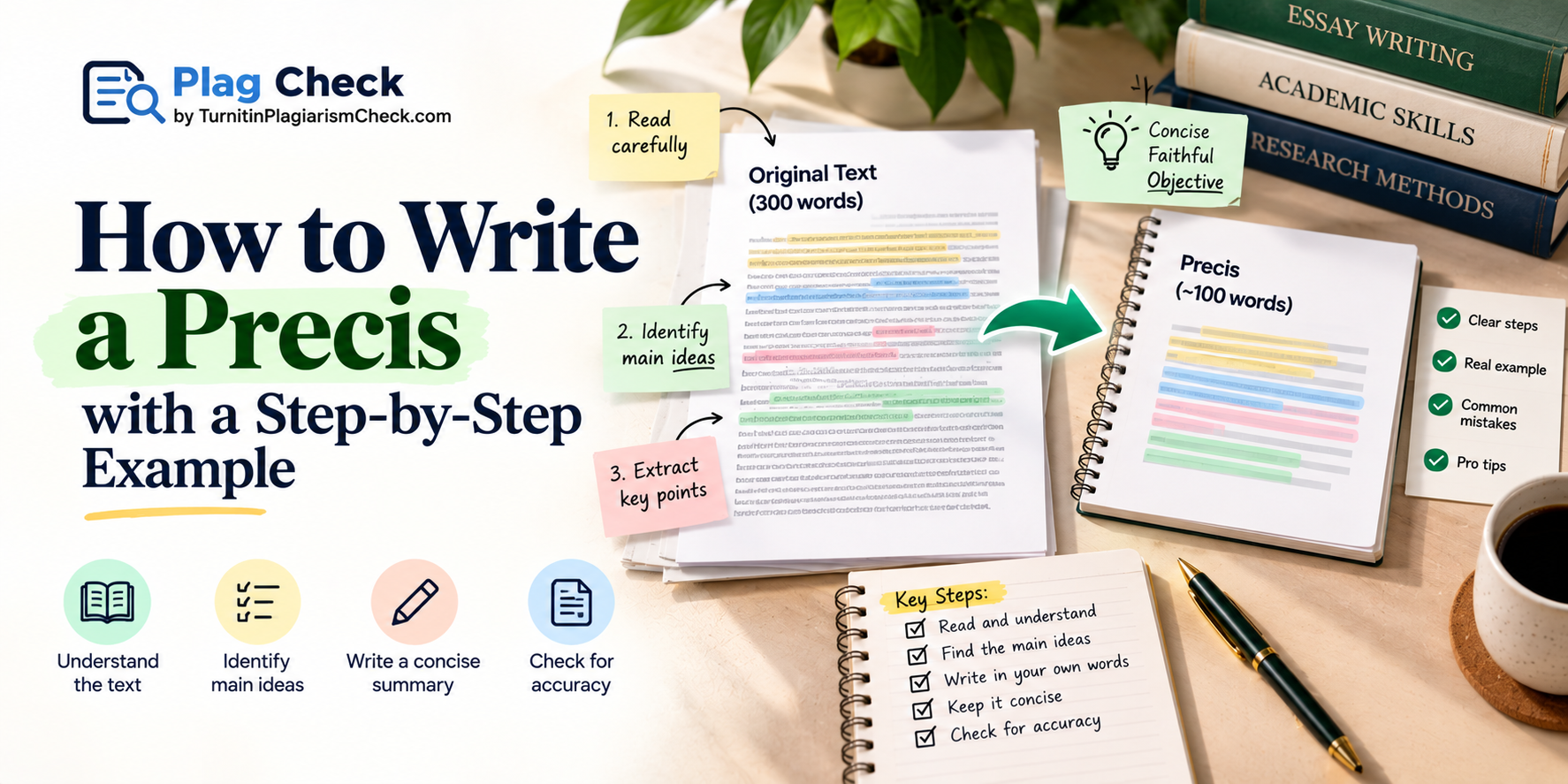
How to Write a Precis with a Step-by-Step Example
A precis is a short, precise summary of a text that captures its main ideas in your own words, usually about a third of the original length. To write one, read the text closely, identify the main points, and rewrite them concisely and accurately without adding opinion, examples or your own commentary. A good precis is faithful, concise and objective.
A precis is one of the most useful academic skills and one of the most underrated: the ability to condense a text into a short, accurate summary in your own words. It trains you to identify what matters in a source, understand it deeply, and express it concisely, all of which feed into essays, literature reviews and revision. This guide explains what a precis is, how to write one step by step, and the mistakes to avoid, with an example. The summarising skill it builds is closely related to paraphrasing, which our quoting, paraphrasing and summarising guide covers.
What is a precis?
A precis is a concise summary of a longer text that captures its essential meaning and main ideas in your own words. It is usually about a third of the length of the original, though the exact proportion varies. What defines a precis is that it is faithful, conveying the author’s meaning accurately without distortion; concise, including only the main points and cutting detail, examples and repetition; and objective, presenting the author’s ideas without adding your own opinion or commentary. A precis is not a paraphrase of the whole text, nor a review; it is a compressed, accurate restatement of what the text says, in your own words.
Why writing a precis is useful
Learning to write a precis develops several skills at once. It forces you to read closely and understand a text deeply, since you cannot summarise what you do not grasp. It trains you to identify the main ideas and distinguish them from supporting detail, which is essential for research and note-taking. And it develops concise, precise writing, since a precis has no room for padding. These skills transfer directly to academic work: summarising sources for a literature review, taking effective notes, and writing with economy all draw on the same ability. A precis is often set as an exercise precisely because it builds these core academic abilities.
How to write a precis: step by step
Writing a good precis follows a clear process:
- Read the text closely, more than once, until you fully understand its meaning and main argument.
- Identify the main ideas, the central points the author is making, and separate them from examples and detail.
- Note the author’s purpose and the overall message, so your precis reflects the text’s intent.
- Write the summary in your own words, covering only the main ideas, in about a third of the original length.
- Check it against the original for accuracy, and cut anything that is detail rather than a main point.
Working in this order, from understanding to selection to concise rewriting, is what produces a precis that is both faithful and short, rather than either a distortion or a near-copy.
An example of the approach
Imagine a 300-word passage arguing that remote work improves productivity but weakens team cohesion, using several studies and examples. A precis of about 100 words would capture only the core argument: that remote work tends to raise individual productivity while making it harder to maintain team relationships and a shared culture, and that organisations therefore face a trade-off between the two. Notice what the precis does: it states the main argument accurately, in different words, and leaves out the specific studies, examples and detail. That selection, keeping the essential argument and cutting the supporting material, is the heart of writing a precis, and it is what distinguishes a precis from a full paraphrase.
Precis versus summary versus paraphrase
These three are related but distinct. A paraphrase restates a specific passage in your own words at roughly the same length, changing the wording but not shortening it much. A summary condenses a text to its main points, and a precis is a particular, disciplined kind of summary: concise, proportional to the original, faithful and objective, often set as a formal exercise. So a precis is a tightly controlled summary rather than a loose one. Knowing the difference matters because a task that asks for a precis expects that discipline, whereas a general summary allows more flexibility, and our quoting, paraphrasing and summarising guide sets the three side by side.
Common precis mistakes to avoid
● Copying phrases from the original instead of writing in your own words.
● Adding your own opinion, commentary or examples, when a precis stays objective.
● Including minor details and examples rather than only the main ideas.
● Distorting or misrepresenting the author’s meaning.
● Making it too long, when a precis should be about a third of the original.
Because a precis is written in your own words, it also reinforces good academic habits: expressing sources in your own language rather than copying is central to how you avoid plagiarism.
How long should a precis be?
The usual guide is that a precis should be about a third of the length of the original text, though the exact proportion depends on the task and the density of the source. A very detailed text with lots of repetition can be condensed more sharply, while a dense, tightly written one may need slightly more. What matters more than a precise fraction is the principle: a precis includes only the main ideas and cuts everything else, so its length follows from ruthless selection rather than a word target. If your precis is coming out much longer than a third, you are probably keeping detail and examples that should go; if it is far shorter, you may have cut genuine main points. Let faithful coverage of the key ideas, at the shortest length that preserves them, decide the length.
Finally, remember that the discipline a precis teaches, capturing an author’s meaning accurately and concisely in your own words, is exactly what you draw on every time you summarise a source in an essay or a literature review. Students who can write a good precis tend to write better summaries throughout their academic work, because they have practised separating the essential from the incidental. So even when a precis is set purely as an exercise, the skill it builds pays off far beyond the task itself.
Final tips for a strong precis
Aim for accuracy above all, since a concise summary that misrepresents the text has failed at its main job. Keep it objective, resisting the urge to react to or judge the ideas, and keep it proportional, cutting until only the main points remain. Read your precis against the original one final time to check you have captured the essential meaning faithfully and left out the detail. Done well, a precis shows that you have understood a text deeply enough to distil it, which is a skill that will serve you across every piece of academic work you write, from summarising sources to sharpening your own arguments.
Popular posts
How to Write a Precis with a Step-by-Step Example
October 9, 2026
How to Write a Report with Structure and Tips
October 7, 2026
Proper Essay Format: A Complete Guide (2026)
October 6, 2026
Aims, Objectives and Research Questions Explained (2026)
October 5, 2026
How to Write an Explanatory Essay (2026)
October 4, 2026
Want more tips & great deals? Get them sent to your inbox
Please enter a valid E-mail
By clicking "Subscribe" you agree to be contacted via e-mail. You can always unsubscribe from the newsletter


