On this page
- How do the five systems compare at a glance?
- How does the US grading system work?
- How does the UK grading system work?
- How does the Australian grading system work?
- How does the Canadian grading system work?
- How does grading work in the EU?
- Why does this matter when you compare results?
- Frequently Ask Questions
The short answer
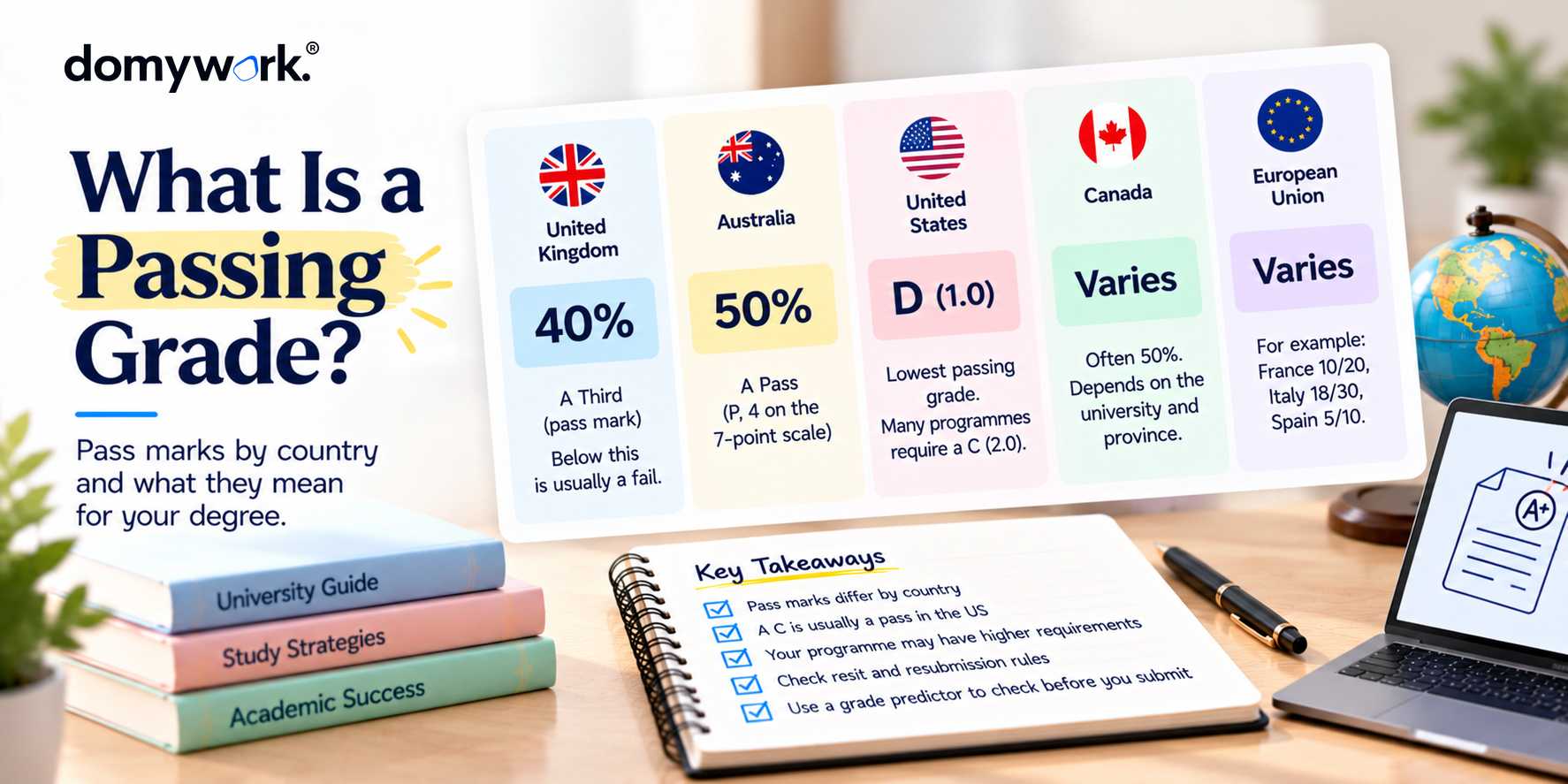
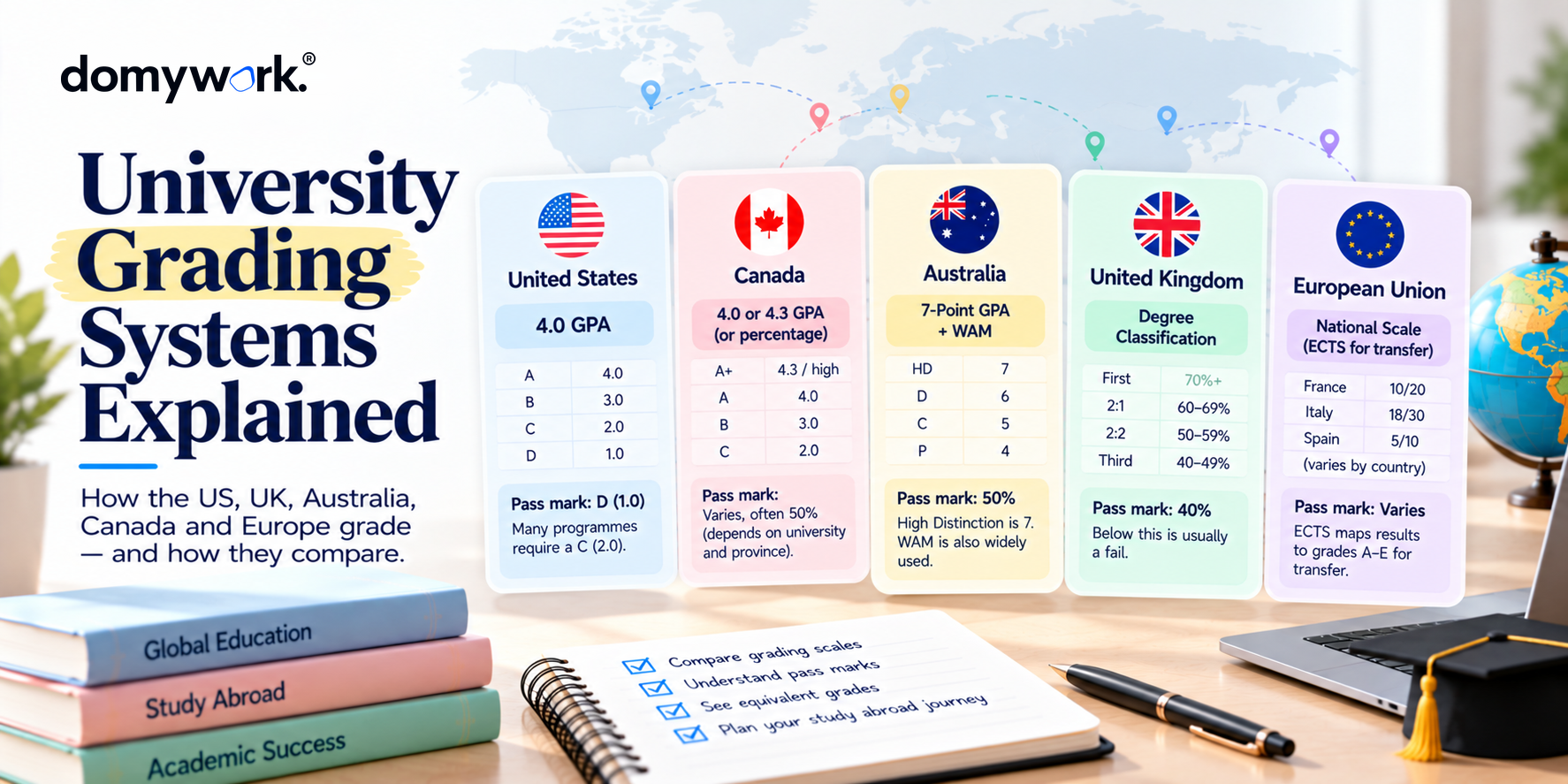
University grading is not the same across countries. The US and Canada use a 4.0 grade point average, Australia uses a 7-point scale and a percentage WAM, the UK uses degree classifications, and most of Europe keeps national scales linked by ECTS. Here is how each one works and how they line up.
How do the five systems compare at a glance?
| Region | Main measure | Top band | Pass mark | Source |
|---|---|---|---|---|
| United States | 4.0 GPA | A (4.0) | D (1.0); many programmes need a C (2.0) | apporto.com |
| Canada | 4.0 or 4.3 GPA, or percentage | A or A+ | Varies, often 50 per cent | idp.com |
| Australia | 7-point GPA plus WAM | High Distinction (7) | 50 per cent | openeducat.org |
| United Kingdom | Degree classification | First (70 per cent and above) | 40 per cent | prospects.ac.uk |
| EU (varies) | National scale, ECTS for transfer | Top of each scale | Varies by country | ECTS Users’ Guide 2015 |
How does the US grading system work?
US universities convert each grade into points on a 4.0 scale, then take a credit-weighted average (apporto.com). An A is 4.0, a B is 3.0 and a C is 2.0. A D (1.0) is the lowest passing grade, though many programmes require a 2.0 (C) average to graduate. The result is a cumulative GPA shown on your transcript. The step by step is in how to calculate your GPA.
How does the UK grading system work?
The UK does not use a GPA. Marks are given as percentages and combined into a single degree classification at the end (prospects.ac.uk):
| Classification | Common name | Percentage |
|---|---|---|
| First Class Honours | First, 1st | 70 and above |
| Upper Second | 2:1 | 60 to 69 |
| Lower Second | 2:2 | 50 to 59 |
| Third Class | Third, 3rd | 40 to 49 |
| Fail | Below 40 |
The pass mark is typically 40 per cent, and a 2:1 is the most commonly awarded classification (prospects.ac.uk). For how the marks are decided, see how UK universities mark essays.
How does the Australian grading system work?
Australian universities mostly use a 7-point GPA and a percentage-based Weighted Average Mark (openeducat.org):
| Grade | Label | GPA points | Typical range |
|---|---|---|---|
| HD | High Distinction | 7 | 80 to 85 and above |
| D | Distinction | 6 | 70 to 84 |
| C | Credit | 5 | 60 to 74 |
| P | Pass | 4 | 50 to 64 |
| F | Fail | 0 | Below 50 |
The exact band boundaries vary between universities. The pass mark is 50 per cent, and honours and research entries usually look at WAM rather than GPA.
How does the Canadian grading system work?
Canada has no single standard (idp.com). Ontario universities such as Toronto use a 4.0 scale. Alberta universities and McGill use a 4.3 scale that reserves the top point for an A+. Waterloo and Quebec report percentages, and some provinces use a 9-point scale. The calculation is still a credit-weighted average, but the scale depends on the institution, so always read your transcript’s own key.
How does grading work in the EU?
There is no single EU grade. Each country keeps its national scale, for example France out of 20 (pass 10), Italy out of 30 (pass 18) and Spain out of 10 (pass 5) (ECTS Users’ Guide 2015). ECTS is a translation layer, not a grade of its own: it ranks passing students and maps them to grades A to E by statistical distribution so results transfer between countries in the European Higher Education Area.
Why does this matter when you compare results?
Because the same number means different things on different scales. A 3.5 is excellent on a 4.0 scale but mid-range on a 4.3 one, and a UK 68 per cent is a strong 2:1 even though the number looks low next to a US percentage. When you apply abroad, registrars and services like WES convert your grades rather than reading them at face value (idp.com).
Frequently Ask Questions
Does every country use a GPA?
No. GPA is used in the US, Canada and Australia. The UK uses classifications and most of Europe uses national scales.
What is the pass mark in the UK?
Typically 40 per cent, which is the lowest honours boundary (a Third).
What is the Australian grading scale?
A 7-point scale: High Distinction 7, Distinction 6, Credit 5, Pass 4, Fail 0, plus a percentage WAM.
Written by the DoMyWork team. First published 28 Oct 2026.