On this page
The short answer
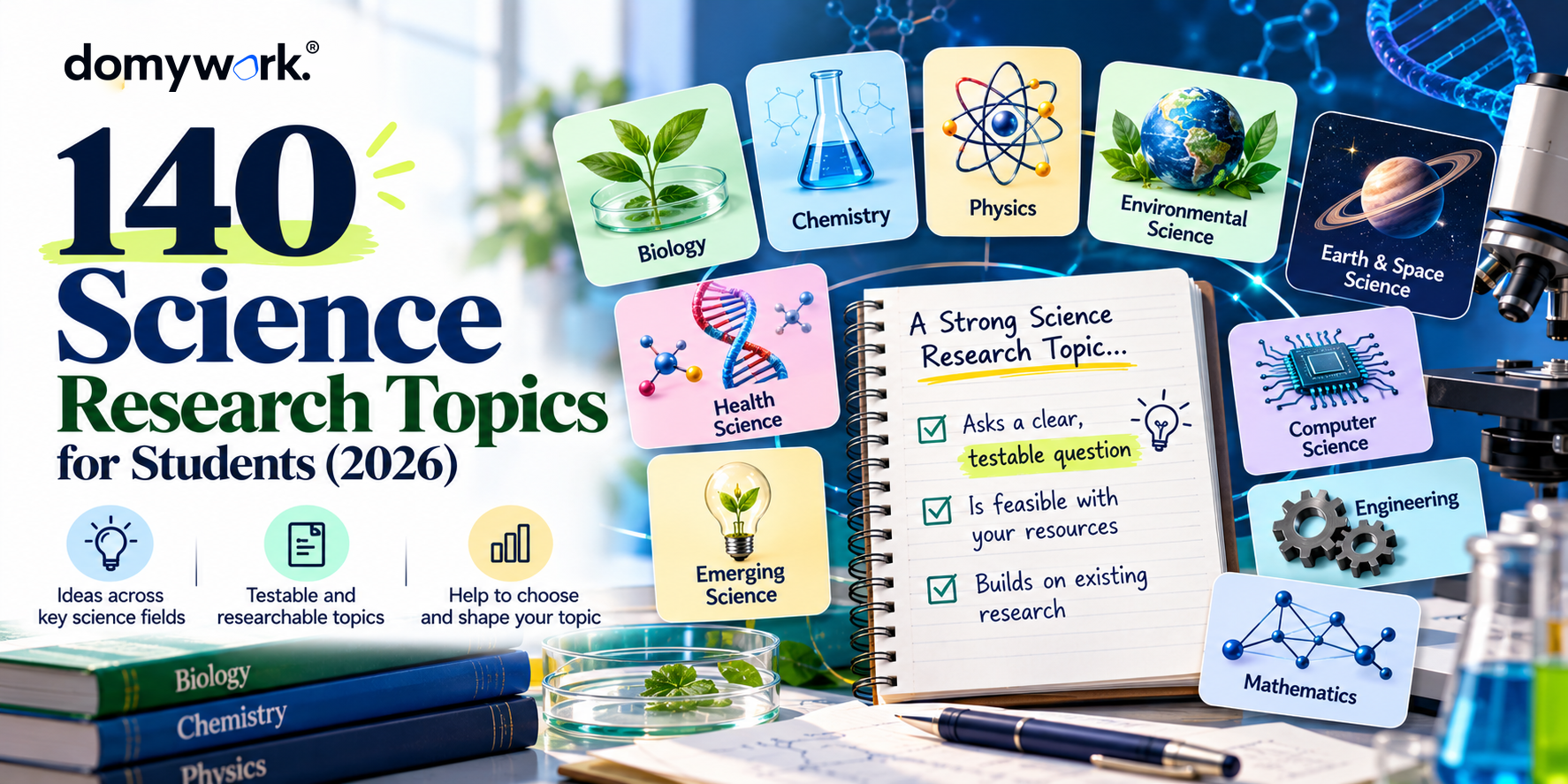
A strong science research topic asks a clear, testable question you can investigate with experiment or data. Fruitful fields include biology, chemistry, physics, environmental science, health science, and technology and engineering. This guide gives 140 topics grouped by field, with guidance on choosing one and shaping it into a research question.
Science research is built on questions you can test, so the best topics are not the biggest but the most answerable: a clear relationship you can investigate through experiment, observation or data. That focus on testability is what separates a workable science topic from a broad theme, and it depends on an early decision about how you will gather and treat your data, which our qualitative vs quantitative research guide helps you weigh, since most science projects are quantitative. This guide gives 140 topics grouped by field, then shows how to turn one into a research question.
What makes a good science research topic?
A good science topic has three qualities. It asks a clear, testable question, usually about how one variable affects another. It is feasible with the equipment, data and time you have, since a question you cannot test or measure is not a project. And it connects to existing science, so reading recent work, much as you would when writing a literature review, shows you what is known and where a gap lies. The most common mistake is choosing something too broad: ‘climate change’ is a field, while ‘how urban tree cover affects local air temperature’ is a question you can investigate with data. Narrow every promising idea to that level of focus.
140 science research topics by field
The topics below are grouped by field. Narrow any of them to a specific context, sample or dataset you can work with.
Biology
- How light exposure affects the growth rate of plants.
- What factors influence the development of antibiotic resistance?
- How diet affects enzyme activity in cells.
- What conditions improve the efficiency of photosynthesis?
- How genetic mutations alter protein function.
- What factors shape population dynamics in an ecosystem.
- How temperature affects enzyme reaction rates.
- What conditions affect seed germination success.
- How pollutants affect aquatic organisms.
- What mechanisms control gene expression?
- How microbiome diversity influences health.
- What factors shape biodiversity in a habitat?
- How invasive species disrupt ecosystems.
- What drives adaptation in changing environments.
Chemistry
- How reactant concentration affects reaction rate.
- What factors influence the solubility of salts?
- How temperature shifts chemical equilibrium.
- What affects the effectiveness of a catalyst?
- How pH alters enzyme activity.
- What causes differences in corrosion among metals?
- How molecular structure influences boiling point.
- What sources of error appear in titration.
- How surface area affects reaction speed.
- What chemical processes affect battery efficiency.
- How solvent polarity influences solubility.
- What factors stabilise colloidal solutions?
- How antioxidants slow oxidation.
- What limits product yield in a synthesis reaction.
Physics
- How air resistance affects projectile motion.
- What factors influence solar panel efficiency.
- How temperature changes electrical resistance.
- What limits the precision of gravity measurements.
- How magnetic fields affect charged particles.
- What affects energy loss in mechanical collisions?
- How sound travels differently through materials.
- What explains variation in pendulum motion.
- How lens curvature affects image clarity.
- What affects the resonance frequency of a system?
- How pressure changes the behaviour of gases.
- What influences heat transfer through insulation.
- How friction affects rotational motion.
- What variables shape light diffraction patterns.
Environmental science
- How urban development affects local air quality.
- What impact plastic waste has on freshwater ecosystems.
- How soil composition influences crop yield.
- What factors affect water quality in rivers?
- How temperature change influences local biodiversity.
- What effect deforestation has on soil erosion.
- How seasonal change affects carbon dioxide levels.
- What impact traffic has on noise pollution.
- How fertiliser use affects groundwater.
- What relationship exists between rainfall and plant growth?
- How land-use change affects wildlife habitats.
- What role vegetation plays in reducing urban heat.
- How recycling behaviour varies across communities.
- What affects the breakdown rate of biodegradable materials?

Earth and space science
- How ocean currents affect regional climate.
- What factors influence volcanic activity?
- How the water cycle responds to warming.
- What affects the accuracy of weather prediction.
- How soil type affects landslide risk.
- What causes variation in tidal patterns.
- How urbanisation affects local weather.
- What factors shape river erosion.
- How atmospheric pressure affects weather systems.
- What influences the formation of clouds?
- How light pollution affects night-sky observation.
- What role oceans play in carbon storage.
- How glacial melt affects sea levels.
- What factors affect earthquake frequency in a region.
Health and medical science
- How exercise affects resting heart rate.
- What impact sleep has on cognitive performance.
- How diet affects energy levels.
- What relationship exists between hydration and concentration.
- How physical activity affects stress hormones.
- What effect posture has on muscle fatigue.
- How hand hygiene influences illness frequency.
- What factors affect recovery after physical strain.
- How caffeine affects blood pressure.
- What impact screen time has on sleep quality.
- How nutrition relates to immune function.
- What role vaccination plays in disease control.
- How lifestyle affects long-term health outcomes.
- What factors influence antibiotic effectiveness?
Technology and computer science
- How software design affects user efficiency.
- What factors influence cybersecurity vulnerability.
- How machine learning improves data analysis.
- What impact automation has on productivity.
- How algorithm choice affects search efficiency.
- What factors affect mobile application performance.
- How cloud computing affects data storage.
- What role encryption plays in protecting data.
- How interface design influences user satisfaction.
- What affects battery life in portable devices?
- How network congestion affects data transfer.
- What factors influence adoption of new technology?
- How data backup frequency affects data loss risk.
- What improves reliability in software systems.
Engineering
- How material selection affects structural load capacity.
- What design features improve building energy efficiency.
- How sensor placement influences system accuracy.
- What affects the durability of recycled materials?
- How structural geometry affects stress distribution.
- What limits efficiency in wind turbine design.
- How cooling systems extend device lifespan.
- What factors influence composite material strength?
- How control systems stabilise mechanical processes.
- What affects accuracy in 3D-printed parts.
- How load variation causes mechanical fatigue.
- What strategies reduce construction material waste.
- How environmental exposure affects material degradation.
- What improves performance in energy storage systems.
Mathematics and data science
- How patterns in prime numbers support cryptography.
- What real-world problems rely on graph theory.
- How probability guides risk assessment.
- What role matrices play in computer graphics.
- How algorithms improve search efficiency.
- What limits accuracy in numerical approximation.
- How statistics reveal bias in data sets.
- What applications rely on linear optimisation.
- How probability distributions model real data.
- What assumptions weaken regression analysis.
- How data visualisation improves interpretation.
- What mathematical models describe population growth.
- How chaos theory explains unpredictable systems.
- What patterns emerge in fractal geometry.
Emerging and interdisciplinary science
- How machine learning improves medical diagnosis.
- What role mathematics plays in climate modelling.
- How engineering supports sustainable agriculture.
- How data science enhances public health monitoring.
- What impact technology has on conservation.
- How biological systems inspire robotic design.
- What role physics plays in medical imaging.
- How computer modelling supports chemical research.
- How sensors improve environmental data collection.
- What influence AI has on energy efficiency.
- How mathematical models predict disease spread.
- What impact automation has on laboratory accuracy.
- How chemistry supports advances in materials science.
- What challenges arise in combining scientific disciplines.

How do you turn a topic into a research question?
A topic is a starting area; a research question is what your study answers, so the next step is to sharpen one into the other. Take your chosen area, add specific variables and a context, and phrase it as a question you can test, so ‘photosynthesis’ becomes ‘how does light intensity affect the rate of photosynthesis in a chosen plant?’. From there you decide how to gather your data, whether through experiment or an existing dataset, a choice our primary vs secondary research guide helps you make, and for data-heavy projects our statistics project ideas guide shows how to plan the measurement. Set the whole plan out in a research proposal, and ground the question in existing science so it builds on what is known.
Tips for choosing your topic
- Start with a field that interests you, then narrow to a specific, testable question.
- Check you can measure or gather data on the question with the equipment and time you have.
- Keep the variables clear, so you know what you are changing and what you are measuring.
- Read recent research to find gaps and avoid over-studied questions.
- Keep the scope tight; a narrow question tested well beats a broad one you cannot complete.
Once you have a topic and question, the next step is planning the study and writing it up. Our how to structure an assignment guide helps you organise the report clearly. Whichever field you choose above, the same principle holds throughout: pick a testable question, make sure you can gather the data, and let a clear, evidenced analysis carry the work.
Written by the DoMyWork team. First published 13 Oct 2026.