On this page
The short answer
A persuasive essay argues a clear position and tries to convince the reader to accept it. To write one, take a clear stance, support it with strong evidence and reasoning, use persuasive techniques, and address counter-arguments fairly before refuting them. A strong structure and a confident, reasoned tone are what make it convincing.
A persuasive essay sets out to convince the reader of a particular position, which makes it one of the most engaging kinds of essay to write and one of the most demanding to do well. Persuasion is not about forcing an opinion; it is about building a case so well-reasoned and well-supported that the reader is convinced. This guide explains how to write a persuasive essay: taking a position, building your argument, using persuasive techniques, and handling counter-arguments. The clear, arguable position it depends on is exactly what our thesis statement guide helps you build.
What is a persuasive essay?
A persuasive essay is a piece of writing that argues a clear position on an issue and aims to convince the reader to accept it. Unlike an informative essay, which explains objectively, a persuasive essay takes a side and makes a case for it. It combines reasoned argument, strong evidence and persuasive language to move the reader towards your view. What separates a good persuasive essay from a rant is that it persuades through evidence and reasoning, fairly engaging with other views, rather than through assertion or emotion alone. It is closely related to the argumentative essay and to the opinion essay, and our opinion essay topics guide offers ideas to argue.
Take a clear position
A persuasive essay must have a clear, definite position, stated as a strong thesis, since you cannot persuade a reader of a view you have not clearly taken. Choose a debatable issue, where a reasonable person could disagree, and commit to one side. Vagueness is fatal to persuasion, so your thesis should state exactly what you are arguing, and the whole essay should drive towards convincing the reader of it. Sitting on the fence, or arguing a position so obvious that no one would dispute it, undermines the essay, so take a clear, arguable stance from the outset and defend it throughout.
Support your argument with evidence
Persuasion rests on evidence, not just conviction. Support every point with strong evidence, facts, statistics, examples, expert opinion and research, so the reader has reasons to accept your view rather than just your say-so. Choose credible sources and relevant, compelling evidence, and integrate it into your argument, explaining how it supports your position. An essay full of assertion persuades no one, while one grounded in solid evidence is genuinely convincing. Reference your sources properly, as our how to cite sources guide covers, since credible referencing itself adds to your persuasiveness by showing your argument is well-founded.

Use persuasive techniques
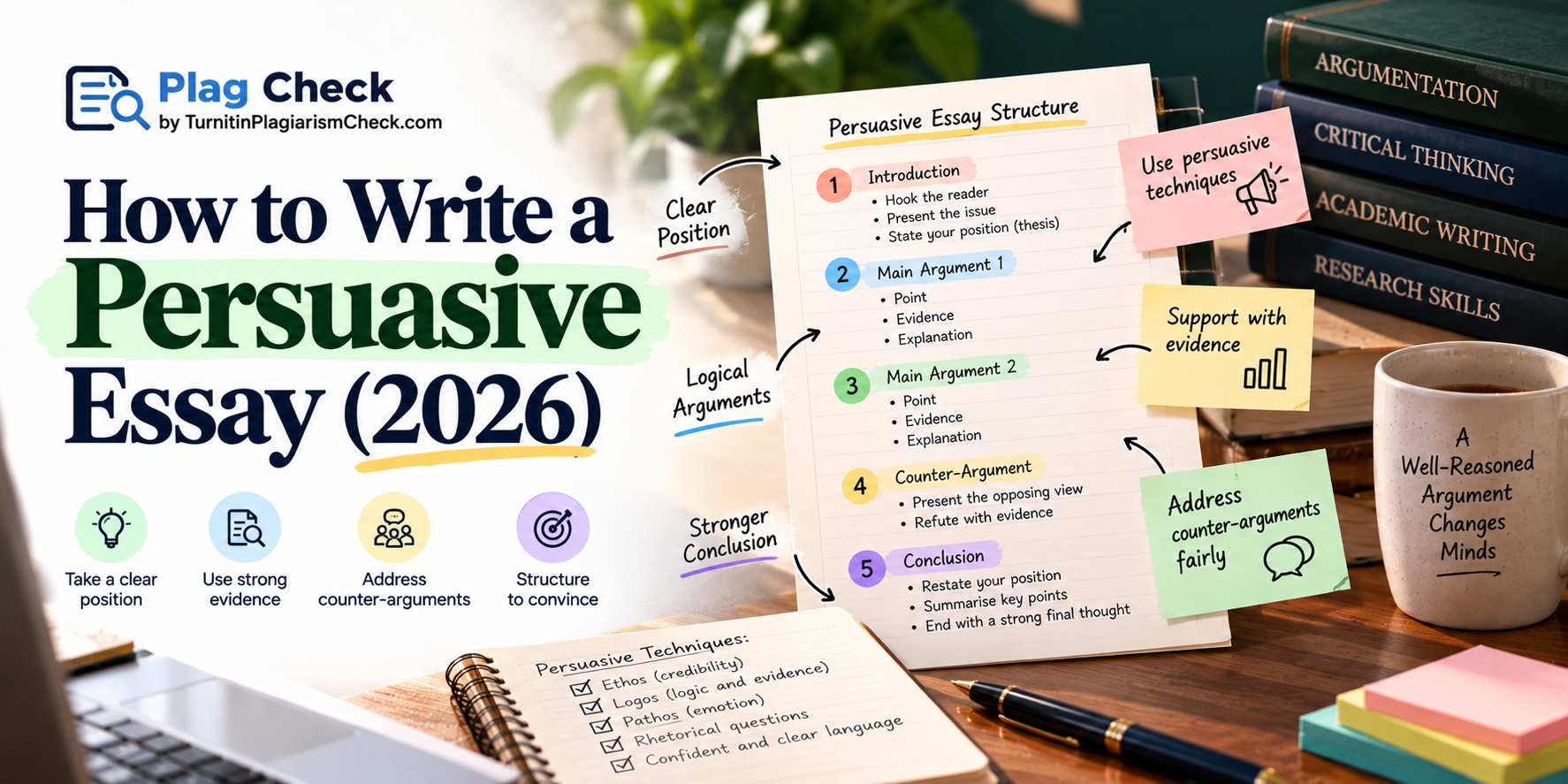
Alongside evidence, persuasive writing uses rhetorical techniques to strengthen its effect. The classical appeals are a useful framework: ethos, establishing credibility and trust; logos, appealing to logic and evidence; and pathos, appealing to the reader’s emotions and values. In academic persuasive writing, logos, sound reasoning and evidence, should dominate, with ethos and pathos used carefully to support rather than replace it. Techniques such as rhetorical questions, confident language and vivid examples can reinforce your case, but they work best on top of solid argument. Persuasion that relies on emotion without evidence is weak, so let reasoning lead and rhetoric support it.
Address counter-arguments
Counter-intuitively, the most persuasive essays acknowledge the opposing view rather than ignoring it. Addressing a counter-argument fairly, then explaining why your position still holds, makes your case stronger, because it shows you have considered the issue fully and are not simply dismissing the other side. Ignoring obvious objections, by contrast, makes your argument look one-sided and leaves the reader’s doubts unanswered. So identify the strongest argument against your position, present it fairly, and then refute it with evidence and reasoning, a technique our guide to a rebuttal in an argumentative essay develops. Answering the other side is often what tips a sceptical reader towards your view.
How to structure a persuasive essay
A persuasive essay follows a clear structure. The introduction hooks the reader, presents the issue, and states your position as a strong thesis. The body then develops your argument across several paragraphs, each making one point supported by evidence, and includes a paragraph that addresses and refutes the main counter-argument. The conclusion restates your position powerfully, summarises your strongest points, and often ends with a call to action or a memorable final thought. Organising each paragraph around a clear point, with evidence and analysis, keeps the argument building, and our how to structure an assignment guide covers the wider shape.
Keep the tone confident but reasoned
The tone of a persuasive essay should be confident and committed, but still reasoned and fair. Write with conviction, using clear, assertive language that shows you believe your case, but avoid exaggeration, insults or emotional manipulation, which undermine credibility. The most persuasive voice is one that sounds both passionate about its position and fair to the evidence, since readers trust a writer who argues strongly but reasonably far more than one who overstates or attacks. Striking that balance, confident but not arrogant, committed but not blind to the other side, is what makes persuasive writing genuinely convincing rather than merely forceful.
Persuasive essay versus argumentative essay
Persuasive and argumentative essays are close cousins and are sometimes used interchangeably, but there is a useful distinction. An argumentative essay is the more formal, academic form: it argues a position primarily through logic and evidence, engages rigorously with counter-arguments, and maintains a measured, objective tone throughout. A persuasive essay shares the goal of convincing the reader but allows a somewhat freer use of rhetorical and emotional appeals alongside evidence, and it often addresses the reader more directly. In practice, university work usually leans towards the argumentative end, so even when a task is persuasive, keep evidence and reasoning firmly in the lead and use rhetorical technique with restraint. Knowing where your task sits on this spectrum tells you how much weight to give reason versus rhetoric.

Final checks for a persuasive essay
Before you submit, check that your position is clear and consistent throughout, that every point is supported by evidence, and that you have addressed the main counter-argument. Make sure your tone stays confident but reasoned, and that your conclusion drives your position home. Confirm your referencing is complete and, if useful, run your finished essay through our plagiarism check so your sources are properly credited. A persuasive essay succeeds when a reader who starts unsure finishes convinced, so read yours as that reader would, and strengthen any point that would leave them unpersuaded.
Written by the DoMyWork team. First published 10 Oct 2026.