On this page
The short answer
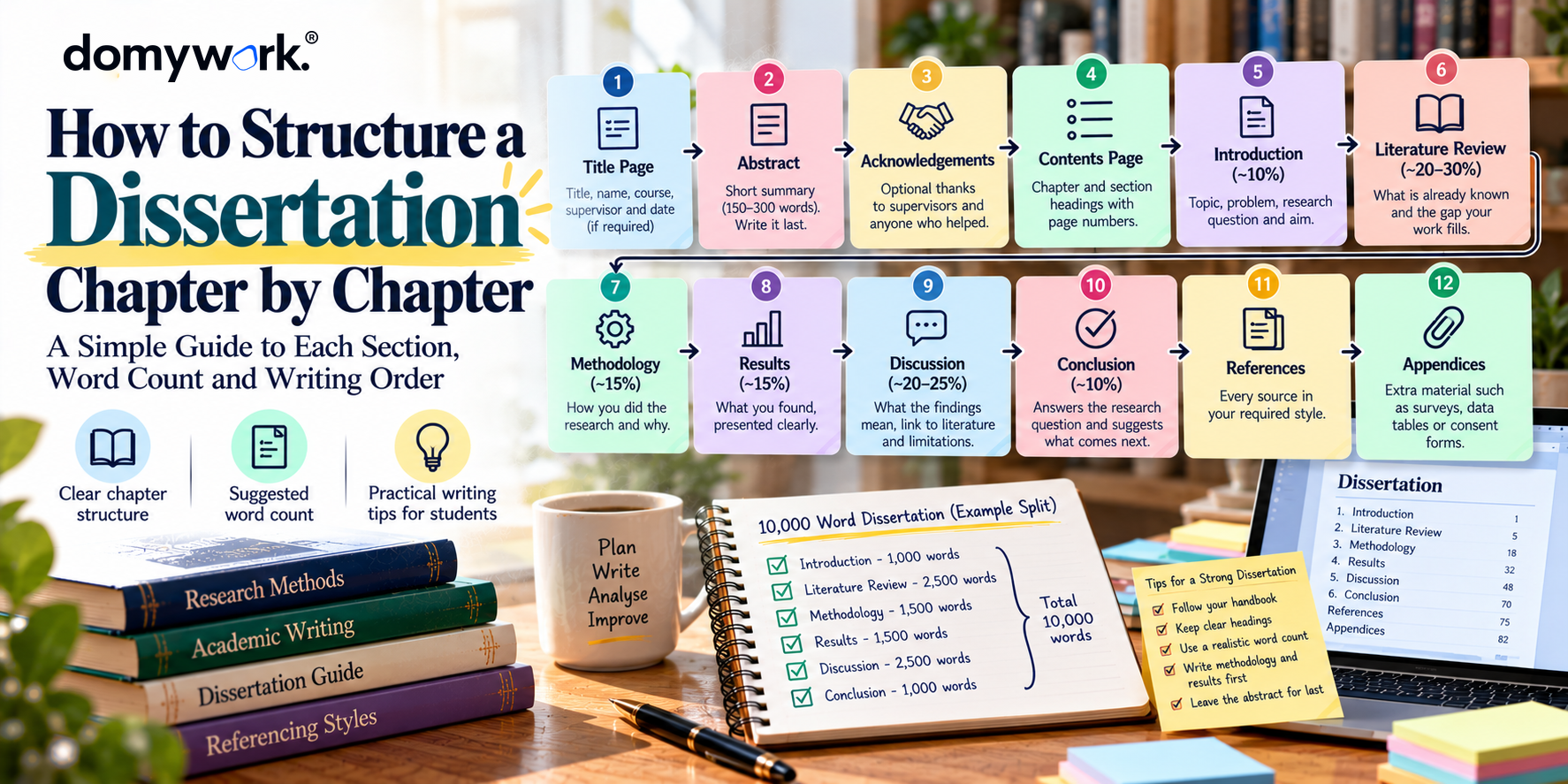
Most dissertations follow the same order: title page, abstract, acknowledgements, contents, introduction, literature review, methodology, results, discussion, conclusion, references and appendices. Check your department handbook first, because chapter names and word counts vary by subject.
The standard dissertation structure
- Title page: title, your name, course, supervisor and the date if required.
- Abstract: a short summary of your aim, method, findings and conclusion. Usually 150 to 300 words. Write it last.
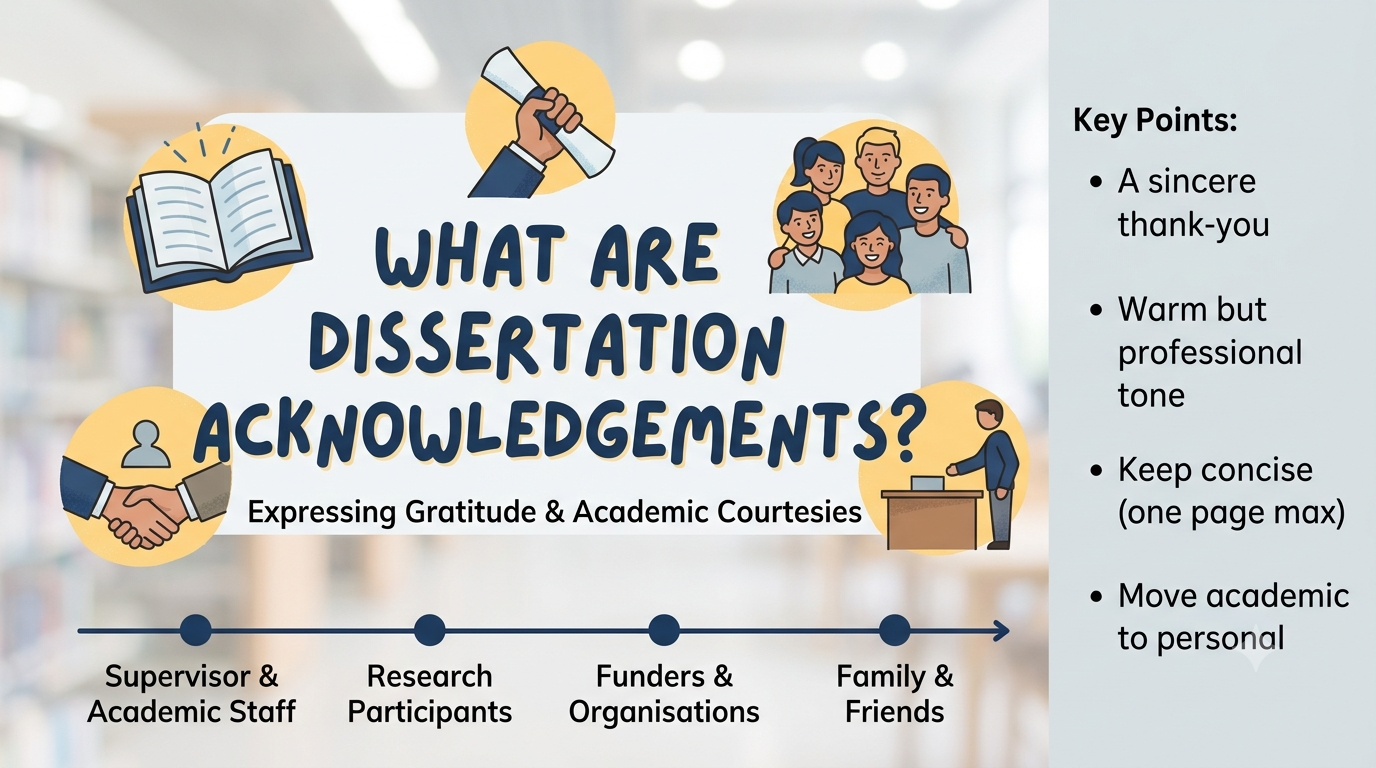
- Acknowledgements: optional thanks to supervisors and anyone who helped.
- Contents page: chapter and section headings with page numbers. It builds itself if you use proper heading styles.
- Introduction (about 10%): the topic, the problem, your research question and aim, and the shape of the dissertation.
- Literature review (about 20 to 30%): what is already known, and the gap your work fills.
- Methodology (about 15%): how you did the research and why, with enough detail for someone to repeat it.
- Results or findings (about 15%): what you found, presented clearly, without interpreting it yet.
- Discussion (about 20 to 25%): what the findings mean, how they link to the literature, and the limitations.
- Conclusion (about 10%): answers the research question, states your contribution, and suggests what comes next.
- References: every source, in your required style.
- Appendices: extra material such as surveys, full data tables or consent forms.
Science dissertations often merge results and discussion and use the IMRaD shape. Humanities dissertations may use themed chapters instead of a fixed template. Your handbook wins over any general guide.
How to split your word count
As a worked example, here is a 10,000 word dissertation split by the proportions above. Scale it to your own length.
- Introduction: about 1,000 words
- Literature review: about 2,500 words
- Methodology: about 1,500 words
- Results: about 1,500 words
- Discussion: about 2,500 words
- Conclusion: about 1,000 words
The abstract, references and appendices usually sit outside the main word count, but check your handbook.
Write it in a sensible order
You do not have to write front to back. Draft the methodology and results first, since you know them best. Then the discussion, then the introduction, and the abstract last once everything is settled.
Before you submit
Keep your headings consistent so the contents page is clean, and reference everything using referencing styles explained. A dissertation is a long project, so plan backwards from the deadline with the time management guide.
Not sure where your draft stands? Upload it with your brief and rubric to Grade Predictor and see your likely grade before you submit. The first two predictions are free and you do not need a card. Your files are kept private and never shared, and you can delete them from your result page.
Before you submit, run your draft through Plag Check for a Turnitin similarity and AI report in about 15 minutes. Your draft is not stored in Turnitin’s database, so it will not come back as a match when you hand in.
Frequently Ask Questions
How long is a dissertation?
It varies. Undergraduate dissertations are often 8,000 to 12,000 words, and masters dissertations often 15,000 to 20,000. Always follow your handbook.
What is the difference between a dissertation and a thesis?
The terms swap by country. In the UK, dissertation often means the final taught project. In the US, thesis often means the masters project and dissertation the doctoral one.
Do I write the abstract first or last?
Last. You can only summarise the whole thing once the whole thing exists.
What is IMRaD?
Introduction, Methods, Results and Discussion. It is a common shape for science dissertations and papers.
Written by the DoMyWork team. First published 19 Oct 2026.